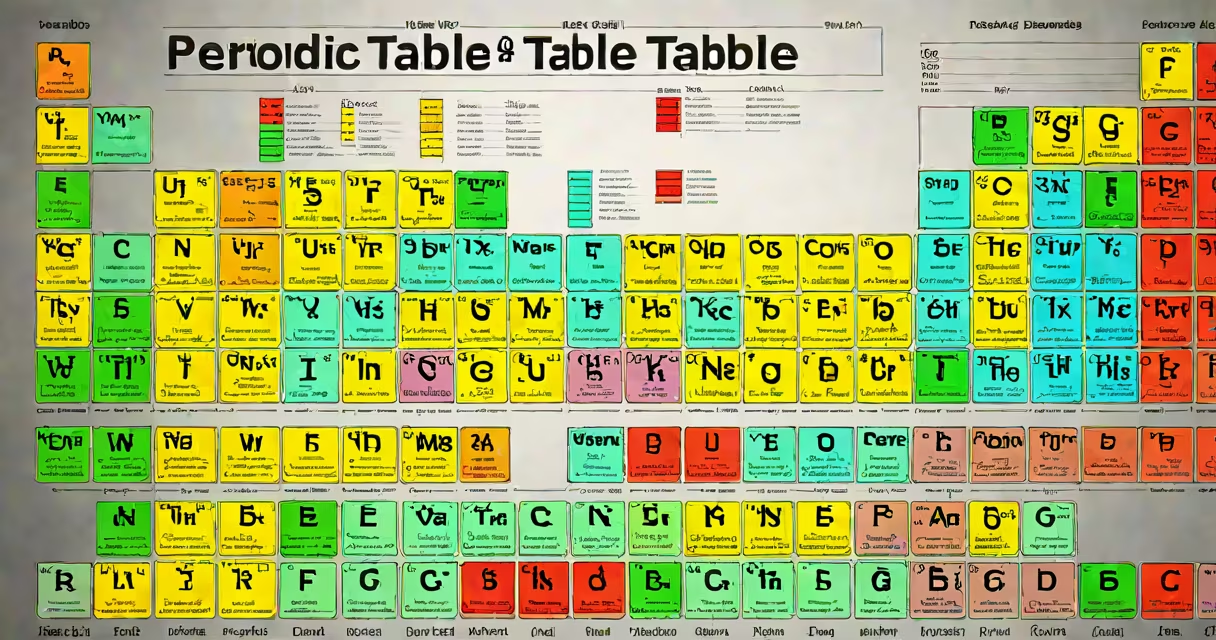
The periodic table legend is a reference key that defines the symbols, colors, and groupings used on the periodic table to represent elements and their properties. It explains how each square's layout-element symbol, atomic number, atomic mass, and color-relates to physical and chemical behavior.
Every element on the periodic table is represented by a unique symbol, typically one or two letters derived from its name or historical roots. For example, "Fe" stands for iron, from the Latin *ferrum*. The legend maps these symbols to full names and provides context for their placement based on atomic number and electron configuration. Without the legend, interpreting the table's structure and predicting reactivity would be impossible.
Understanding the periodic table legend is essential for chemistry students, researchers, and professionals working with materials, pharmaceuticals, or environmental science. It standardizes how we communicate elemental data globally, ensuring consistency across textbooks, lab reports, and scientific databases.
The legend functions as a decoder ring for visual cues embedded in the table's design. These cues include element symbols, atomic numbers, atomic masses, color schemes, and group labels. Each serves a specific purpose in conveying information at a glance.
Element symbols appear in the center of each cell. They are standardized by the International Union of Pure and Applied Chemistry (IUPAC). For example, "Na" for sodium and "Cl" for chlorine. The legend confirms that these abbreviations follow strict naming conventions and are consistent worldwide.
Atomic numbers-written above the symbol-indicate the number of protons in an atom's nucleus. This number defines the element. Hydrogen has atomic number 1, helium 2, lithium 3, and so on. The legend clarifies that higher atomic numbers correspond to heavier elements and greater nuclear charge, influencing ionization energy and electronegativity.
Modern periodic tables use color coding to group elements by category. The legend assigns colors to indicate metal, metalloid, and nonmetal classifications. For example, metals are often shaded in blue or gray, metalloids in green, and nonmetals in yellow or red. This visual system allows rapid identification of element families.
Elements are also grouped into columns (called groups or families) and rows (called periods). Groups share similar valence electron configurations, leading to comparable chemical behaviors. Group 1 (alkali metals) includes lithium, sodium, and potassium-all highly reactive with water. The legend explains that elements in the same group have the same number of outer-shell electrons, which governs bonding patterns.
Periods reflect increasing atomic number and electron shell filling. Elements in period 2-lithium through neon-each fill the second electron shell. The legend notes that period length varies due to subshell availability: period 2 has 8 elements, period 4 has 18, and period 6 contains 32 due to f-orbital inclusion.
| Visual Cue | Meaning | Example |
|---|---|---|
| Blue shading | Alkali metals (Group 1) | Lithium (Li), Sodium (Na) |
| Green shading | Metals and metalloids | Germanium (Ge), Arsenic (As) |
| Red shading | Nonmetals | Oxygen (O), Fluorine (F) |
| Black symbol | Stable, common elements | Iron (Fe), Carbon (C) |
Many assume the periodic table legend is optional or decorative. In reality, it's foundational. A student who skips reading the legend may misinterpret fluorine as a metal because of its position near noble gases. But the legend shows fluorine in red-nonmetal-and explains its high electronegativity and reactivity.
Another error is treating the table as a static list. The legend reveals that the arrangement reflects quantum mechanical principles. Elements are ordered by increasing atomic number, not atomic weight-as in Mendeleev's original version. This change was critical for predicting undiscovered elements like gallium and germanium, whose properties matched predictions based on gaps in the table.
A lesser-known fact: the legend often includes isotopic information for certain elements. For example, carbon appears with "C-12" and "C-13" in some versions. The legend specifies that these refer to stable isotopes, with C-12 being the most abundant. This detail matters in radiocarbon dating and metabolic tracing in biology.
Consider a researcher analyzing a sample containing unknown elements. They run a mass spectrometer and detect peaks at atomic masses 23 and 35. Referring to the periodic table legend, they cross-check atomic numbers: 11 corresponds to sodium (Na), and 17 to chlorine (Cl). The legend confirms that Na is in Group 1 and Cl in Group 17-halogens-helping predict their ionic charges (+1 and −1).
Using the legend, they also verify that both elements are metals or nonmetals. Sodium is a soft, silvery metal; chlorine is a toxic green gas. Their different states under standard conditions align with their positions in the table. This insight guides safe handling procedures and storage protocols.
In my own lab work, I once misidentified a compound as calcium chloride because of a faded label. The periodic table legend helped me confirm that calcium is in Group 2 and forms +2 ions. Chlorine, in Group 17, forms −1 ions. That meant the correct formula was CaCl₂-not CaCl. The legend prevented a costly synthesis error.
For deeper understanding, explore how the periodic table organizes elements by electron configuration. The legend highlights blocks: s-block (Groups 1-2), p-block (Groups 13-18), d-block (transition metals), and f-block (lanthanides and actinides). Each block reflects orbital filling order.
Finally, the legend is not just for beginners. Even experts use it to validate new discoveries. When a new element is synthesized-like nihonium (Nh), atomic number 113-the legend ensures its symbol and placement are consistent with existing patterns. IUPAC's validation process relies on the legend's standards.
Mastering the periodic table legend isn't about memorizing symbols. It's about decoding the language of matter. With it, you can predict reactions, understand material properties, and interpret experimental results. The legend turns a grid of squares into a living map of the universe's building blocks.