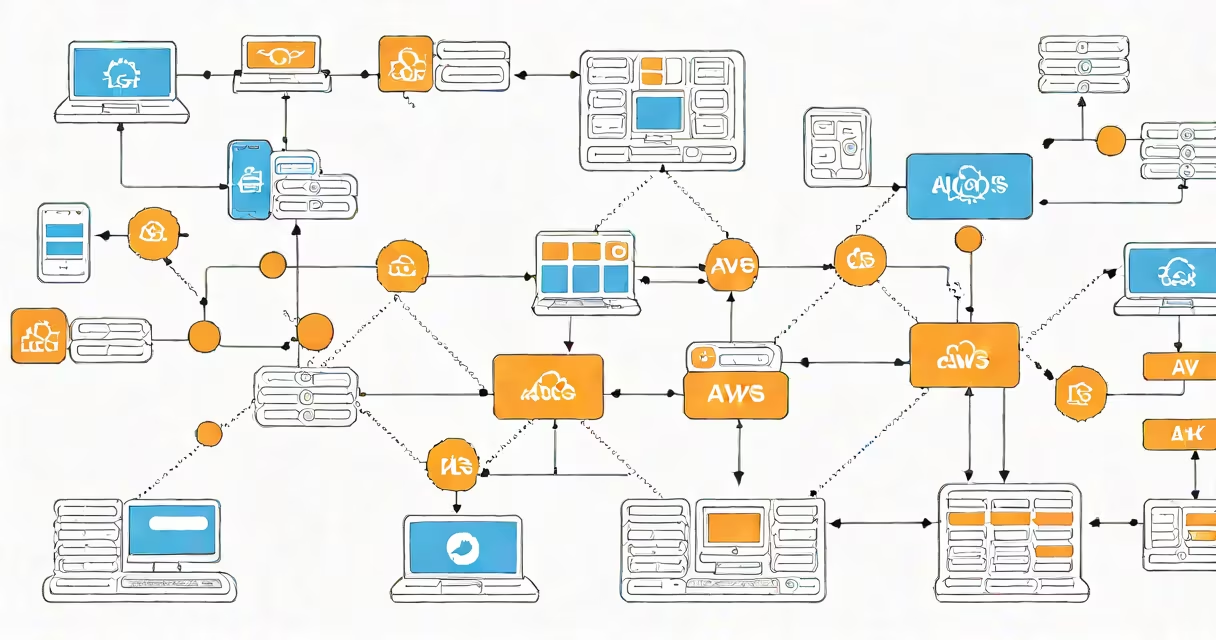
A reverse proxy AWS service acts as an intermediary between client requests and backend servers, routing traffic based on rules such as URL paths, host headers, or SSL termination. It improves scalability, security, and performance for web applications hosted on AWS.
Reverse proxy AWS solutions operate at Layer 7 (application layer) of the OSI model. They receive incoming HTTP/HTTPS traffic, evaluate request details, and forward connections to appropriate backend resources-typically EC2 instances, containers, or serverless functions. This abstraction hides internal infrastructure from external users and centralizes access control.
Amazon Web Services offers multiple managed reverse proxy services. The most common is the Application Load Balancer (ALB), which supports advanced routing features like path-based routing, host-based routing, and integration with AWS Lambda for changing responses. For high-throughput TCP/UDP workloads, the Network Load Balancer (NLB) operates at Layer 4 and handles millions of requests per second.
When a user sends a request to a domain like app.example.com, the DNS resolves to an AWS load balancer's public IP. The ALB inspects the HTTP Host header or path and forwards the request to a specific target group-such as a set of EC2 instances running a Node.js app or a fleet of containers on Amazon ECS.
For HTTPS traffic, the ALB terminates TLS encryption, decrypts the request, and forwards it to the backend using plain HTTP. This offloads cryptographic processing from application servers and simplifies certificate management. AWS Certificate Manager (ACM) integrates with ALB to automatically provision and renew SSL certificates.
Each target group can have health checks that monitor backend instances. If an instance fails, the ALB stops routing traffic to it until it recovers. This ensures high availability and reduces downtime during deployments or hardware failures.
Amazon provides several reverse proxy options tailored to different workloads:
| Service | Protocol | Routing Level | Use Case |
|---|---|---|---|
| Application Load Balancer (ALB) | HTTP/HTTPS | Layer 7 (application) | Web apps, microservices, API gateways |
| Network Load Balancer (NLB) | TCP/UDP | Layer 4 (transport) | High-throughput, low-latency systems like gaming or video streaming |
| API Gateway | HTTP/HTTPS, WebSocket | Layer 7 | REST and WebSocket APIs, often paired with Lambda |
While ALB and NLB both act as reverse proxies, they differ in functionality. ALB supports host-based routing (e.g., api.example.com → API service), path-based routing (/admin → admin dashboard), and can integrate with AWS WAF for threat protection. NLB focuses on raw throughput and connection persistence, making it ideal for stateful protocols like SIP or database replication.
API Gateway is a specialized reverse proxy for APIs. It manages authentication, rate limiting, and request/response transformation. It can route to Lambda functions, EC2 instances, or other AWS services via integration types like HTTP_PROXY or AWS_PROXY.
One major use case is hosting multi-environment web applications behind a single public endpoint. For example, a company might deploy staging, production, and preview environments under subdomains: staging.app.example.com, prod.app.example.com, and preview.app.example.com. An ALB configured with host-based routing directs each subdomain to its respective backend.
Another example is securing internal services. A financial institution uses ALB to expose a customer portal while hiding internal microservices behind private subnets. The ALB performs SSL termination and authenticates requests via OAuth2 through AWS Cognito. Traffic never reaches the internal services unless properly validated.
A non-obvious distinction: ALB does not support UDP or multicast traffic. If you need to proxy UDP-based services like DNS or VoIP, you must use NLB or a custom solution like a reverse proxy running on EC2 with HAProxy or Nginx.
Reverse proxy AWS is often mistaken for a traditional forward proxy. A forward proxy sits between users and the internet, filtering outbound traffic. A reverse proxy sits between the internet and servers, managing inbound traffic. In AWS, you'd use a forward proxy (like AWS PrivateLink or a self-managed Squid instance) for controlled outbound access, not for exposing services.
Also, ALB is not the same as Elastic Load Balancing (ELB) in legacy terms. ELB referred to classic load balancers, which were deprecated in favor of ALB and NLB. Classic ELB supported basic round-robin routing and lacked host/path-based routing. Migrating from classic ELB to ALB improves routing precision and reduces configuration overhead.
Reverse proxy AWS should not be conflated with AWS CloudFront. While CloudFront acts as a global CDN and edge proxy, it is optimized for caching static assets and accelerating content delivery-not for changing routing decisions. You can combine ALB with CloudFront for hybrid setups: CloudFront caches images and JS files, while ALB routes changing requests to origin servers.
In a project I deployed for a SaaS startup, we used ALB to route traffic across multiple regions. We configured weighted routing to send 90% of traffic to the primary region and 10% to a secondary region for failover testing. During a regional outage, the ALB automatically shifted traffic to the backup region within 60 seconds, minimizing user impact.
Best practices include enabling access logs to track request patterns and errors. Use AWS CloudTrail to audit ALB configuration changes. Set up health checks with appropriate thresholds-too aggressive settings may mark healthy instances as unhealthy during brief spikes.
For security, restrict ALB access to trusted IP ranges using security groups and network ACLs. Enable WAF integration to block SQL injection and cross-site scripting attacks. Always use ACM to manage SSL certificates rather than uploading them manually.
reverse proxy AWS is a core component of secure, scalable web architectures on AWS. It enables intelligent traffic routing, centralized security, and efficient load distribution. Whether using ALB for web applications, NLB for high-performance systems, or API Gateway for REST APIs, choosing the right reverse proxy service depends on protocol, performance needs, and routing complexity.