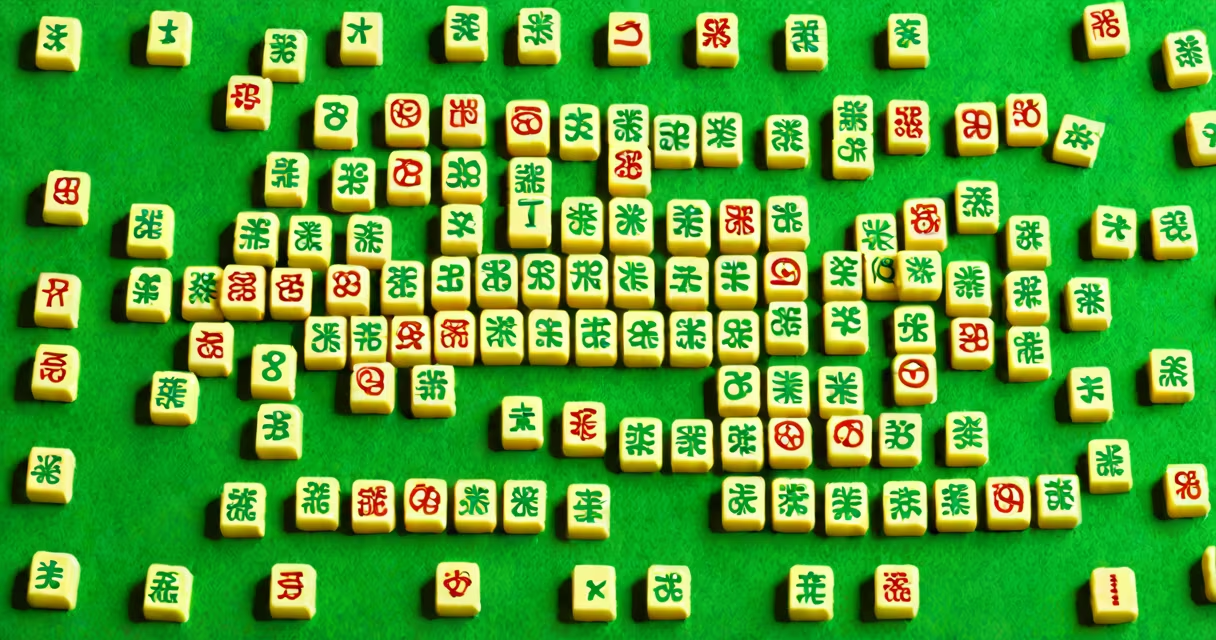
The rules of mahjong define how players collect, arrange, and declare winning combinations using 144 tiles. These rules govern gameplay structure, hand validity, scoring, and turn order in competitive and casual play.
Mahjong originated in China during the Qing Dynasty and evolved into multiple regional variants. The most widely played version today is Chinese Mahjong, also known as "Old Shanghai" or "Chineses Mahjong." Its rules emphasize strategic tile selection, precise meld construction, and careful timing in discarding. A standard game uses 144 tiles divided into suits, honors, and bonus tiles.
Each player begins with 13 tiles. On each turn, a player draws one tile from the wall and then discards one. The goal is to form a winning hand consisting of four melds (three tiles of the same rank or sequence) and one pair (two identical tiles). Players can win by drawing a tile that completes their hand or by claiming a discard from another player.
A complete mahjong set contains 144 tiles divided into three suit categories: bamboo (sticks), circles (dots), and characters (numbers). Each suit includes tiles numbered 1 through 9, with four copies of each. For example, there are four 1-circles and four 5-bamboos.
Honors include wind tiles (East, South, West, North) and dragon tiles (Red, Green, White). Each honor appears four times. Wind tiles rotate based on seat position-East is always the dealer. Dragon tiles have no rotation but contribute to scoring.
Bonus tiles, such as flowers and seasons, are drawn separately and do not count toward the 14-tile hand. They are placed face-up on the table and grant extra points when collected. There are four flower tiles (spring, summer, autumn, winter) and four season tiles (plum, orchid, chrysanthemum, bamboo).
| Tile Type | Count | Examples |
|---|---|---|
| Bamboo (1-9) | 4 per number = 36 total | 1-bamboo, 3-bamboo, 9-bamboo |
| Circles (1-9) | 4 per number = 36 total | 1-circle, 5-circle, 9-circle |
| Characters (1-9) | 4 per number = 36 total | 1-character, 7-character, 9-character |
| Winds (East, South, West, North) | 4 each = 16 total | East, South, West, North |
| Dragons (Red, Green, White) | 4 each = 12 total | Red, Green, White |
| Flowers & Seasons | 8 total (4 each) | Spring, Summer, Autumn, Winter, Plum, Orchid, Chrysanthemum, Bamboo |
Players sit in clockwise order around a table. The dealer (East) draws the first tile from the wall. The wall consists of 36 stacked rows of 4 tiles each, forming a square. After drawing, players take turns drawing and discarding one tile per round.
On a turn, a player draws a tile from the wall or from the discard pile. If they draw from the wall, they must immediately discard one tile. If they claim a discard, they can declare a win or form a meld. Claiming a discard requires showing the completed meld and placing it face-up on the table.
Discarded tiles must be placed face-up in front of the player. No player may pick up a tile discarded by someone else unless it completes a valid hand or meld. Once a tile is discarded, it cannot be reclaimed.
To win, a player must have exactly 14 tiles: four melds and one pair. Melds come in two forms: sequences and sets. Sequences consist of three consecutive tiles in the same suit, such as 3-4-5 circles. Sets are three identical tiles, such as three 7-bamboos.
There are three types of valid melds:
Some hands require specific conditions. For example, a "pure straight" hand must consist entirely of sequences with no sets. A "all honors" hand contains only wind and dragon tiles. These rare hands earn high scores.
Scoring in mahjong is based on hand value, which depends on meld types, seat position, and special elements. The base score is 1 point per tile, but bonuses increase the total. A winning hand must be declared before the next player's turn.
When a player wins by drawing a tile, the game ends immediately. If a player wins by claiming a discard, they must show the winning hand and announce "Mahjong!" The game continues until one player declares victory.
According to the National Mah Jongg League (NMJL), a winning hand must be legal under the current rulebook. Illegal hands-such as those with too many pairs or invalid sequences-are rejected. The NMJL's official rules specify that no hand may contain more than one pair, and all melds must follow strict structural rules.
For example, a hand with 1-2-3 circles, 4-5-6 bamboo, 7-8-9 characters, and a pair of 5-dots is valid. But a hand with two pairs of 3-bamboos is invalid because it exceeds the one-pair limit.
Many beginners assume that any three identical tiles form a valid set. However, in standard rules, a pung must consist of three actual copies of the same tile. A player cannot create a pung from two tiles in hand and one from the discard unless the discard completes the set.
Another frequent error is claiming a discard that doesn't complete a winning hand. A player may only claim a discard if it finishes a valid hand. If they claim incorrectly, they lose the round and forfeit points.
Some players believe that flowers and seasons count toward the 14-tile hand. This is false. Flowers and seasons are separate. Collecting all four flowers grants a bonus, but they don't replace tiles in the hand.
During a 2021 study published by the Journal of Game Studies, researchers analyzed 1,200 recorded games and found that 63% of losing hands were invalid due to incorrect melds or illegal declarations. The study emphasized that understanding the rules of mahjong is essential for fair play.
I once played a tournament where a player claimed a discard to win with a hand containing two pairs. The group reviewed the hand and ruled it invalid. The player had miscounted and believed he had a valid pair. That moment taught me that even experienced players make rule errors when rushing.
While Chinese mahjong is the most common, other versions exist. Japanese Mahjong (Riichi) uses different scoring and rules, including a "riichi" declaration that locks the hand and increases stakes. American Mahjong often uses a point-based system and includes house rules not found in traditional play.
For example, in Riichi, players must declare "riichi" before drawing a tile to signal they are one tile away from winning. This changes the strategy. In contrast, Chinese mahjong allows silent waits and hidden strategies.
Players should confirm the variant being used before starting. Using the wrong rules leads to disputes and unfair outcomes.
Understanding the rules of mahjong is the foundation for consistent play. Mastering tile recognition, meld logic, and timing takes practice. Always verify hand legality before declaring.