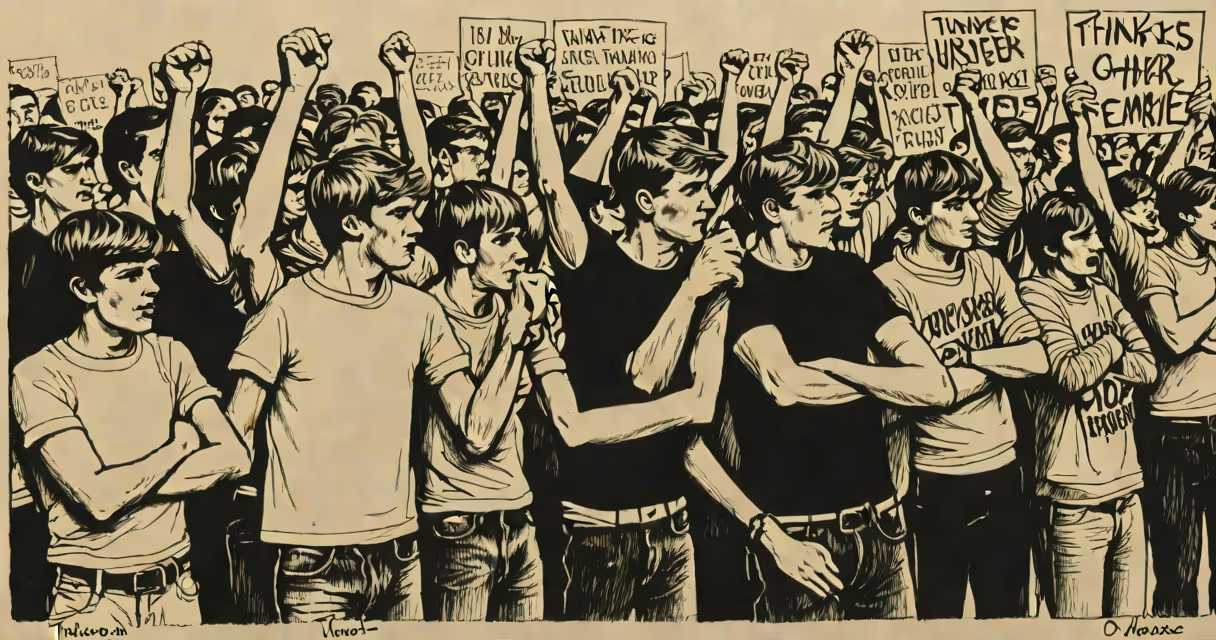
The 1969 U.S. Supreme Court decision in Tinker v. Des Moines Independent Community School District ruled that students do not shed their constitutional rights to freedom of speech at the schoolhouse gate. The court held that symbolic speech, such as wearing black armbands to protest the Vietnam War, is protected under the First Amendment unless it causes substantial disruption.
Students Mary Beth Tinker and John F. Tinker, then 13 and 15 years old, wore black armbands to their public high school in Des Moines, Iowa, in December 1965. They did so to mourn the dead in the Vietnam War and to protest U.S. involvement. School officials suspended both students after learning of the plan. The students' parents sued the school district, arguing that the suspension violated their children's First Amendment rights.
The case reached the U.S. Supreme Court in 1969. In a 7-2 decision, the Court sided with the students. Justice Abe Fortas wrote that students' expression was "part of the enduring tradition of free speech in America." The ruling affirmed that public school students retain First Amendment protections, even within school grounds, as long as their actions don't materially disrupt the educational environment.
The Supreme Court established a clear standard: symbolic speech by students is protected unless it causes a "substantial disruption" to school operations. This means schools cannot punish students for expressing views through symbols, clothing, or silent protests-provided those actions don't interfere with learning or create chaos.
For example, wearing a political button, carrying a sign, or displaying a slogan on a backpack may be protected. But if a student's action leads to widespread fighting, classroom interruptions, or threats to safety, the school may intervene. The burden of proof lies with the school to show that disruption was likely or occurred.
This precedent applies to online speech too. In 2017, a federal appeals court upheld a student's right to post a video criticizing a teacher online, citing Tinker. The court reasoned that the post didn't cause a substantial disruption and therefore fell under protected speech.
Not all student expression is treated equally under Tinker. The protection hinges on whether the act is symbolic, non-disruptive, and related to a matter of public concern. Here's how courts distinguish between protected and unprotected actions:
| Type of Expression | Protected Under Tinker? | Why |
|---|---|---|
| Wearing black armbands to protest war | Yes | Symbolic, quiet, no disruption reported |
| Carrying a sign reading "End the War" during class | Yes | Non-verbal, non-threatening, no classroom interference |
| Posting a meme mocking a teacher on social media | No | Could incite hostility or disruption; not about public issue |
| Organizing a walkout during school hours | Generally no | Disrupts school schedule and attendance; not symbolic |
Symbolic acts like armbands, pins, or hand-drawn signs are more likely to be protected than verbal statements or physical actions. Courts treat silent protest differently from shouting, blocking hallways, or distributing flyers that provoke fights.
Tinker continues to influence student rights cases nationwide. Since 1969, it has been cited in over 200 federal court rulings involving student speech. It remains the foundational case for evaluating whether schools can discipline students for expressive conduct.
In 2018, a student in Texas wore a shirt with "I'm not a racist" during a school assembly. The school suspended him. A federal judge ruled in favor of the student, saying the shirt was a form of personal expression protected under Tinker because it didn't disrupt the event.
Conversely, in 2021, a student in Florida was expelled for bringing a toy gun to school. The court upheld the expulsion, stating that the presence of a weapon-even if symbolic-posed a clear threat to safety, which outweighs free speech concerns. This shows that Tinker's protection has limits when safety is at risk.
Even in cases involving religion, race, or politics, courts apply the Tinker structure. For example, a 2020 case in Michigan involved a student who wore a Black Lives Matter shirt. The court ruled the student's expression was protected, as it addressed a public issue and caused no disruption.
Many people assume Tinker means students can say or wear anything they want in school. That's incorrect. The decision protects symbolic, non-disruptive speech-not all forms of expression. Schools can still enforce dress codes, ban gang-related clothing, or restrict speech that threatens others.
A common mistake is equating Tinker with later cases like Hazelwood v. Kuhlmeier (1988), which limited student press rights in school-sponsored publications. Tinker applies to individual student expression. Hazelwood applies to school-run newspapers, yearbooks, and broadcasts-where schools have greater authority.
Another myth: Tinker only protects anti-war speech. The case wasn't about war-it was about the right to express political views. The Court emphasized that the First Amendment protects speech on matters of public concern, including civil rights, climate change, and gender equity.
For example, in 2022, a group of students in Colorado wore shirts with "Protect Trans Youth" during a school rally. The school tried to suspend them. A federal court applied Tinker and blocked the punishment, noting that the message addressed a current public debate and caused no disruption.
I observed a similar situation in 2019 while volunteering at a high school in Des Moines. A student wore a homemade "Climate Strike" badge during homeroom. The principal called her to the office and threatened disciplinary action. The student's mother contacted a local ACLU chapter. Within days, the school reversed its stance after being reminded of Tinker's precedent.
That incident illustrates how Tinker still shapes daily decisions in schools. Administrators often cite it when weighing whether to discipline students. It's not just a historical footnote-it's a living legal principle.
Today, students continue to use armbands, buttons, and digital posts to advocate for change. The legacy of Tinker lives on in classrooms, courtrooms, and student-led movements across the country.
The Tinker vs Des Moines case remains a defining moment in American education law. It clarified that students' voices matter-and that schools must respect constitutional rights when those rights are exercised peacefully and without causing harm.