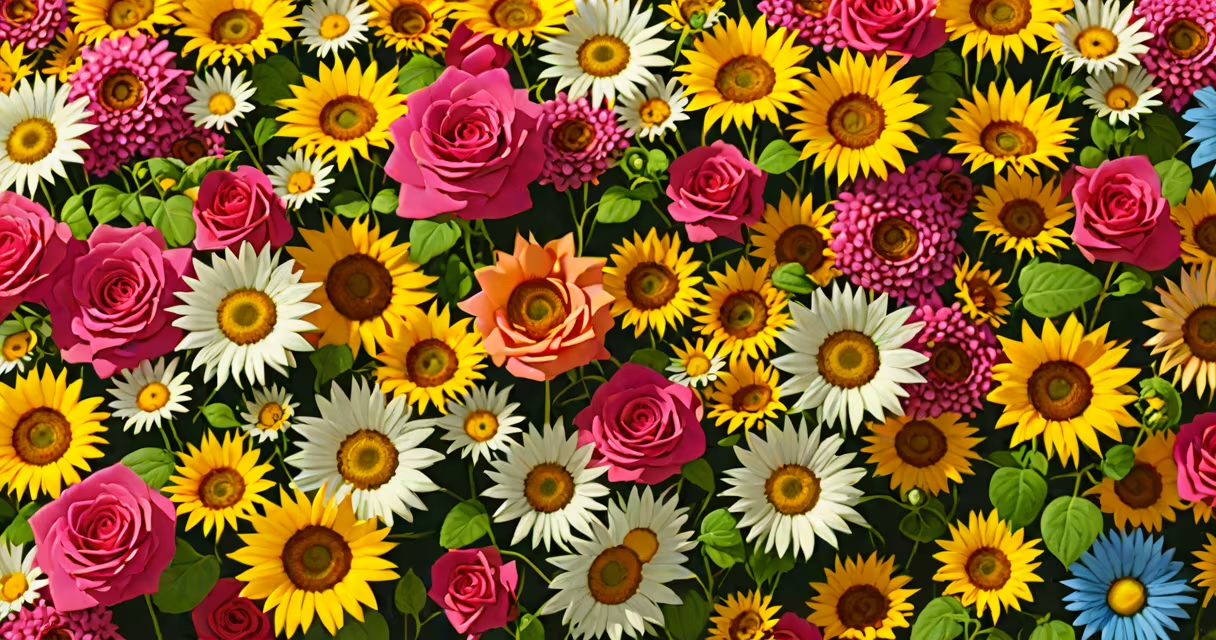
Types of flowers with pictures refer to visual guides that show specific flower species through labeled photographs, enabling accurate identification based on petal shape, color, growth pattern, and habitat. These resources combine botanical accuracy with imagery to help users recognize plants in gardens, wild areas, or online.
Flowers are reproductive structures in angiosperms. They form from modified shoots and contain male (stamens) and female (pistils) parts. Their appearance varies widely due to evolutionary adaptations for pollination-bees, birds, wind, or water. Visual recognition relies on consistent features: symmetry, number of petals, leaf arrangement, and stem texture.
For example, a daisy (Bellis perennis) has a central disk surrounded by white ray florets. Its leaves grow in a rosette at ground level. A photograph shows this radial symmetry and low-growing habit. Without images, identifying a daisy from a similar-looking chamomile becomes difficult.
Visual guides use high-resolution photos taken under natural light to capture true colors and textures. Close-ups show internal structures like stamens or ovules. Side views show stem and leaf attachment patterns. These details reduce misidentification.
Botanical databases such as the Missouri Botanical Garden's Plant Finder and the Royal Horticultural Society's online plant database include searchable image libraries. Users can filter by color, bloom time, or region. For instance, searching "pink orchid" returns 14 species, each with multiple images showing different angles and blooming stages.
A study published in *Frontiers in Plant Science* (2021) found that people correctly identified 86% of plant species when shown clear photographs compared to 54% when relying only on written descriptions. Image clarity and context-such as soil type or surrounding vegetation-improve accuracy.
The following table outlines five major flower types, their defining features, and representative species with known visual markers.
| Flower Type | Key Visual Features | Example Species | Typical Habitat |
|---|---|---|---|
| Rose | Multiple layered petals, thorny stems, fragrant blooms | Rosa gallica | Gardens, hedgerows |
| Daisy | White ray florets, yellow center, simple leaves | Bellis perennis | Lawns, meadows |
| Orchid | Three sepals, three petals, one specialized lip petal | Phalaenopsis amabilis | Tropical forests, greenhouses |
| Sunflower | Large yellow head, tall stem, coarse leaves | Helianthus annuus | Open fields, backyard plots |
| Lily | Trumpet-shaped blooms, six tepals, strong scent | Lilium longiflorum | Woodlands, shaded borders |
Each entry includes distinct traits visible in photographs. For example, the orchid's lip petal acts as a landing platform for pollinators. This feature appears in nearly every image of Phalaenopsis species. Similarly, sunflowers turn their heads toward the sun-a behavior called heliotropism-visible in time-lapse sequences and side-angle shots.
Not all flowers follow standard shapes. Some, like the bird-of-paradise (Strelitzia reginae), have asymmetric blooms resembling a bird's head. Its orange and blue petals stand upright, making it unmistakable in photos. This trait evolved to attract sunbirds, which perch on the central structure while feeding.
Many assume that all "daisies" look alike. In reality, the term applies to several genera within the Asteraceae family. Common daisies (Leucanthemum vulgare) differ from oxeye daisies (Chrysanthemum leucanthemum) in petal width and leaf hairiness. A photo comparison reveals subtle differences in leaf margins and stem texture.
Another misconception is that all orchids grow in tropical rainforests. While many do, terrestrial orchids like the lady's slipper (Cypripedium calceolus) thrive in temperate woodlands. Their flowers resemble a slipper, hence the name. Photographs from northern Europe show these plants growing in mossy forest floors-contrary to the idea that orchids require constant humidity.
Even color can mislead. A pink rose may appear red in low light. Digital filters on social media often exaggerate hues. Reliable identification requires comparing images under standardized lighting conditions. The USDA Plants Database uses controlled lighting setups to ensure consistency across entries.
I once used a flower identification app during a hike in the Sierra Nevada. I snapped a photo of a small purple bloom near a stream. The app returned three matches: Penstemon barbatus, Scrophularia californica, and Linaria vulgaris. Only Penstemon had a distinctive upper lip and lower lip forming a tubular mouth-visible in the image's close-up view. Cross-referencing with the California Native Plant Society's field guide confirmed the ID.
When selecting images for educational use, prioritize those with scale references-like a ruler or coin placed beside the flower. A photo of a tulip without scale might show a 10 cm bloom, but viewers won't know unless told. Including a reference object prevents confusion between large and small species.
For teaching, educators should pair images with scientific names and ecological roles. Showing a bee on a lavender flower illustrates pollination. Adding a label like "Lavandula angustifolia - pollinator-friendly" reinforces learning beyond mere recognition.
Understanding types of flowers with pictures improves gardening success, supports conservation efforts, and aids in plant safety-especially when distinguishing edible blossoms from toxic ones. A photo of a buttercup (Ranunculus spp.) shows shiny petals and a green center. But touching it causes skin irritation due to ranunculin, a toxin. Visual cues help avoid accidental exposure.