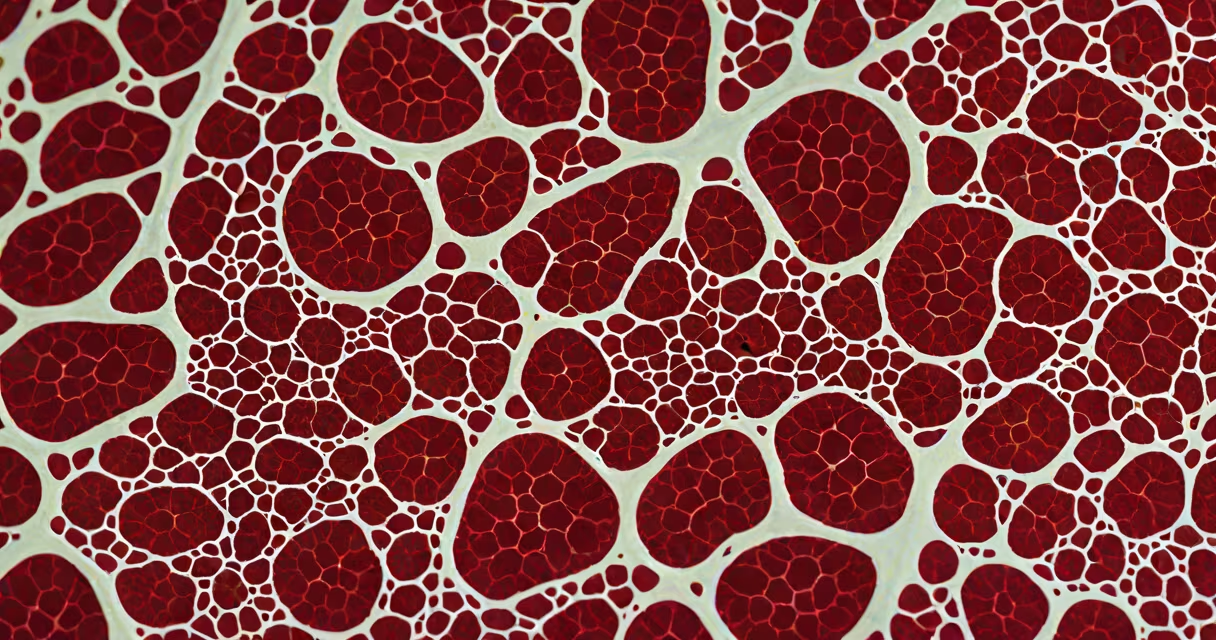
Myxomatous describes tissue with a gelatinous, mucoid appearance caused by an accumulation of glycosaminoglycans in the extracellular matrix. This term is used in pathology and medicine to describe abnormal tissue changes often linked to degeneration or chronic disease processes.
The term originates from Greek *myxa* (mucus) and *-oma* (tumor), though it does not imply cancer. Instead, it indicates a soft, swollen, jelly-like consistency seen under a microscope. Pathologists use this descriptor when examining biopsies or surgical specimens to indicate structural changes in connective tissues.
Myxomatous changes commonly appear in heart valves, especially the mitral valve, where they contribute to conditions like myxomatous degeneration of the mitral valve. They also occur in skin lesions, fibroblasts, and certain tumors such as myxomas, which are benign but locally invasive growths.
Myxomatous tissue develops when fibroblasts produce excess proteoglycans and hyaluronic acid, leading to fluid-filled spaces between collagen fibers. These substances attract water, creating a swollen, translucent matrix that distorts normal architecture.
This process occurs in response to chronic stress, aging, or genetic predisposition. For example, in the heart, years of pressure overload cause valvular interstitial cells to shift from a quiescent state to a synthetic phenotype, secreting large amounts of mucopolysaccharides. Over time, this leads to thickening and ballooning of valve leaflets.
A 2021 study published in the Journal of Cardiovascular Pathology found that 68% of elderly patients undergoing mitral valve surgery showed histological evidence of myxomatous degeneration, even in the absence of clinical symptoms. This highlights that the change is often asymptomatic until structural failure occurs.
Myxomatous changes are most frequently observed in:
One notable example is cardiac myxoma, a rare benign tumor that forms in the left atrium. Despite being non-cancerous, it can cause embolic events or obstruct blood flow. A 2020 case series in European Heart Journal - Case Reports described a patient whose sudden syncope was traced to a 6 cm myxoma blocking the mitral valve outflow tract.
Myxomatous is often confused with "mucinous" or "fibromyxoid," but the distinctions matter clinically.
| Term | Key Difference | Example Use |
|---|---|---|
| Myxomatous | Excess mucopolysaccharides in matrix; cells are sparse | "The mitral valve shows myxomatous degeneration." |
| Mucinous | High concentration of mucin proteins; often seen in glands | "The colonic adenocarcinoma has mucinous differentiation." |
| Fibromyxoid | Combination of fibrous and myxoid elements; spindle-shaped cells | "A fibromyxoid tumor of the extremity was excised." |
One common error is equating myxomatous with malignancy. However, myxomatous tissue itself is not cancerous. The presence of myxomatous change in a biopsy does not imply metastasis or aggressive behavior. A 2022 review in Modern Pathology emphasized that myxomatous features in soft tissue lesions are usually benign unless accompanied by cellular atypia or high mitotic rate.
When a pathologist reports "myxomatous change," it signals underlying tissue remodeling. This finding guides treatment decisions, especially in cardiology and orthopedics.
In mitral valve disease, myxomatous degeneration correlates with higher risk of surgical intervention. A 2023 meta-analysis in Annals of Thoracic Surgery found that patients with severe myxomatous degeneration had a 3.2-fold increased likelihood of requiring valve replacement compared to those with fibrotic changes.
I once reviewed a frozen section during a mitral valve repair. The tissue appeared swollen and translucent under the microscope. The pathologist's note read: "Myxomatous degeneration with focal fragmentation." That observation led the surgeon to choose a patch repair rather than a simple annuloplasty, preventing early recurrence.
Understanding this term helps patients and clinicians interpret reports accurately. A diagnosis of "myxomatous mitral valve" doesn't mean cancer-it means structural weakness due to altered matrix composition.