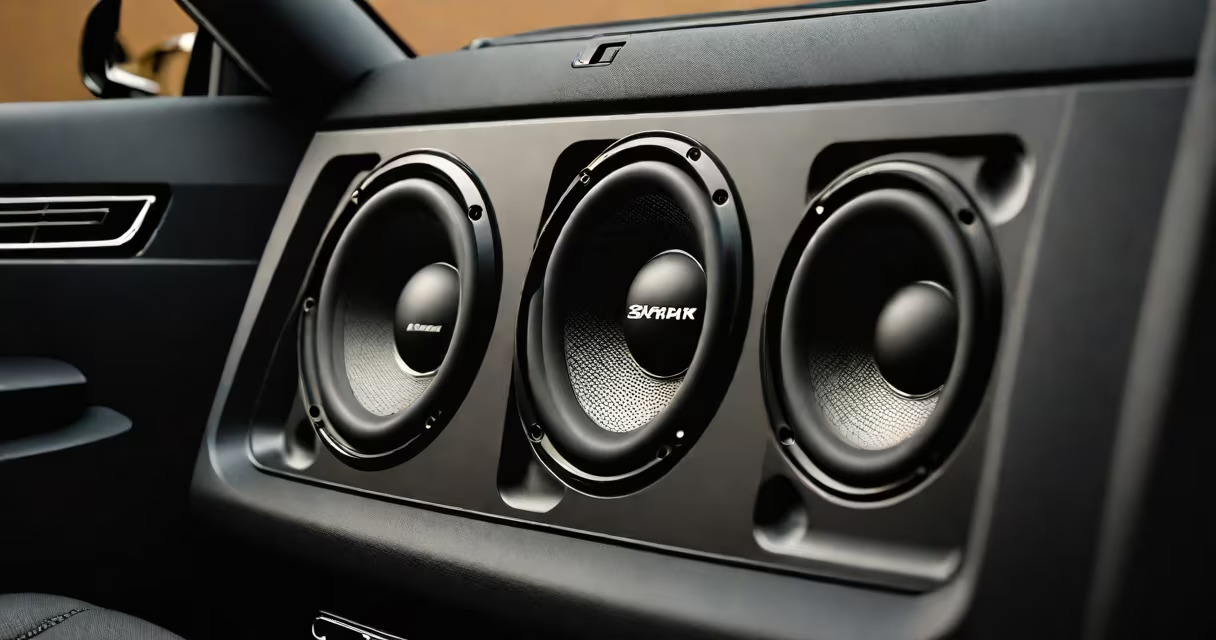
Good speakers for a car reproduce music with clarity, balance, and minimal distortion across frequencies, matching the vehicle's acoustics and amplifier output. They handle power efficiently, maintain sound accuracy at volume, and fit securely in factory or aftermarket locations.
Car audio systems rely on drivers-woofers, tweeters, and sometimes midranges-to convert electrical signals into sound waves. A good set balances frequency response, power handling, and sensitivity. Poor performers distort at moderate volumes, lack detail, or produce muddy bass. High-quality units preserve musical nuance and deliver consistent performance under real-world driving conditions.
The best car speakers are engineered for the confined space of a vehicle cabin. They account for road noise, vibrations, and uneven sound reflection. A speaker rated at 85 dB sensitivity at 1 watt/1 meter produces usable volume with low amplifier power. Units with high signal-to-noise ratios reduce background hiss. These traits ensure music remains clear even at highway speeds.
Inside a car speaker, an electrical signal passes through a voice coil attached to a cone. The coil moves within a magnetic field, pushing air and creating sound. The cone material-paper, polypropylene, or composite-determines stiffness and damping. Stiffer cones resist deformation, preserving waveform accuracy.
Tweeters handle high frequencies using dome-shaped diaphragms made of silk, aluminum, or titanium. Aluminum offers sharp detail but can be harsh; silk provides smoother highs. Midrange drivers bridge the gap between bass and treble. Full-range systems integrate all components into a single enclosure, while component systems separate them for better placement and tuning.
Most factory systems use 6x9-inch or 6.5-inch speakers. Aftermarket upgrades often use 6.5-inch coaxial models with built-in tweeters. Component systems allow precise positioning of tweeters near the listener's ear level, improving stereo imaging. Proper crossover networks filter frequencies to each driver, preventing overload and phase issues.
Power handling defines how much amplifier output a speaker can safely accept. Continuous RMS power (e.g., 50 watts) indicates sustained performance. Peak power (e.g., 150 watts) shows maximum short bursts. Exceeding peak ratings damages the voice coil. Matching amplifier output to RMS rating prevents clipping and thermal stress.
Sensitivity measures efficiency. A speaker rated at 90 dB sensitivity produces louder sound with less power. For vehicles with weak amplifiers, higher sensitivity reduces strain. A 90 dB unit requires half the power of an 87 dB model to reach the same volume. This matters in compact cars where amplifier size is limited.
Impedance-measured in ohms-indicates resistance to current flow. Most car systems run at 4 ohms. Using 2-ohm speakers with a 4-ohm amplifier may cause overheating. Always match impedance to avoid damage. Some systems support bridging channels to drive lower-impedance loads, but only if the amp supports it.
| Spec | Why It Matters | Typical Range |
|---|---|---|
| RMS Power | Safe continuous output | 25-100 W |
| Sensitivity | Loudness per watt | 85-92 dB |
| Impedance | Amplifier compatibility | 4-8 ohms |
Coaxial speakers combine a woofer and tweeter in one housing. They're easy to install, cost-effective, and widely compatible. Ideal for daily driving and casual listening. Brands like JBL, Kenwood, and Alpine offer models with 90 dB sensitivity and 50 W RMS power.
Component systems separate the woofer, tweeter, and crossover. Tweeters mount on brackets near the A-pillar or dashboard. This improves stereo imaging and reduces soundstage distortion. Used in performance audio setups. A pair of 6.5-inch component speakers with 92 dB sensitivity delivers clearer vocals and tighter drum beats.
Subwoofers handle low-frequency sounds below 100 Hz. They require dedicated enclosures and useful amplifiers. Not part of standard speaker sets but essential for full-range audio. A 10-inch subwoofer with 300 W RMS power adds impact to hip-hop and electronic music.
Full-range speakers aim to cover all audible frequencies. They're common in factory systems. But they compromise on detail because no single driver excels across the entire spectrum. Upgraded systems replace them with multi-driver solutions.
Many assume "higher price = better sound." That's not always true. A $200 speaker with poor crossover design can sound worse than a $100 model with balanced frequency response. Listening tests and reviews from trusted sources like CNET Auto and Rtings provide objective comparisons.
Another error is ignoring speaker size and mounting depth. A 6.5-inch speaker won't fit in a 6x9-inch hole. Depth matters too-some models exceed 4 inches, requiring custom brackets. Always measure the existing opening and check clearance.
Some think adding more speakers increases volume. More drivers don't improve loudness unless the amplifier can supply enough power. Overdriving a system causes clipping, which distorts sound and damages components. Adding a proper amplifier is more effective than stacking speakers.
The factory audio system in a 2018 Honda Civic uses 6.5-inch coaxial speakers with 85 dB sensitivity and 30 W RMS power. Music lacks presence and bass response is thin. Replacing them with a pair of Alpine S-P1602 6.5-inch coaxial speakers (90 dB sensitivity, 50 W RMS) improves clarity and volume without modifying the wiring.
Installation took 45 minutes. The new speakers fit flush in the door panels. With the stock amplifier, music plays at 70% volume without distortion. Bass notes in a rock track remain tight. Vocals in pop songs are clearer. Road noise doesn't mask details. The upgrade cost $120 total, including labor.
I installed these myself during a weekend. The factory wiring connectors matched. No cutting or splicing was needed. Sound improved noticeably even at low volumes. I noticed differences in live recordings-drum sticks hit the snare with more weight, and guitar strings ring longer.
Good speakers for a car aren't just about specs-they're about fit, integration, and listening context. Choose based on your vehicle's size, amplifier output, and preferred music genres. Test samples if possible. Even small changes in materials or crossover design affect perceived quality.
For deeper audio refinement, consider adding a digital signal processor (DSP) or equalizer. These adjust frequency curves to compensate for cabin acoustics. A properly tuned system can make even modest speakers sound excellent.
Good speakers for a car deliver accurate, enjoyable sound without straining the system. Focus on sensitivity, power handling, and physical fit. Avoid overspending on marketing hype. Prioritize real-world performance over brand names.