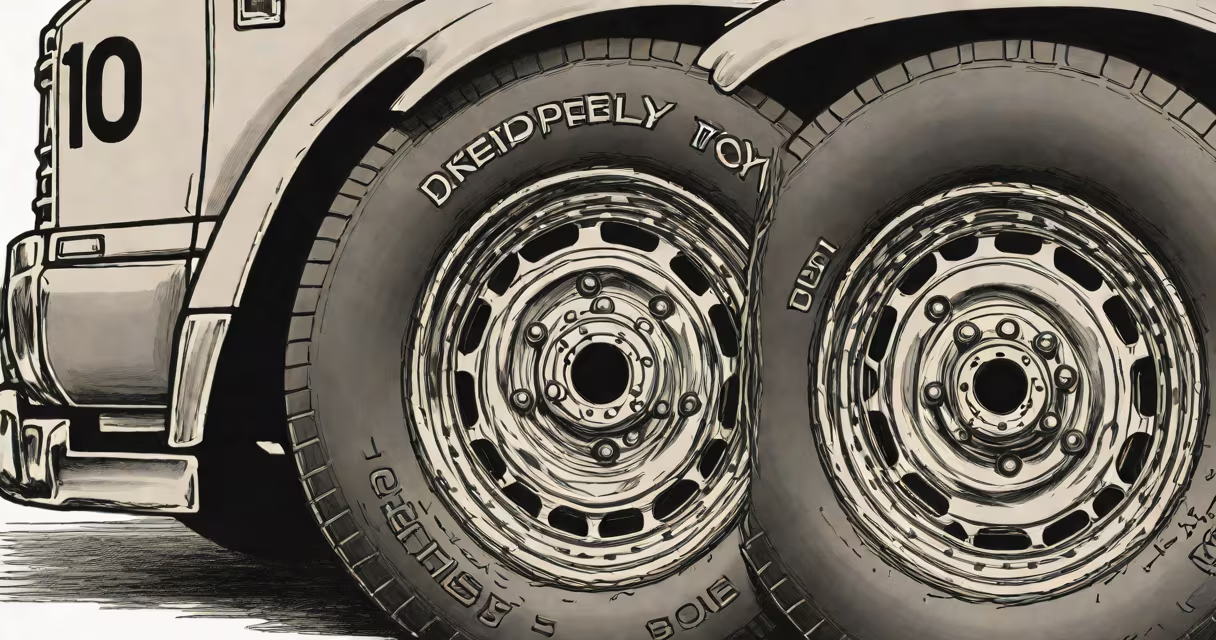
10 ply means a tire's internal structure is engineered to support a load equivalent to ten layers of reinforcing fabric, though actual construction may use fewer layers with higher-strength materials. This rating indicates high durability and load-carrying capability, essential for commercial and off-road vehicles.
The term "ply" originates from early tire design, where layers of fabric (like rayon or nylon) were stacked to build strength. Today, modern tires use synthetic fibers and advanced materials, so a 10 ply rating doesn't mean ten physical layers. Instead, it reflects performance equivalence. A 10 ply tire meets or exceeds the load-bearing standard of a 10-layer construction from older designs.
For example, a 10 ply rating allows a tire to carry heavier loads at higher speeds than lower-rated tires. A passenger car tire typically ranges from 4 to 6 ply equivalents, while a 10 ply tire is designed for trucks, trailers, and heavy equipment. This distinction ensures safety under demanding conditions.
Tire manufacturers assign ply ratings based on standardized load and inflation tests. The American Society for Testing and Materials (ASTM) sets guidelines for testing tire strength under pressure and temperature extremes. A 10 ply tire must maintain structural integrity at specified load levels and inflation pressures, as verified through lab simulations and field trials.
Load capacity increases with ply rating. A typical 10 ply tire can support between 3,500 and 4,500 pounds per tire, depending on size and speed rating. For reference, a 6 ply tire supports around 2,500 pounds. This difference matters when hauling cargo or towing trailers, especially on long hauls or rough terrain.
Manufacturers use a combination of steel belts, high-tensile polyester cords, and reinforced sidewalls to achieve 10 ply performance. These materials resist punctures, heat buildup, and deformation under stress. A 10 ply tire used on a logging truck in mountainous terrain must endure constant weight shifts and sharp rocks-conditions that would quickly fail a lower-rated tire.
Not all 10 ply tires are the same. They fall into categories based on application and construction:
| Type | Use Case | Typical Load Capacity | Example Application |
|---|---|---|---|
| Radial | Trucks, buses, trailers | 3,500-4,500 lbs | Freight hauler, RV tow |
| Bias-Belted | Heavy equipment, farm machinery | 3,800-4,200 lbs | Excavator, combine harvester |
| Off-Road | Construction, mining, agriculture | 4,000-5,000 lbs | Skid steer loader, dump truck |
Radial tires dominate commercial use due to better fuel efficiency and longer tread life. Bias-belted tires offer greater sidewall strength, ideal for uneven surfaces. Off-road variants include deeper treads and reinforced bead areas to resist damage from rocks and debris.
For example, the Michelin XZL 10 ply radial tire is rated for 4,300 pounds at 80 psi. It's used on delivery vans and small freight trucks. Its construction uses a dual steel belt layer and high-density nylon casing, delivering 10 ply performance with reduced rolling resistance compared to older models.
10 ply tires are standard on Class 3-5 commercial vehicles, including delivery trucks, service vans, and medium-duty tow trucks. They're also common on recreational vehicles (RVs) and large trailers. The U.S. Department of Transportation mandates minimum load ratings for vehicles exceeding 10,000 lbs GVWR (Gross Vehicle Weight Rating), and 10 ply tires often meet or exceed those standards.
Consider a 2023 Ford F-350 Super Duty pickup. Its factory-installed tires are rated 10 ply. With a GVWR of 14,500 lbs, the vehicle must handle heavy payloads and towing. Using a 6 ply tire would risk blowouts, excessive wear, and handling instability-especially on highways or mountain roads.
These tires are also critical in emergency response. Fire trucks and ambulances require consistent performance under extreme conditions. A 10 ply tire maintains stability during rapid acceleration, braking, and cornering-key for safe operation in time-sensitive scenarios.
Many assume that a 10 ply tire is physically made of ten layers. That's incorrect. Modern tires use fewer layers of advanced materials. A 10 ply rating is a performance benchmark, not a literal count. The Federal Motor Carrier Safety Administration (FMCSA) clarifies this in its 49 CFR Part 393 regulations, stating that "ply rating is a measure of load-carrying capacity, not physical layer count."
Another misconception is that higher ply rating equals better ride quality. In reality, 10 ply tires often have stiffer sidewalls, leading to a harsher ride on paved roads. They prioritize strength over comfort. For daily driving, a 6 or 8 ply tire may offer better balance between durability and ride smoothness.
A third error is equating 10 ply with speed rating. A 10 ply tire can be rated for high speeds (e.g., S or T speed class), but the rating is independent. A 10 ply tire with a speed rating of "H" (up to 130 mph) is suitable for highway use, while a "Q" rating (99 mph) limits speed but still offers high load capacity.
Suppose you're towing a 12,000-pound travel trailer using a 2022 Ram 2500. The trailer's axle weight is 6,000 lbs per axle. The manufacturer recommends 10 ply tires on the trailer's wheels. Using 6 ply tires would exceed their load limit, risking overheating and blowouts.
With 10 ply tires, the trailer maintains proper inflation and load distribution. During a 500-mile trip across Arizona deserts, temperatures reached 120°F. The 10 ply tires handled the heat without failure-proving their durability under stress. In contrast, a similar setup with 6 ply tires showed signs of tread separation after 300 miles.
Even when not towing, 10 ply tires provide peace of mind. I once replaced the rear tires on my 2018 Ford Transit van with 10 ply radials after noticing premature wear on the original 6 ply tires. After switching, the van handled full cargo loads without sagging or overheating. The improved stability was noticeable on highway turns and sudden stops.
10 ply does not mean the tire is twice as strong as a 5 ply tire. Strength scales nonlinearly. A 10 ply tire supports more weight, but not double. Load capacity depends on size, inflation, and material density. A 10 ply tire on a 16-inch rim won't perform the same as one on a 20-inch rim.
Also, 10 ply is not synonymous with "heavy-duty." Some brands market 10 ply tires as "heavy-duty," but the term lacks regulatory definition. The correct term is "high-load-capacity" or "commercial-grade." Confusing marketing language can mislead buyers into thinking they're getting extra protection when they're not.
Finally, 10 ply does not guarantee longevity. A tire's lifespan depends on maintenance, driving habits, and road conditions. A 10 ply tire worn out from underinflation or aggressive driving will fail faster than a well-maintained 6 ply tire.
Understanding what 10 ply means prevents costly mistakes. Always match tire rating to vehicle specifications. Check the owner's manual or placard on the driver's door jamb for recommended load and ply ratings. If you're replacing tires, consult a professional mechanic or tire specialist.