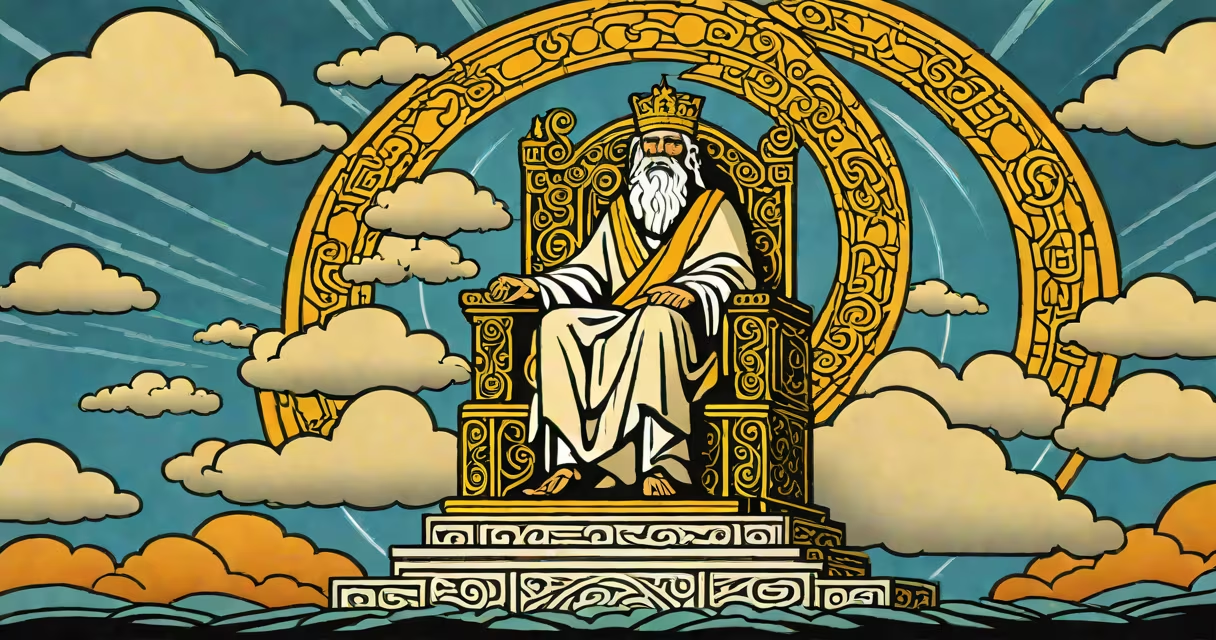
Ezekiel chapter 1 presents a vivid, apocalyptic vision of God's glory revealed to the prophet during his exile in Babylon. The passage centers on a divine manifestation involving four living creatures, rotating wheels, and a throne above a stormy sky, symbolizing God's sovereignty, holiness, and presence among His people.
The vision begins with a storm coming from the north-a traditional biblical sign of divine judgment and revelation. Ezekiel describes a whirlwind, fire, and flashing lightning, forming a cloud of intense light. Within this cloud, he sees what appears to be a throne made of sapphire, and upon it, a figure resembling a human form, glowing with brilliance. This is not a physical throne but a metaphysical representation of God's eternal authority.
Four living creatures surround the throne, each with four faces: a man, a lion, an ox, and an eagle. These faces represent different aspects of creation-human intelligence, royal strength, sacrificial service, and divine insight. Their wings are joined, moving in perfect coordination, indicating unity and purpose. The creatures do not turn but move forward in any direction, guided by the spirit, showing that God's will operates beyond human limitation.
The structure of Ezekiel's vision follows a pattern common in ancient Near Eastern prophecy: a divine messenger appears, delivers a message, and often includes symbolic imagery to convey spiritual truths. Ezekiel was a priest exiled from Jerusalem in 597 BCE, taken to the Kebar Canal near Babylon. He received this vision while sitting among the exiles, likely in a state of religious despair.
God's appearance is not static. The creatures move with wheels that rotate independently yet remain connected to the creatures' bodies. These wheels are described as "full of eyes," suggesting omniscience and constant awareness. The wheels reflect the idea that God's movement through history is deliberate, all-seeing, and not bound by time or space.
When Ezekiel hears a voice from the throne, he falls face-down in worship. This moment marks the beginning of his prophetic commission. God speaks directly to him, saying, "Son of man, stand up on your feet, and I will speak with you." The phrase "son of man" becomes a recurring title throughout Ezekiel's book, emphasizing humanity's role in receiving divine revelation.
The vision draws from ancient Mesopotamian and Canaanite cosmology, but repurposes those symbols for Israelite theology. The storm, fire, and cloud echo Exodus 19:16-18, where God descends on Sinai. The sapphire throne recalls the stone tablets of the law and the foundation of God's dwelling in the Tabernacle.
The four faces of the living creatures appear again in Revelation 4:6-8, linking Ezekiel's vision to later Christian eschatology. However, Ezekiel's original audience would have recognized these figures as representations of God's universal rule-not limited to Israel but extending over all nations.
A lesser-known detail: the creatures' wings touch each other, creating a continuous surface. This suggests that God's presence is not fragmented but unified. The interlocking wings symbolize harmony among diverse elements-humanity, animals, nature, and the divine.
| Element | Symbolic Meaning | Biblical Source |
|---|---|---|
| Four faces (man, lion, ox, eagle) | Creation's diversity under God's rule | Ezekiel 1:10; Matthew 16:13 |
| Wheels within wheels | Divine movement beyond human understanding | Ezekiel 1:15-21 |
| Sapphire throne | God's eternal majesty and justice | Exodus 24:10; Ezekiel 1:26 |
| Fire and storm | Divine presence and judgment | Psalm 18:8; Isaiah 6:4 |
Ezekiel chapter 1 serves as the theological foundation for the entire book. It establishes God's presence even in exile-contrary to the belief that God had abandoned Judah. The vision reassures the exiles that God remains sovereign, active, and capable of restoring His people.
Christian liturgy uses this passage during Advent and Pentecost, emphasizing God's presence in unexpected places. The Catholic Church cites Ezekiel 1:28 in the Catechism (paragraph 108) to explain the mystery of God's transcendence and immanence.
Modern scholars such as John Goldingay (Old Proof scholar at Fuller Seminary) argue that the vision's complexity reflects the difficulty of expressing divine reality in human language. "The more we try to describe God, the more we realize our limits," Goldingay writes in *The Message of Ezekiel* (IVP, 2001).
Many readers assume the four creatures are angels. They are not. The term "living creature" (Hebrew: *chayot*) refers to sacred beings distinct from angelic orders. In Jewish tradition, they are linked to the cherubim of the Holy of Holies, but Ezekiel expands their role to include cosmic oversight.
Another mistake: interpreting the wheels as literal mechanical parts. The text says the wheels "moved in any direction without turning," which defies physics. This is intentional-God's movement is not constrained by logic or space. The wheels symbolize divine action that transcends human mechanics.
A non-obvious point: the vision occurs on the fifth day of the month, in the fifth year of Jehoiachin's captivity. That date-Tishri 1, 593 BCE-coincides with the start of the religious calendar in ancient Israel. This timing signals that God's revelation begins at the beginning of a new cycle, not the end.
Consider Ezekiel 1:26-28: "Above the expanse over their heads was something like a throne, in appearance like sapphire. And seated above the expanse was a figure whose appearance was like that of a man. From what appeared to be his waist up, I saw a glow like amber, and from what appeared to be his waist down, I saw fire. There was a radiance around him..."
Breaking this down: the sapphire throne represents divine justice and purity. The fire below signifies judgment and purification. The glow above suggests glory and holiness. Together, they form a visual metaphor for God's dual nature-just and merciful, holy and accessible.
When Ezekiel saw this, he fell prostrate. His reaction mirrors the response of Isaiah in Isaiah 6:5-"Woe is me! I am ruined!"-showing that encountering divine glory leads to awe, repentance, and readiness to serve.
I once stood in the ruins of Babylon's Ishtar Gate, where similar winged creatures adorned the walls. The scale of the carvings overwhelmed me. But Ezekiel's vision wasn't meant to be seen-it was meant to be felt. The power lies not in the image, but in the realization: God is present even when He seems absent.
Understanding Ezekiel chapter 1 requires setting aside modern expectations of how God should appear. He does not descend in a beam of light. He reveals Himself through symbols, dreams, and visions that challenge human perception. The vision is not about seeing God -it's about learning to see Him at all.