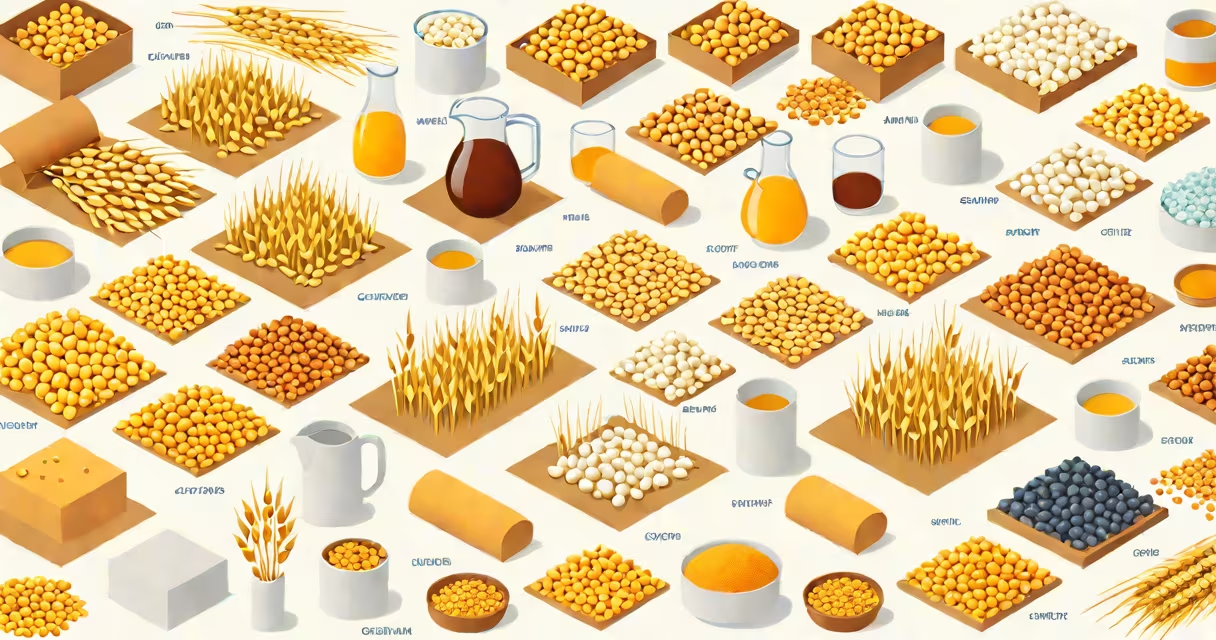
A commodity product is a standardized good produced in large volumes with minimal differences between suppliers, where price and availability dominate buyer decisions. These products are fungible-each unit is interchangeable with another-and are typically traded on global exchanges. Examples include crude oil, wheat, copper, and natural gas.
Commodity products lack unique features or branding. A barrel of West Texas Intermediate crude oil is identical to any other barrel of the same grade, regardless of who produces it. This uniformity allows buyers to switch suppliers easily based on cost, delivery time, or contract terms. The absence of differentiation reduces customer loyalty and makes pricing the primary competitive factor.
Commodities are often raw materials or basic agricultural goods used as inputs in manufacturing. Their value stems from consistent quality and widespread demand, not from added services or design. Because supply and demand determine prices in real time, commodity markets are highly sensitive to geopolitical events, weather patterns, and shifts in industrial activity.
Commodity products operate within transparent, global markets governed by futures contracts and spot pricing. Traders buy and sell standardized units through exchanges like the Chicago Mercantile Exchange (CME) or the London Metal Exchange (LME). Prices are set daily based on supply forecasts, inventory levels, and macroeconomic indicators.
For example, the price of benchmark crude oil (WTI) is published each trading day and reflects global supply-demand imbalances. If a conflict disrupts oil flows from the Middle East, prices spike even before physical shortages occur. Similarly, a bumper wheat harvest in Ukraine lowers global grain prices due to increased supply.
Because commodity products are fungible, producers cannot charge premium prices based on origin or branding. A farmer growing wheat in Kansas sells it at the same market rate as one in Canada, assuming quality meets standards. This level playing field keeps margins narrow and forces producers to focus on operational efficiency rather than marketing.
Commodity products fall into two broad categories: hard and soft. Hard commodities are mined or extracted, such as metals (copper, gold, nickel) and energy resources (crude oil, natural gas). Soft commodities are agricultural products grown or raised, including grains (corn, soybeans), livestock (cattle, hogs), and specialty crops (coffee, cocoa).
| Type | Examples | Market Example |
|---|---|---|
| Hard | Copper, gold, crude oil | ICE Futures Europe - Brent Crude Oil |
| Soft | Wheat, coffee, sugar | CBOT - Chicago Board of Trade Wheat Futures |
Each category trades under specific regulations and benchmarks. For instance, gold is priced in U.S. dollars per troy ounce and traded on the COMEX exchange. Coffee futures are settled based on quality grades and delivery locations, with contracts tied to the New York Board of Trade.
Producers often hedge against price volatility using derivatives. A Canadian wheat farmer might lock in a selling price six months ahead via a futures contract, protecting against a drop in harvest-season prices. This practice stabilizes income but limits upside potential if prices rise.
Commodity products serve as foundational inputs across industries. Steelmakers rely on iron ore and coking coal; electronics manufacturers depend on refined copper and rare earth elements. Without stable access to these materials, production lines halt. As a result, businesses enter long-term supply agreements to secure volume and mitigate risk.
For consumers, commodity products rarely appear directly. Instead, they're transformed into finished goods. A bushel of corn becomes high-fructose corn syrup in processed foods. A ton of aluminum turns into beverage cans or car parts. The original commodity's identity disappears during manufacturing, but its cost influences the final product's price.
Energy is the most visible commodity sector. Gasoline prices at the pump reflect crude oil costs, refining fees, and distribution expenses. When oil prices rose above $100 per barrel in 2022, U.S. gasoline averages exceeded $5 per gallon-a direct pass-through effect. This illustrates how commodity volatility affects everyday spending.
People often confuse commodity products with generic or undifferentiated goods. While both lack branding, a commodity product must meet strict quality standards and trade on regulated exchanges. A store-brand bottled water may be generic, but it's not a commodity because it's not traded on a futures market.
Another mistake is equating low price with commoditization. A $10 smartphone may be inexpensive, but it's not a commodity product-it has distinct features, software, and brand identity. True commoditization requires fungibility and standardization across suppliers, not just affordability.
Not all standardized goods are commodities. Industrial chemicals like ethylene or propylene are standardized but often sold under private contracts, not public exchanges. They lack the transparent pricing mechanism that defines commodity markets.
One non-obvious fact: commodity prices often lead economic indicators. The World Bank tracks 60 commodity prices monthly through its Commodity Price Index. Historically, sharp drops in commodity prices have preceded recessions. For example, the 2008 financial crisis was preceded by a 70% decline in oil prices over six months, signaling weakening global demand.
Copper is a critical component in electric vehicles (EVs). An average EV uses about 80 kilograms of copper-more than double a traditional internal combustion engine vehicle. Demand for copper has risen steadily since 2020, driven by green energy infrastructure and EV adoption.
As of 2023, copper futures traded at around $4.50 per pound on the LME. A mining company in Chile exporting copper concentrate to China must deliver material meeting ISO 1113 standard specifications. Any deviation results in rejection or discount pricing. The buyer doesn't care which mine produced the metal-only that it meets purity and particle size requirements.
This standardization enables efficient global trade. A battery manufacturer in South Korea can source copper from multiple suppliers worldwide without requalifying each batch. The uniformity ensures reliability and reduces procurement complexity.
I've observed this firsthand while working with a mid-sized steel producer in Pennsylvania. During a 2021 supply chain disruption, the company switched from a single domestic iron ore supplier to a mix of Brazilian and Australian exports. The change required no engineering adjustments-the ore met the same chemical and physical specs. That's the power of commoditization: interchangeability at scale.
Understanding what is a commodity product reveals how global markets function beneath the surface of everyday goods. These standardized inputs drive industrial output, influence inflation, and shape national economies. Their value lies not in uniqueness but in consistency and accessibility.
When you see a price tag on a product, consider whether its raw materials were once traded as commodities. The process from field, mine, or well to finished item is invisible-but essential. Recognizing this helps explain price fluctuations, supply risks, and the role of data in managing them.