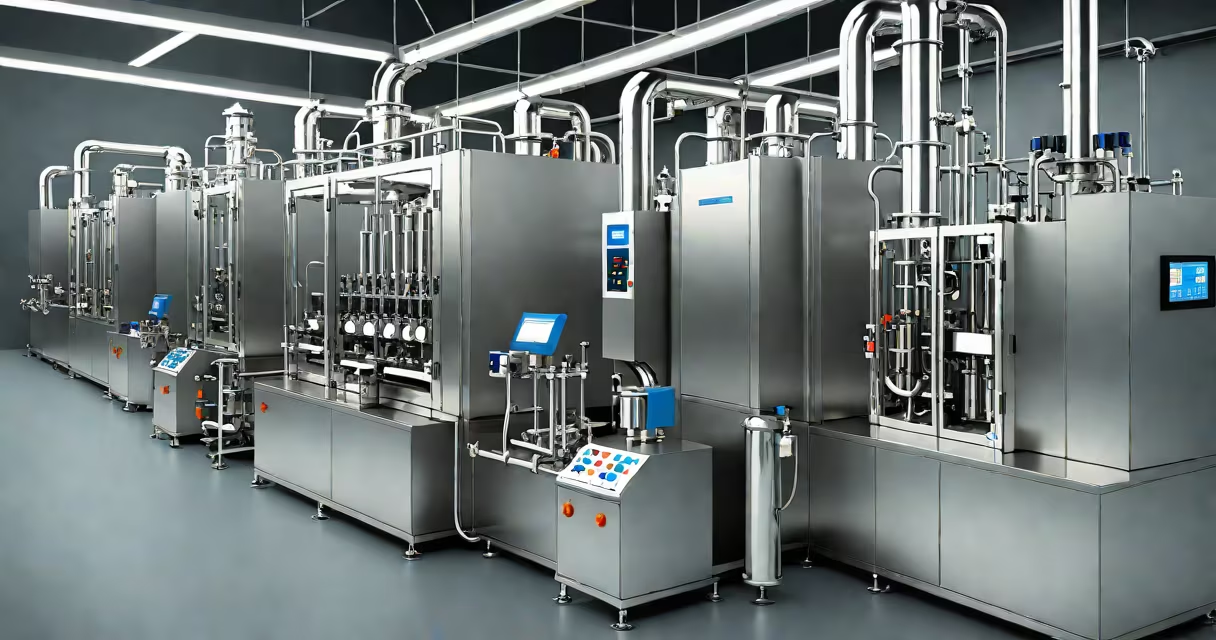
Continuous manufacturing is a production method where raw materials flow through a series of interconnected unit operations without interruption, producing a consistent product stream. Unlike batch processing, which operates in discrete stages with pauses between steps, continuous manufacturing runs 24/7 with real-time quality control and minimal inventory. This approach is widely adopted in industries requiring high consistency and efficiency, such as pharmaceuticals, chemicals, and food processing.
The core principle is uninterrupted material flow. Raw ingredients enter one end of a system, undergo sequential transformations-mixing, heating, cooling, drying, granulation, compression-and exit as finished product at the other end. Each stage is tightly coupled, monitored, and adjusted automatically based on sensor feedback. This eliminates the need to stop, empty, clean, and restart equipment between batches.
According to the U.S. Food and Drug Administration (FDA), continuous manufacturing enables better process understanding and control, leading to higher product quality and reduced variability. The agency emphasizes that this model supports real-time release testing, where products are approved for distribution immediately after production, rather than after lengthy lab analysis.
Continuous manufacturing begins with automated feeding systems that deliver precise amounts of raw materials into the process. These inputs are blended in a mixer, then processed through reactors, heat exchangers, and separation units. Each step is linked by conveyors, pumps, or pneumatic transfer systems that maintain constant flow.
Sensors embedded throughout the line measure temperature, pressure, viscosity, particle size, and chemical composition in real time. Data feeds into a central control system that adjusts parameters instantly-like altering reaction speed or adjusting solvent ratios-to maintain product specifications. For example, if a tablet's weight deviates by 0.5%, the system reduces powder feed rate within seconds.
A fully integrated continuous line can produce 10,000 tablets per hour with less than 1% variation in weight or potency. This level of precision is difficult to achieve in batch systems, where each batch must be tested individually and adjustments applied retrospectively.
Continuous manufacturing systems consist of several interdependent modules:
| Component | Purpose | Example Application |
|---|---|---|
| Feeders | Deliver accurate quantities of solid or liquid inputs | Rotary screw feeders for powders in tablet production |
| Inline mixers | Ensure homogeneity during blending or reaction | Static mixers in polymer extrusion lines |
| Process analytical technology (PAT) | Monitor critical quality attributes in real time | NIR spectroscopy for detecting moisture levels in drying zones |
| Automated controls | Adjust process variables based on live sensor data | PLC-based logic for maintaining optimal temperature in reactors |
There are two primary configurations: single-product lines and multi-product modular systems. Single-product lines are optimized for high-volume output of one formulation, common in large-scale pharmaceutical plants. Modular systems allow rapid changeover between products using standardized units-ideal for specialty drugs or clinical trial supplies.
One non-obvious distinction: continuous systems do not require cleaning between batches because they operate in a steady state. Batch systems, by contrast, demand thorough cleaning validation after each run to prevent cross-contamination. This reduces downtime and operational costs.
Pharmaceuticals lead adoption due to regulatory support. The FDA's Process Analytical Technology (PAT) initiative, launched in 2004, encourages continuous processes by enabling real-time release. Since 2015, the agency has approved multiple continuous manufacturing lines for approved drugs, including Janssen's Vyvanse and Pfizer's Lyrica.
In food and beverage, continuous manufacturing ensures uniformity in products like baked goods and beverages. A bottling line at a major soft drink producer runs continuously, filling 2,000 bottles per minute with consistent sugar concentration and carbonation levels.
Chemical manufacturing uses continuous reactors for high-purity intermediates. A European specialty chemical plant produces caprolactam-used in nylon-via a continuous catalytic process that runs for 18 months without shutdown, achieving 99.6% yield.
I experienced this firsthand while visiting a pilot facility in North Carolina. The line produced a generic antipsychotic drug in continuous mode. After 48 hours of operation, the final product met all quality standards without a single batch failure. The team attributed this to constant monitoring and immediate corrective actions.
Many assume continuous manufacturing requires massive capital investment and long implementation timelines. While initial setup is costly, the long-term savings in energy, labor, and waste reduction often justify the expense. A 2021 study by the International Society for Pharmaceutical Engineering (ISPE) found that continuous lines reduce energy consumption by 30-40% compared to batch equivalents.
Another misconception is that continuous systems cannot handle complex formulations. In reality, advanced modeling tools allow simulation of multi-step reactions and phase changes. A continuous process for a biologic drug was successfully validated in 2022 using computational fluid dynamics to predict protein aggregation risks.
Continuous manufacturing is not interchangeable with "automated" or "digital" production. Automation refers to machine control; digitalization involves data integration. Continuous manufacturing combines both but adds the defining feature of uninterrupted flow. A line may be automated yet still operate in batch mode.
Consider a hypothetical continuous line producing 50 mg tablets of a cardiovascular drug:
This entire process runs unattended for 72 hours. If a deviation occurs-say, API concentration drops below specification-the system shuts off the feed and alerts operators. No batch is lost. The line maintains a consistent output of 2.5 million tablets per day.
For comparison, a batch system would require five separate steps, each taking 2-4 hours, with manual sampling and lab testing after each stage. Total cycle time: 48 hours. Waste: 15% due to out-of-spec batches. Energy cost: 2.3 times higher.
As regulations evolve, continuous manufacturing is expected to become standard for new drug approvals. The FDA's 2023 guidance document states that continuous processes are preferred for drugs with narrow therapeutic windows, where small quality differences can impact patient safety.
Continuous manufacturing is not just faster-it's smarter, safer, and more sustainable. It represents a shift from reactive quality control to proactive process management. As automation and analytics mature, this model will underpin the next generation of industrial production.