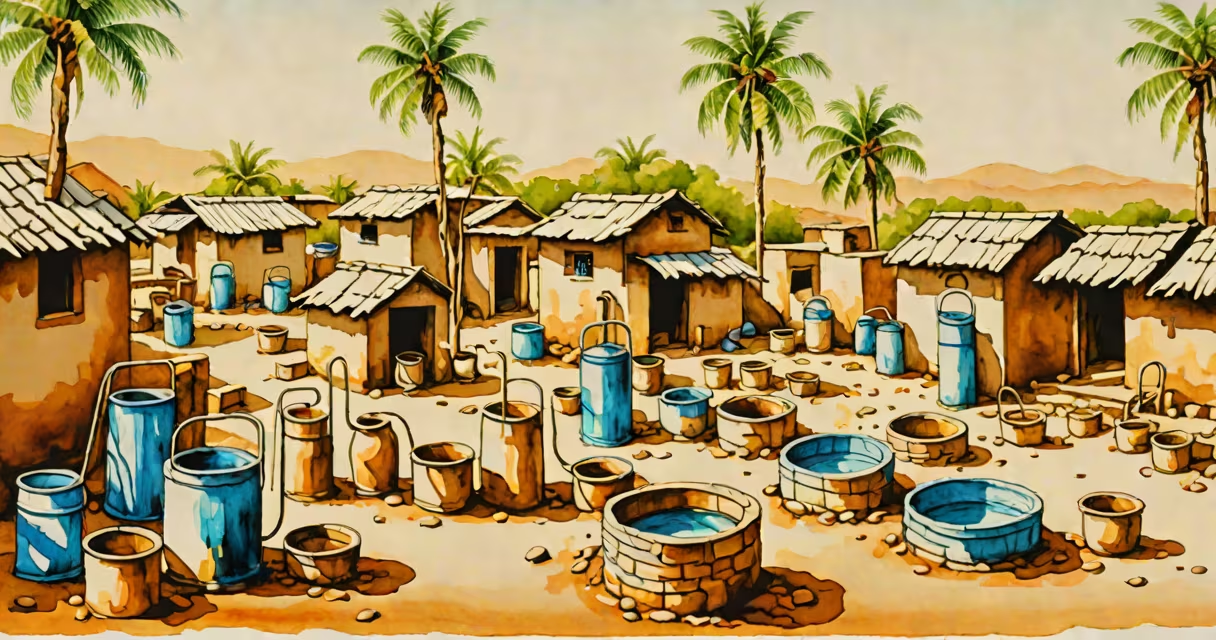
Economic water scarcity exists when adequate water is available but people cannot access it due to poor infrastructure, financial constraints, or institutional failure-not because of physical shortage. This condition affects over 2 billion people globally, particularly in sub-Saharan Africa and parts of South Asia.
Unlike physical water scarcity-where rainfall and groundwater are insufficient-economic water scarcity arises from mismanagement, underinvestment, and unequal distribution. It reflects systemic gaps in human and financial capital needed to deliver water effectively.
The World Bank identifies economic water scarcity as a primary barrier to achieving Sustainable Development Goal 6 (clean water and sanitation for all). In regions with seasonal rainfall and healthy aquifers, water may be abundant-but without pipes, storage tanks, or maintenance systems, it remains out of reach.
Water availability is measured in cubic meters per capita per year. A region with more than 1,700 m³/capita/year is considered water-rich. Yet even in such areas, people may lack running water if no system connects sources to homes.
For example, in parts of northern Nigeria, annual rainfall averages 1,200 mm-well above the 750 mm threshold for water security. But only 45% of rural households have access to improved water sources. Wells exist, but many are dry during the dry season, and no piped network reaches remote villages.
When communities rely on manual labor to fetch water from distant sources, time spent collecting water reduces opportunities for education and income generation. Women and children often walk 3-5 km daily, carrying 20-liter jugs. This burden compounds poverty and limits development.
Economic water scarcity stems from three core deficiencies: inadequate infrastructure, limited funding, and weak governance. These factors interact to create persistent gaps between supply and access.
Infrastructure includes boreholes, pipelines, reservoirs, and treatment plants. In Kenya's Rift Valley, 60% of boreholes fail within five years due to poor construction and lack of repair mechanisms. Without trained technicians or spare parts, broken pumps remain idle.
Financial barriers include high upfront costs for well drilling ($3,000-$8,000 per borehole) and recurring expenses for maintenance. Rural cooperatives often lack credit access. Even when donors fund projects, local ownership falters without training or accountability structures.
Governance failures manifest as fragmented authority. In India's Rajasthan state, multiple agencies manage water-state irrigation departments, municipal corporations, and village councils-leading to overlapping responsibilities and uncoordinated planning. A 2021 study found that 40% of rural water schemes failed within three years due to unclear roles and poor monitoring.
Many assume water scarcity means drought or low rainfall. But according to the United Nations, 70% of global water stress cases stem from economic causes, not climate shortages. Physical scarcity affects less than 10% of the world's population.
Another myth is that water scarcity is solely a problem of arid regions. In fact, urban centers like Jakarta and São Paulo face acute water crises despite heavy rainfall. Jakarta's underground aquifers are over-extracted due to rapid urbanization and poor regulation-resulting in land subsidence and saltwater intrusion.
Some confuse economic scarcity with pollution. While contaminated water reduces usability, it doesn't equate to scarcity. A river may be clean but inaccessible if no pipeline runs to nearby towns. The issue is not quality-it's delivery.
| Type of Water Scarcity | Primary Cause | Example Location | Key Indicator |
|---|---|---|---|
| Physical scarcity | Low precipitation, high evaporation | Atacama Desert, Chile | <1,000 m³/capita/year |
| Economic scarcity | Lack of infrastructure, financing, or management | Rural Ethiopia | Available water but no functional taps |
| Pollution-induced scarcity | Contaminated sources | Delhi, India | Groundwater with high arsenic levels |
The Kagera River basin spans Rwanda, Burundi, and Tanzania. Annual rainfall exceeds 1,500 mm-plenty for agriculture and domestic use. Yet 60% of rural families depend on unprotected springs or surface water.
A 2019 UNICEF report documented that 78% of households in the Rwandan portion of the basin walked more than 30 minutes to collect water. Despite nearby rivers, no piped system existed. Local authorities cited budget constraints and political disputes over cross-border water rights.
One community in Nyamasheke District installed a gravity-fed pipeline using donated materials and volunteer labor. The project cost $12,000-funded through a micro-grant program. Within six months, 120 households gained access to clean water. Child diarrhea rates dropped by 40% in the following year.
This case illustrates that economic scarcity is solvable with targeted investment and local coordination. The solution wasn't more rain-it was better planning.
Water scarcity is not equally distributed across gender, class, or geography. Women and girls bear 60% of the global water collection burden, according to WHO/UNICEF Joint Monitoring Programme (JMP). In low-income settings, they spend an average of 200 million hours daily fetching water-time that could support schooling or income-generating work.
Economic water scarcity disproportionately impacts marginalized groups. Indigenous communities in the Amazon basin face displacement and contamination of ancestral water sources, even though their lands receive abundant rainfall. Legal recognition of water rights remains rare.
There's also a feedback loop: lack of water access reduces agricultural productivity, which lowers household income, making it harder to afford water services. This cycle entrenches inequality and undermines long-term resilience.
In 2022, I observed a community water committee in Nsanje District, southern Malawi. The group had secured a grant to install a solar-powered pump at a shallow aquifer. After installation, water availability increased from 2 liters per person per day to 50 liters-enough for drinking, cooking, and small-scale farming.
But within nine months, the pump failed. No local technician knew how to fix it. The community lacked funds for replacement parts. The system remained inactive until a regional NGO returned with training and tools. The lesson: infrastructure without capacity building leads to collapse.
Addressing economic water scarcity requires coordinated action across sectors. Prioritize investments in decentralized systems-rainwater harvesting, small-scale boreholes, and solar pumps-that suit local conditions. Support community-led management models to ensure sustainability.
Policy reforms must clarify water rights and reduce bureaucratic delays. Countries like Morocco and Jordan have implemented national water strategies that integrate economic, environmental, and social goals. These frameworks allocate funding based on need and track outcomes through digital dashboards.
What is economic water scarcity? It is not a lack of water-but a failure to deliver it. Solving it demands more than engineering. It requires justice, foresight, and sustained commitment.