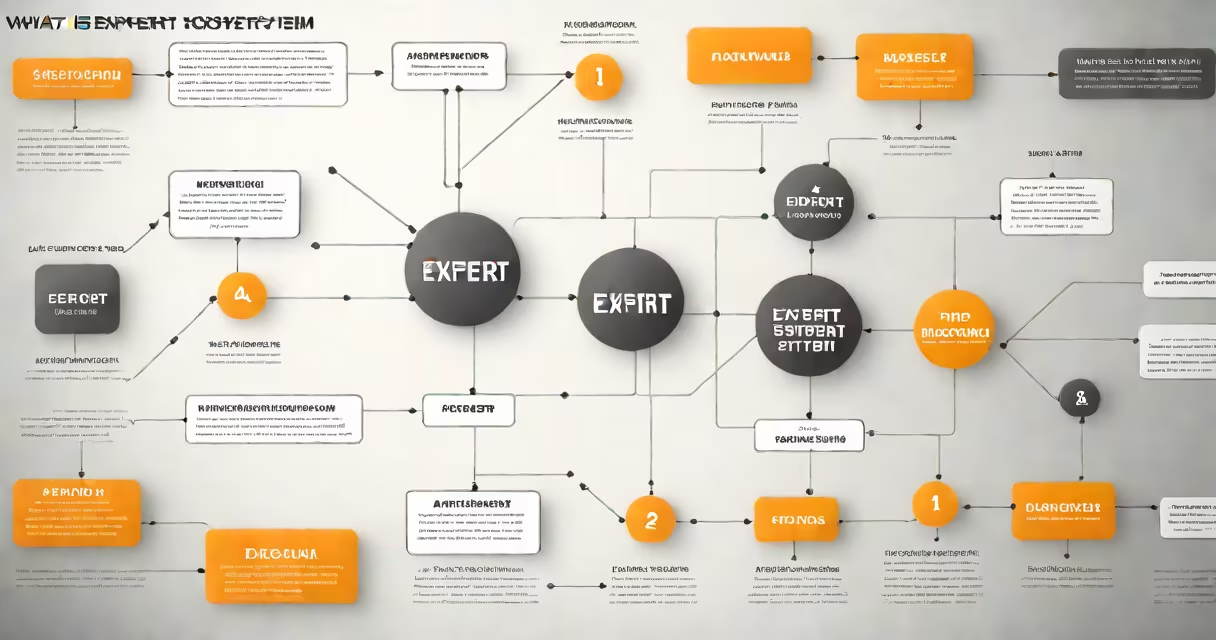
An expert system in AI is a computer program that emulates the decision-making ability of a human expert by combining a knowledge base of facts and rules with an inference engine that applies logic to reach conclusions. These systems operate within narrow domains, such as diagnosing diseases or evaluating loan applications, and deliver consistent, explainable outcomes based on predefined expertise.
Expert systems emerged in the 1970s as early attempts to make AI practical. They rely on structured knowledge rather than learning from data, distinguishing them from modern machine learning models. A core component is the knowledge base-a collection of domain-specific facts and conditional rules. For example, in medicine, a rule might state: "If patient has fever above 101°F and cough lasting more than 5 days, then suspect bacterial pneumonia." The inference engine processes these rules against input data to generate diagnoses or recommendations.
These systems were foundational in fields requiring high accuracy under uncertainty. MYCIN, developed at Stanford University in the 1970s, diagnosed blood infections and recommended antibiotics with 65% accuracy-on par with experienced physicians. Today, expert systems remain relevant in regulated environments where transparency matters, such as healthcare, finance, and engineering troubleshooting.
Expert systems follow a three-step process: knowledge acquisition, reasoning, and explanation. First, domain experts-doctors, engineers, or financial analysts-are interviewed to extract their decision-making logic. This information is formalized into a set of rules stored in the knowledge base. The system doesn't learn from experience; it applies static rules to new inputs.
The inference engine executes the reasoning. It uses forward chaining (starting from known facts and applying rules until a conclusion is reached) or backward chaining (starting from a hypothesis and working backward to find supporting evidence). For instance, in a loan approval system, forward chaining might begin with income level and credit score, then apply rules to assess risk. Backward chaining might start with "approve loan" and trace back to verify eligibility criteria.
After computing a result, the system explains its reasoning. This transparency is critical in legal or medical contexts. If a loan is denied, the system can list the specific rules that triggered the rejection-such as "credit score below 600" or "debt-to-income ratio exceeds 40%"-allowing users to challenge or correct assumptions.
Every expert system consists of four parts: knowledge base, inference engine, user interface, and explanation facility. The knowledge base holds facts and rules. The inference engine applies logic. The user interface allows input and displays results. The explanation facility documents the chain of reasoning.
| Type | Use Case | Example | Limitation |
|---|---|---|---|
| Rule-Based | Medical diagnosis, fraud detection | MYCIN for infection treatment | Cannot adapt to new data |
| Frame-Based | Engineering design, asset management | NASA's diagnostic tools for spacecraft | Complex to maintain |
| Hybrid | Financial risk modeling, customer service bots | Banking systems combining rules and ML | Higher development cost |
Rule-based systems dominate early implementations. Frame-based systems organize knowledge around objects or concepts-like a car's engine, transmission, and fuel system-with attributes and relationships. Hybrid systems integrate symbolic reasoning with statistical models, allowing limited adaptation while preserving explainability.
A non-obvious distinction: expert systems do not improve over time unless manually updated. Unlike neural networks trained on millions of examples, they don't adjust rules based on feedback. This makes them brittle in changing environments. For example, a medical expert system built in 2010 may fail to recognize new strains of a virus because its knowledge base hasn't been revised.
Many confuse expert systems with general AI or machine learning. An expert system in AI is not intelligent in the human sense. It lacks awareness, creativity, or emotional understanding. It cannot reason beyond its programmed rules. Calling it "artificial intelligence" is technically accurate but misleading-it's symbolic AI, not cognitive AI.
Another misconception is that expert systems replace human experts. They don't. They assist by reducing errors in routine decisions. A radiologist using an expert system for detecting lung nodules still interprets results. The system flags anomalies; the expert confirms and acts.
Some assume all AI tools are transparent. Not true. While expert systems provide step-by-step explanations, many modern AI models-especially deep learning systems-are black boxes. Their decisions lack traceable logic. For example, a neural network predicting stock prices may be accurate but offer no insight into why it chose a particular outcome. Expert systems avoid this issue by design.
One of the most enduring applications is in healthcare. The INTERNIST-I system, developed in the 1970s, could diagnose over 600 diseases based on symptoms and test results. Though outdated today, it proved that computers could handle complex clinical reasoning. Modern versions, like Isabel Health's diagnostic support tool, integrate with electronic health records and suggest rare conditions doctors might overlook.
In finance, expert systems detect fraud. A bank might use a system that flags transactions where the amount exceeds $10,000, the location is foreign, and the card was last used in a different country-all within 15 minutes. If all three conditions match, the system triggers a freeze and alerts a fraud analyst. This reduces false positives compared to purely statistical models.
I once observed a manufacturing plant use an expert system to monitor conveyor belt failures. The system tracked temperature spikes, vibration levels, and motor current. When readings exceeded thresholds, it triggered maintenance alerts. Over six months, it reduced unplanned downtime by 37%, saving $280,000 in repair costs. The system didn't predict failure-it reacted to signs already present.
Use an expert system in AI when you have well-defined problems with clear rules and stable requirements. Ideal scenarios include regulatory compliance, safety-critical operations, and domains where audit trails are mandatory. Avoid them in rapidly changing environments or when patterns evolve unpredictably.
Key limitations include brittleness, high maintenance, and difficulty scaling. Adding new rules requires revisiting the entire knowledge base. If a rule conflicts with another, resolution depends on manual prioritization. Also, the knowledge acquisition phase is time-intensive-interviewing experts can take weeks or months.
For building your own expert system in ai, start with a focused problem. Choose a domain with clear decision boundaries-like equipment diagnostics or insurance claim processing. Use tools like CLIPS (C Language Integrated Production System) or Drools for rule management. Test thoroughly with edge cases before deployment.
As AI continues to evolve, expert systems remain relevant not because they're advanced, but because they're predictable. In settings where trust and accountability matter, their structure provides value. They are not the future of AI-but they are a proven foundation for solving specific problems today.