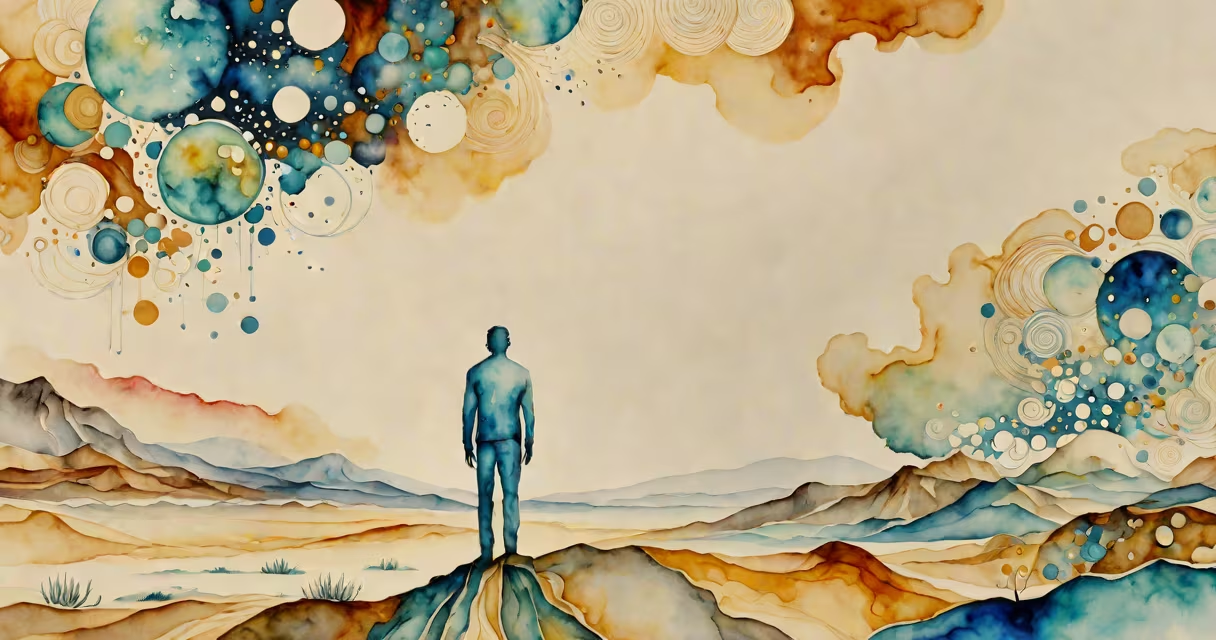
The meaning of life and everything refers to the search for purpose behind human existence, consciousness, and the universe's structure. This question spans millennia, appearing in religious texts, scientific theories, and philosophical debates. It is not a single answer but a series of inquiries into why we are here, what our role is, and whether existence has a design.
At its core, the question challenges individuals and cultures to define value, direction, and significance in a world that often appears indifferent. Ancient Greeks debated it through ethics and virtue; Eastern traditions explored it via enlightenment and detachment; modern science examines it through evolutionary biology and cosmology. No consensus exists, but the pursuit itself shapes how people live.
When someone asks "what is the meaning of life and everything," they're not seeking a literal explanation of the universe's origin. They want to know: What gives my life value? Why do I exist? How should I act?
Some interpret the question as asking for a universal purpose-like a divine plan or cosmic blueprint. Others treat it as a personal challenge: "What should I care about?" or "What makes my life matter?" The difference matters. A universal answer implies meaning exists independently of human belief. A personal answer suggests meaning is created through choices, relationships, and experiences.
For example, a person raised in a Christian tradition may believe life's purpose is to love God and serve others. A secular biologist might see survival and reproduction as the ultimate drivers. A Buddhist sees suffering as central and liberation as the goal. These aren't contradictions-they reflect different frameworks for interpreting existence.
The meaning of life and everything is not a physical object. It's composed of ideas, beliefs, and interpretations drawn from multiple fields. Philosophy provides the most direct tools. Existentialists like Jean-Paul Sartre argued that life has no inherent meaning-humans must create their own. Albert Camus called this absurdity, the conflict between our desire for meaning and a silent universe.
Science offers another lens. Evolutionary theory shows that life evolved through natural selection, not design. Organisms survive and reproduce because traits increase fitness-not because they fulfill a higher purpose. The universe began with the Big Bang, expanded, formed stars and planets, and eventually gave rise to life. None of this required intention.
Religious traditions offer structured answers. In Islam, life's purpose is submission to Allah's will. In Hinduism, it's moksha-liberation from the cycle of rebirth. In Judaism, it's building a just society and observing commandments. These systems provide moral frameworks and narratives that give life coherence.
| Perspective | Core Idea | Source |
|---|---|---|
| Existentialism | Meaning is chosen, not given | Sartre, *Being and Nothingness* |
| Scientific Materialism | No purpose; evolution drives life | Dawkins, *The Selfish Gene* |
| Buddhism | Life is suffering; freedom comes from detachment | Thich Nhat Hanh, *The Heart of the Buddha's Teaching* |
| Christianity | Love God and neighbor; eternal salvation | Bible, Matthew 22:37-40 |
People ask about the meaning of life and everything during moments of crisis, transition, or reflection. A student facing graduation might wonder if years of study had deeper significance. A grieving parent may question why loss occurred. A person diagnosed with a terminal illness often confronts the question directly.
It's also central in literature and film. *The Hitchhiker's Guide to the Galaxy* famously answers "42" to the question, satirizing humanity's obsession with finding a single solution. The film *Interstellar* explores meaning through love, sacrifice, and connection across time-suggesting emotional bonds transcend physical laws.
Even in daily decisions, the question surfaces. Choosing a career, forming relationships, raising children-all involve implicit judgments about what matters. When you decide to volunteer, donate money, or spend time with family, you're acting on a sense of purpose-even if you don't label it as such.
Many assume the meaning of life and everything must have one correct answer. That's false. The question is not like solving a math problem. There is no final equation or universal code. The idea that there's a single, discoverable meaning leads to frustration when reality doesn't match expectations.
Another mistake is equating meaning with happiness. People think if life has purpose, it must be joyful. But purpose and pleasure are distinct. A soldier fighting in war may find deep meaning in protecting others, yet endure fear and trauma. Meaning doesn't require comfort-it requires commitment.
A lesser-known but critical point: meaning is not dependent on external validation. You don't need approval from religion, science, or society to feel your life matters. Research in psychology shows that people derive meaning from small acts-helping a stranger, creating art, maintaining a garden. These are not grand gestures, but they anchor identity.
Consider Maria, a 34-year-old nurse working night shifts in a city hospital. She's tired, overwhelmed, and wonders: "Is this all there is? Does any of this matter?"
She doesn't believe in God. She's read Dawkins and understands evolution. But she still feels compelled to stay. Why?
She reflects on her patients: Mr. Patel, who smiles when she checks his vitals; the young woman in room 312 who holds her hand during pain. These interactions aren't part of a cosmic plan. But they matter to her. She finds meaning not in a big narrative, but in presence-being there when someone needs someone.
This aligns with Viktor Frankl's work in *Man's Search for Meaning*. After surviving Auschwitz, he concluded that even in extreme suffering, people can find purpose through love, responsibility, and choice. Maria didn't need a divine reason to continue. Her meaning was built in the moment, in action.
I once sat with a group of elderly residents in a care home. One man, frail and nearly blind, kept repeating, "I did my job." He'd been a mechanic for 40 years. When asked why he still cared about being useful, he said, "I wasn't just a machine. I was part of something." His sense of dignity came not from legacy, but from daily contribution. That moment taught me that meaning isn't found-it's lived.
Nihilism asserts that life lacks objective meaning. Friedrich Nietzsche warned that rejecting traditional values could lead to despair-but also to creation. He wrote, "He who has a why to live can bear almost any how." The absence of inherent meaning doesn't imply futility. It opens space for invention.
Modern neuroscience supports this. Brain scans show that people report greater well-being when engaged in meaningful activities-even if those activities have no external reward. Purpose activates regions linked to motivation and emotional regulation.
Yet many still struggle. A 2023 survey by the Pew Research Center found that 36% of Americans felt life lacked meaning. Among young adults aged 18-29, the number rose to 44%. These figures aren't about religion-they reflect disconnection, isolation, and uncertainty in a rapidly changing world.
The meaning of life and everything is not a puzzle to solve. It's a condition of being human. You don't find it-you build it. Whether through relationships, creativity, service, or curiosity, meaning emerges from engagement.
Some believe the universe is silent. Others hear a call. Neither view is wrong. The question persists not because it has an answer, but because it demands attention. And in asking it, we begin to live.