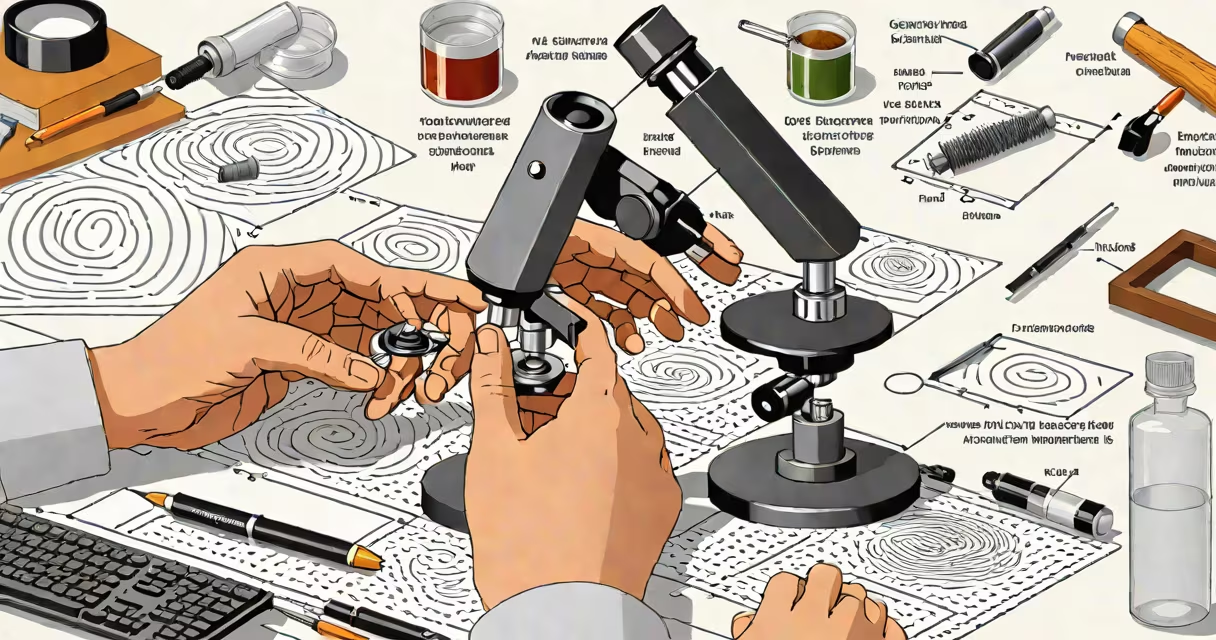
Forensic science applies scientific methods to legal investigations, analyzing physical evidence such as DNA, fingerprints, and digital records to establish facts in criminal and civil cases. It bridges gaps between crime scenes and courtroom conclusions.
Forensic science begins at the crime scene, where trained professionals collect trace evidence like bloodstains, fibers, or tool marks. This evidence is then analyzed in labs using standardized protocols. Results are documented and presented in court as expert testimony.
For example, a single drop of blood at a burglary scene may be tested for DNA. If the sample matches a suspect's profile, it becomes a key piece of evidence. The process relies on chain-of-custody logs, peer-reviewed techniques, and cross-verification to prevent contamination or misinterpretation.
The American Academy of Forensic Sciences (AAFS) sets standards for practice, including accreditation for laboratories and certification for practitioners. According to AAFS, over 90% of forensic labs in the U.S. follow these guidelines to ensure reliability.
Forensic science supports multiple disciplines within law enforcement and legal proceedings. Common types include:
| Type | Primary Use | Example |
|---|---|---|
| DNA Analysis | Identifying individuals from biological samples | Matching a suspect's DNA to semen found on a victim's clothing |
| Fingerprint Examination | Linking a person to a surface they touched | Matching latent prints from a door handle to a known offender |
| Toxicology | Detecting drugs or poisons in bodily fluids | Confirming alcohol levels in a driver involved in a fatal crash |
| Ballistics | Matching bullets to firearms | Reconstructing a shooting based on bullet trajectory and casing residue |
| Digital Forensics | Recovering data from electronic devices | Extracting deleted messages from a phone linked to a kidnapping |
Each method follows strict validation procedures. For instance, the FBI's CODIS database contains over 16 million DNA profiles and supports matches across state lines, aiding cold case resolutions.
Law enforcement agencies use forensic science to solve crimes ranging from homicides to cyber fraud. In high-profile cases, such as the 2018 arrest of the Golden State Killer, investigators combined genetic genealogy with old DNA samples to identify a decades-old suspect.
Civil courts also rely on forensic findings. In personal injury lawsuits, biomechanical engineers analyze accident footage and vehicle damage to reconstruct collisions. In divorce cases, forensic accountants trace hidden assets using transaction patterns and bank records.
A common misconception is that forensic science delivers instant results. In reality, most analyses take days to weeks. A typical DNA test can take 5-10 business days, depending on backlog and complexity. The National Institute of Justice reports that 40% of crime labs face delays due to staffing shortages and outdated equipment.
People often confuse forensic science with detective work or media portrayals like CSI. Unlike TV shows, real forensic labs do not have rapid turnaround times or dramatic reveals. Most findings are inconclusive or require further testing.
Another misunderstanding is equating forensic science with absolute certainty. No test is 100% accurate. Even DNA matches carry a probability value-e.g., a match might be reported as "1 in 10 billion" chance of occurring by random chance. Courts consider these odds during deliberations.
In 2007, Amanda Knox was accused of murdering her roommate in Italy. Prosecutors cited a knife found in her home with traces of blood and DNA. However, subsequent independent testing revealed contamination and poor handling. The Italian Supreme Court later overturned the conviction, citing flawed forensic interpretation.
This case highlights a critical truth: forensic science is only as good as the chain of custody and quality control. Missteps in collection or analysis can lead to wrongful convictions. The Innocence Project estimates that faulty forensic evidence contributed to over 450 wrongful convictions in the U.S. since 1989.
What is forensic science used for? It is used to interpret physical evidence in legal contexts, supporting investigations and judicial decisions. From identifying perpetrators to exonerating the innocent, it plays a central role in modern justice systems. Its accuracy depends on rigorous methodology, not dramatized timelines or infallible results.