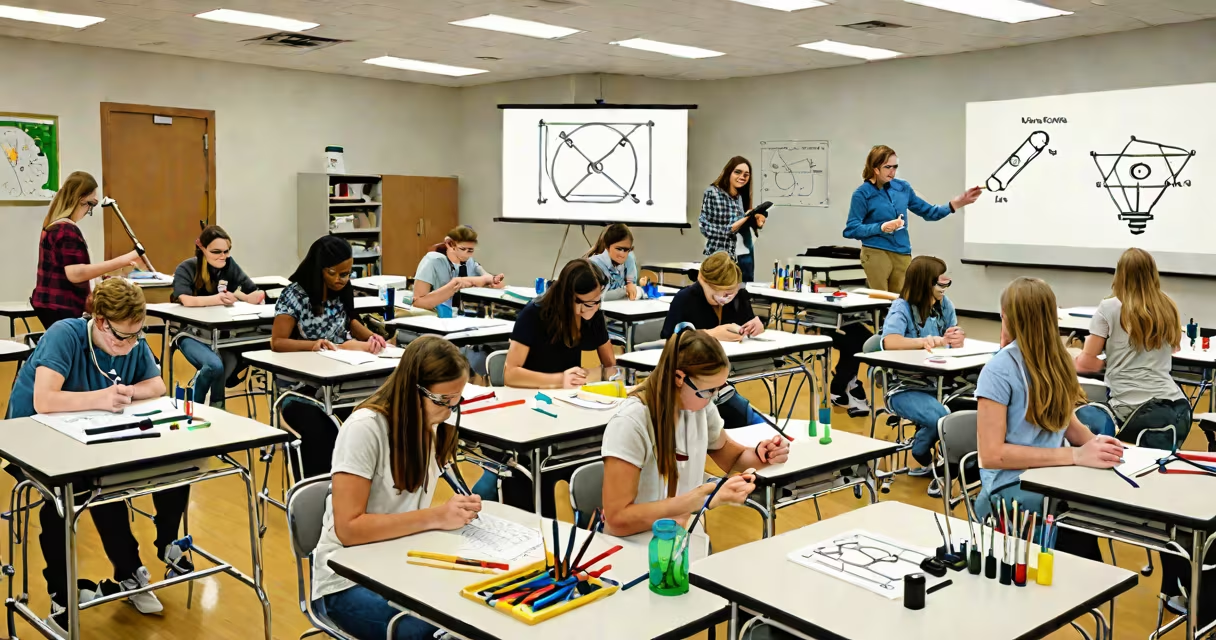
The Next Generation Science Standards (NGSS) are a set of K-12 science education guidelines developed by a consortium of states and scientific organizations to improve science literacy through inquiry-based, three-dimensional learning. They define what students should know and be able to do in science by grade level, emphasizing real-world problem solving over rote memorization.
NGSS standards were released in 2013 after collaboration between the National Research Council, the National Science Teachers Association, and Achieve Inc., a nonprofit organization focused on education policy. The structure underlying NGSS was informed by research into how people learn science, including cognitive science and educational psychology findings from institutions like the University of California, Berkeley's Lawrence Hall of Science.
These standards are not federal law but have been adopted by 20 U.S. states and several territories as part of their state science curricula. States that adopt NGSS align their science assessments and teacher training programs around the structure, ensuring consistency in science instruction across districts.
NGSS replaces traditional science instruction-where students memorized facts and performed isolated labs-with a model based on three interconnected dimensions: disciplinary core ideas (DCIs), science and engineering practices (SEPs), and crosscutting concepts (CCCs).
Each standard combines all three dimensions. For example, a middle school standard requires students to "plan and conduct investigations to provide evidence that the changes in states of matter result from energy transfer." This integrates:
This integration ensures students don't just learn content-they apply it through experimentation, analysis, and explanation. A student studying climate change doesn't just read about greenhouse gases; they analyze atmospheric CO₂ data, model heat retention in sealed containers, and explain patterns using physical principles.
Performance tasks in NGSS classrooms often require students to design solutions, interpret data, and defend conclusions. For instance, a 5th-grade class might build a prototype water filter using household materials, test it with muddy water, and present results using graphs and written explanations-all aligned to specific NGSS standards.
NGSS standards are organized by grade band: K-2, 3-5, 6-8, and 9-12. Each band includes three sets of standards:
| Dimension | Description | Example |
|---|---|---|
| Disciplinary Core Ideas (DCIs) | Foundational science concepts in life, physical, and earth/space sciences. | HS-ESS2-2: Analyze geoscience data to make evidence-based forecasts of future climate conditions. |
| Science and Engineering Practices (SEPs) | Skills scientists and engineers use: asking questions, modeling, analyzing data. | HS-PS3-4: Plan and conduct investigations to determine the relationships among energy transferred, the type of matter, and the change in temperature. |
| Crosscutting Concepts (CCCs) | Overarching themes linking different science disciplines: cause and effect, systems and system models. | HS-LS2-7: Design solutions to reduce human impact on ecosystems using systems thinking. |
Each standard is labeled with a unique identifier. For example, MS-PS1-3 refers to Middle School Physical Science Standard 1, Performance Expectation 3. These identifiers allow teachers, publishers, and state departments to track alignment across curricula.
A common misconception is that NGSS standards are only for STEM-focused schools. In reality, they're designed for all students, including those in under-resourced districts. The structure emphasizes accessibility through phenomena-based learning-using observable events like weather patterns or plant growth to anchor lessons, reducing reliance on expensive equipment.
States such as California, New York, and Massachusetts have fully integrated NGSS into their public school science curricula. In California, NGSS-aligned assessments replaced the old STAR test in 2019. By 2023, over 80% of public middle schools reported using NGSS-aligned instructional materials.
Classroom implementation varies. Some schools use project-based units lasting weeks, while others integrate NGSS elements into daily lessons. A high school biology teacher in Colorado redesigned her unit on evolution to center on fossil evidence and genetic variation in populations. Students collected data from museum databases, modeled allele frequencies, and debated evolutionary mechanisms-skills assessed via NGSS performance tasks.
One non-obvious fact: NGSS standards are not tied to a single textbook or publisher. While many publishers offer NGSS-aligned materials, the standards themselves are open-source and free to access. The official NGSS website (ngss.org) hosts all standards, sample lesson plans, and implementation guides.
Another key point: NGSS does not eliminate content knowledge-it restructures it. Students still learn about atoms, ecosystems, and forces-but they do so through inquiry. For example, rather than memorizing Newton's laws, students test how mass affects acceleration using toy cars and ramps, then explain their results using scientific terminology.
Many educators initially assume NGSS standards require abandoning textbooks entirely. That's incorrect. Textbooks are still used, but they serve as reference tools-not primary sources of instruction. A 7th-grade science teacher in Texas uses a textbook to introduce vocabulary but designs lab activities based on NGSS performance expectations.
Another confusion: NGSS is sometimes mistaken for Common Core math and English Language Arts standards. While both are national frameworks, they differ in purpose. Common Core focuses on literacy and numeracy across subjects. NGSS is exclusively science-focused and includes engineering components absent in Common Core.
There's also a myth that NGSS reduces rigor. Research from the American Educational Research Association shows that students taught under NGSS frameworks score higher on science reasoning assessments than peers taught traditionally. A 2021 study published in Journal of Research in Science Teaching found that NGSS-trained students outperformed control groups in identifying causal relationships in complex systems.
Finally, NGSS is not a curriculum. It's a standard. Curriculum developers, school districts, and teachers create the actual lesson plans, assessments, and materials. This allows local flexibility while maintaining national coherence.
I observed a 9th-grade NGSS-aligned physics class in a suburban Maryland high school. The unit began with a video of a car crash simulation. Students were asked: "Why did the dummy move forward?" They generated hypotheses, then tested them using carts, ramps, and motion sensors. Data collected showed that velocity increased with ramp height-a direct link to Newton's first law.
Students then applied the concept to seatbelt safety. They calculated stopping distances and discussed how inertia affects passengers. The final task involved designing a prototype seatbelt mechanism using rubber bands and plastic frames. The project scored against NGSS criteria: students had to explain their design using scientific principles and justify choices with data.
That class met all three dimensions: DCI (forces and motion), SEP (designing and testing), CCC (cause and effect). It wasn't just science-it was problem-solving, collaboration, and communication.
What is NGSS standards? They are a nationally coordinated structure for science education that shifts focus from memorization to understanding through integrated, real-world learning. They define science proficiency not by recall, but by ability to investigate, explain, and innovate.