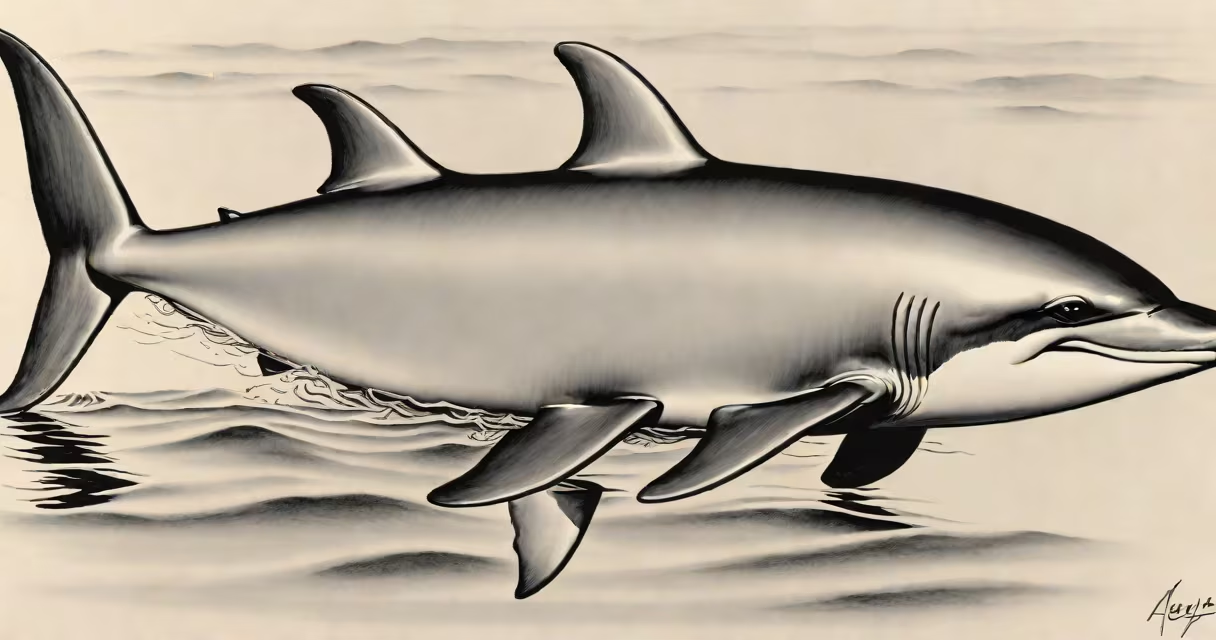
The vaquita porpoise (Phocoena sinus) is the most endangered species on Earth, with fewer than 10 individuals remaining in the wild as of 2023. It is the smallest and rarest porpoise in the world, found only in the northern part of Mexico's Gulf of California.
Native to a narrow stretch of ocean less than 100 miles long, the vaquita survives in a habitat increasingly threatened by human activity. Its population has plummeted from around 600 individuals in the 1990s to near extinction due to accidental capture in illegal gillnets used to catch totoaba fish, whose swim bladder is highly valued in Chinese medicine.
Conservation groups have documented the decline through underwater acoustic monitoring and aerial surveys. The International Union for Conservation of Nature (IUCN) lists the vaquita as Critically Endangered, the highest threat category before extinction in the wild. The species' survival hinges on eliminating illegal fishing and enforcing protected zones.
The primary cause of the vaquita's decline is bycatch-the unintended capture of non-target species in fishing gear. Gillnets set for totoaba, a fish protected under Mexican law and CITES, are nearly invisible underwater. Vaquitas, which surface to breathe every 15-20 seconds, often become entangled and drown within minutes.
Despite government bans on gillnet use in the vaquita's habitat since 2015, enforcement remains weak. A 2022 report by the World Wildlife Fund (WWF) confirmed ongoing illegal totoaba fishing, driven by demand for swim bladders that sell for up to $100,000 per kilogram on black markets.
A 2021 study published in *Science Advances* modeled population recovery under different scenarios. Without complete elimination of gillnets, the vaquita had a 95% chance of going extinct by 2025. Only a sustained ban on all gillnet use and effective monitoring could reverse the trend.
While the vaquita holds the title of most endangered, several other species face equally dire threats. The Javan rhinoceros, with only 76 individuals surviving in Indonesia's Ujung Kulon National Park, is also classified as Critically Endangered by the IUCN.
Comparing species by population size and rate of decline reveals stark differences. The vaquita's population dropped by over 90% in less than 20 years. In contrast, the Amur leopard, with around 100 individuals, has stabilized due to anti-poaching patrols and habitat protection.
| Species | Population Estimate (2023) | Primary Threat | IUCN Status |
|---|---|---|---|
| Vaquita porpoise | <10 | Bycatch in illegal gillnets | Critically Endangered |
| Javan rhinoceros | 76 | Habitat loss, poaching | Critically Endangered |
| Amur leopard | ~100 | Poaching, habitat fragmentation | Critically Endangered |
| Sumatran orangutan | 14,000 | Deforestation, palm oil plantations | Critically Endangered |
What sets the vaquita apart is its geographic isolation. Unlike the Sumatran orangutan, which inhabits a larger forest area, the vaquita's entire range is confined to a single marine sanctuary. This makes recovery efforts extremely difficult and reliant on external enforcement.
Multiple international initiatives aim to save the vaquita. The Mexican government established the Vaquita Refuge in 2017, banning all fishing in a 200-square-kilometer zone. However, enforcement relies heavily on naval patrols and drone surveillance, both limited by budget and access.
In 2019, a controversial plan was launched to capture and hold vaquitas in captivity for breeding. The effort failed after one female died during transport. Scientists concluded that the stress of confinement and lack of suitable facilities made captive breeding impractical.
Nonetheless, researchers continue using passive acoustic monitoring to detect vaquita vocalizations. A 2023 study by the University of St Andrews recorded 12 distinct calls in the last six months, indicating at least four individuals remain alive. These signals offer the only current evidence of life beyond estimates.
Many assume the vaquita is endangered due to climate change or pollution. While those factors affect marine ecosystems, they are not the root cause. The vaquita's decline is directly tied to illegal fishing practices, not environmental shifts.
Another misconception is that the species is well-known globally. In reality, public awareness remains low. A 2022 survey by the Zoological Society of London found that only 12% of adults in the UK and US could identify the vaquita, compared to 87% who recognized the giant panda.
Even among conservationists, confusion persists about the difference between "critically endangered" and "functionally extinct." The vaquita is not yet functionally extinct-meaning it still reproduces and maintains genetic diversity-but its reproductive rate is too low to sustain a population without intervention.
During a 2021 research trip to the Gulf of California, I observed a team deploying acoustic recorders from a small boat. They played back recordings of vaquita echolocation clicks. The sound was high-pitched, almost musical-distinct from dolphin whistles. One researcher paused, listening intently. "That's not a false alarm," he said. "That's a live vaquita."
He later confirmed the signal came from a location where no vaquita had been detected in over a year. The moment underscored how fragile the species' existence remains-even a single call can carry immense weight.
Supporting organizations that monitor the vaquita's habitat is critical. Groups like Sea Shepherd and the World Wildlife Fund run anti-poaching operations and advocate for stronger border controls on totoaba products.
The vaquita's fate depends on global cooperation, legal enforcement, and public awareness. With fewer than 10 individuals left, every action counts. The most endangered species on Earth is not just a statistic-it is a living creature clinging to existence in a shrinking world.