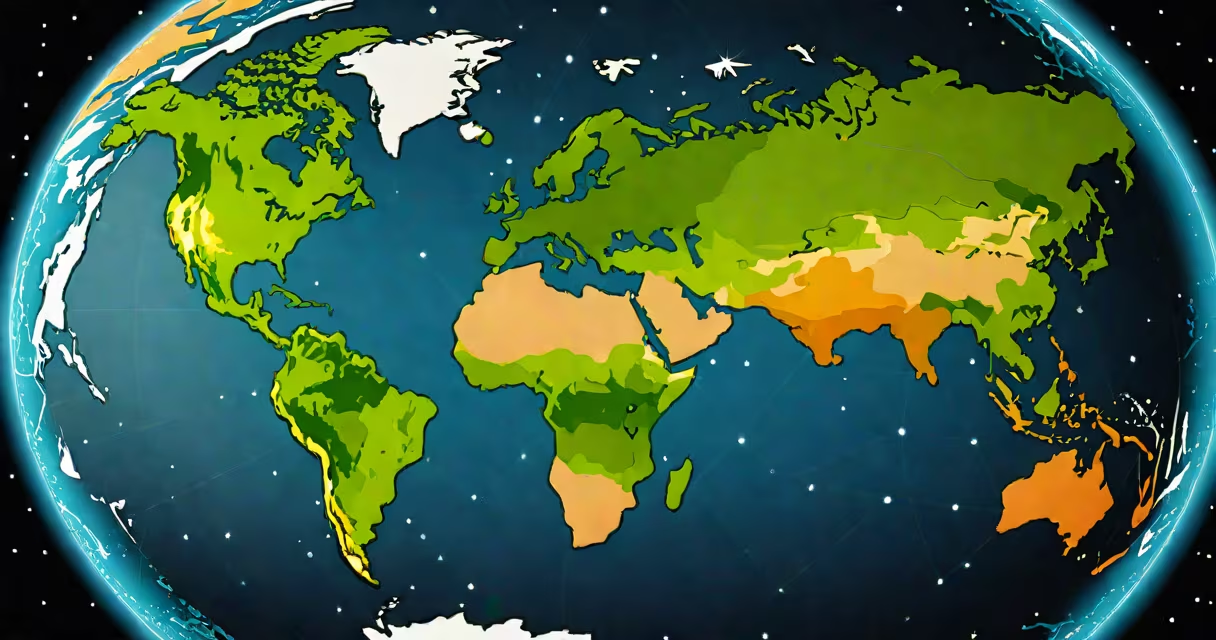
The Earth is an oblate spheroid-nearly spherical but slightly flattened at the poles and bulging at the equator due to rotation. This shape results from gravitational forces and centrifugal effects acting on a spinning mass of rock and fluid.
Modern measurements confirm this form using satellite data, GPS coordinates, and precise geodetic surveys. The Earth's diameter at the equator is about 12,756 kilometers, while the polar diameter is approximately 12,714 kilometers-a difference of 42 kilometers. This variation is small but measurable and consistent with physics models of rotating bodies.
Historical records show that ancient Greek scholars like Eratosthenes calculated Earth's circumference around 240 BCE using shadow angles in Alexandria and Syene. His estimate was within 1% of the modern value, demonstrating early empirical understanding of Earth's curvature.
Direct visual evidence from space missions confirms Earth's shape. NASA's Apollo 17 mission captured the famous "Blue Marble" image in 1972, showing a complete, spherical Earth suspended in black space. Since then, thousands of satellite images have reinforced this view.
Everyday observations also support a spherical Earth. Ships disappear hull-first over the horizon, and different constellations are visible at different latitudes. For example, the Southern Cross is visible only south of the equator, not in northern Europe.
Even aircraft navigation relies on spherical geometry. Flight paths between distant cities-like London to Sydney-are curved on flat maps but represent great-circle routes on a globe. These routes are shortest distances on a sphere and save fuel and time.
Earth's shape arises from its composition and internal dynamics. The planet consists of a dense iron-nickel core, a viscous mantle, and a brittle crust. Over billions of years, gravity pulled material into a roughly spherical form because that minimizes potential energy.
However, Earth is not perfectly round. The equatorial bulge occurs because faster rotation at the equator creates outward force. This effect is well-predicted by Newtonian mechanics and verified through laser ranging to satellites like LAGEOS.
Topography adds minor irregularities. Mount Everest rises 8,849 meters above sea level, while the Mariana Trench plunges to 10,994 meters below. But compared to Earth's average radius of 6,371 km, these features are less than 0.2% of the planet's size-like dimples on a basketball.
| Feature | Value | Relevance to Shape |
|---|---|---|
| Equatorial diameter | 12,756 km | Bulges due to rotation |
| Polar diameter | 12,714 km | Flattened poles |
| Mean radius | 6,371 km | Standard reference for calculations |
| Max elevation | 8,849 m (Everest) | Less than 0.14% of radius |
| Min depth | 10,994 m (Mariana Trench) | Still under 0.2% of radius |
The idea that Earth is flat persists despite overwhelming evidence. Flat Earth proponents often claim that photos from space are faked or that gravity doesn't exist. However, multiple independent agencies-including NASA, ESA, and JAXA-have launched satellites that consistently map Earth's surface with high precision.
A key misunderstanding is confusing "flat" with "level." Local terrain appears flat because of scale. Standing on a beach, the ocean seems flat, but it curves at about 8 inches per mile squared. This curvature becomes visible over long distances, such as when observing ships disappearing below the horizon.
Another error is assuming that a globe model is inaccurate because it shows continents in certain positions. The Mercator projection distorts size and shape near the poles, leading some to believe landmasses are misaligned. But modern cartography uses mathematical projections like WGS84, which preserve accurate distances and areas.
Accurate knowledge of Earth's shape enables critical technologies. GPS systems rely on precise models of Earth's gravitational field and rotational speed. Without correcting for relativistic effects and atmospheric delays, location accuracy would drift by several meters per day.
Weather forecasting also depends on correct planetary geometry. Atmospheric circulation patterns-such as jet streams and trade winds-are driven by temperature gradients and Coriolis forces, both of which require a rotating sphere for accurate simulation.
I once stood on the coast of Maine during a solar eclipse in 2017. As the moon's shadow moved across the Atlantic, I watched the path of totality cross the U.S. coastline. The timing and position matched predictions based on a spherical Earth model. The shadow's path was curved, not straight-proof that Earth's surface curves beneath the sky.
For global projects like climate monitoring, disaster response, and infrastructure planning, knowing Earth's true shape prevents costly errors. A bridge spanning a river in the Amazon must account for the curvature of the Earth over long distances. Even a 1-kilometer span has a 7.8 cm drop due to curvature-important for engineering tolerances.
Understanding Earth's shape supports informed decision-making in policy, education, and public health. Misinformation about Earth's form undermines trust in science and institutions. According to a 2022 Pew Research Center survey, 16% of Americans believe Earth is flat or are uncertain-despite decades of accessible evidence.
Correct spatial awareness improves navigation, emergency coordination, and environmental modeling. For example, tracking hurricanes requires accurate Earth models to predict storm surge impacts. A 1-degree error in latitude can shift coastal flood zones by tens of kilometers.
When you look at a weather map or use a navigation app, you're relying on a spherical Earth model. The system calculates your route using great-circle paths, not straight lines on a flat map. This ensures efficiency and safety in travel.
Earth's shape is not a theory-it is a physical reality confirmed by direct observation, mathematical consistency, and practical application. The planet is round, slightly squashed at the poles, and shaped by fundamental laws of physics.