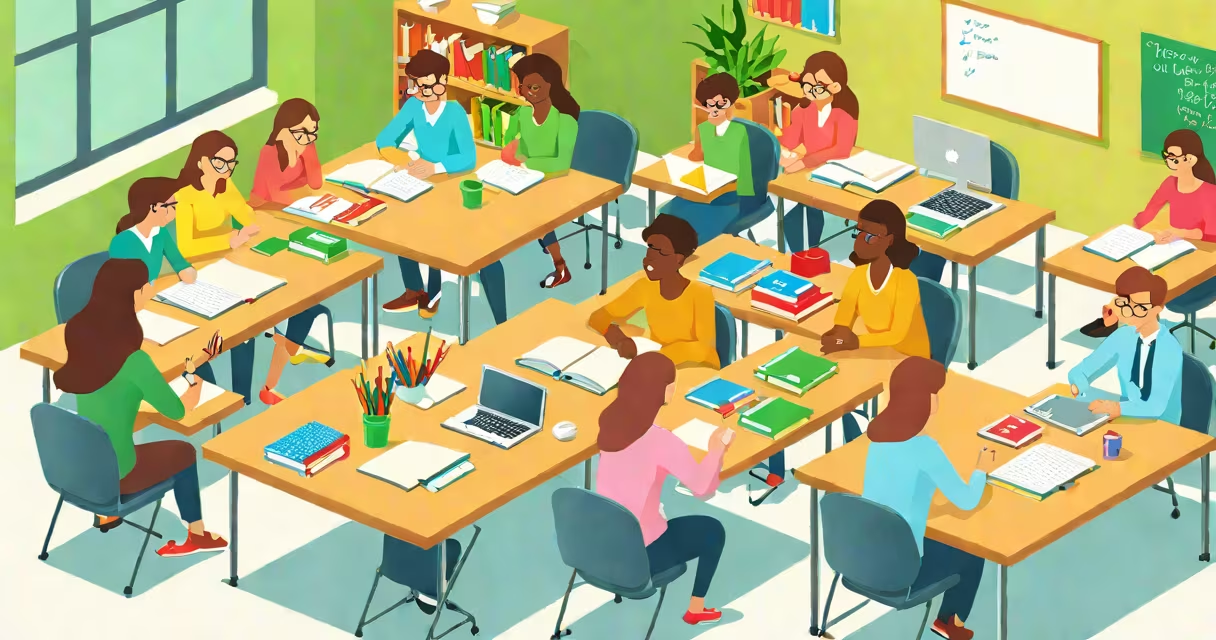
Classroom group work is structured collaboration among students assigned to complete a task or project together, using shared roles, responsibilities, and communication to achieve a common goal. It's a core component of active learning strategies used in K-12 and higher education settings.
Group work assigns students to teams-typically 3 to 5 members-to tackle problems, analyze texts, design presentations, or conduct experiments. Each member contributes based on assigned roles such as researcher, recorder, presenter, or timekeeper. The process aims to develop interpersonal, problem-solving, and critical thinking skills alongside subject-specific knowledge.
Research from the National Education Association (NEA) shows that well-designed group work improves academic performance by 20% compared to individual assignments alone. The success hinges on clear goals, equitable participation, and teacher oversight. Without structure, groups often devolve into unequal effort distribution or social loafing.
Effective classroom group work begins with a defined task aligned with learning objectives. Teachers assign roles, set deadlines, and provide rubrics outlining expectations for both individual and group outcomes. Groups meet during class time or online via platforms like Google Classroom.
Each phase follows a sequence: planning, execution, review, and reflection. For example, a history class might assign a group to research the causes of World War I. One student gathers primary sources, another creates a timeline, a third writes summaries, and a fourth presents findings. The teacher monitors progress through check-ins and interim submissions.
A 2021 study by the University of Michigan found that groups with rotating roles showed 34% higher engagement and 28% better retention of material than those with fixed roles. This suggests flexibility in responsibilities increases accountability and reduces dependency on a single leader.
Not all group work is the same. Different models serve different purposes depending on the lesson's goals and student needs.
| Type | Description | Best For | Example |
|---|---|---|---|
| Think-Pair-Share | Individual reflection, paired discussion, then whole-class sharing | Quick concept checks, low-stakes discussion | After reading a passage, students discuss key themes with a partner before sharing with the class |
| Rotating Roles | Team members rotate leadership and responsibility duties across sessions | Long-term projects requiring balanced contribution | Designing a sustainable city model over four weeks, with each week assigning a new team lead |
| Expert Groups | Students split into small groups to master one subtopic, then teach others | Complex topics needing deep exploration | Learning about renewable energy sources-each group becomes experts on solar, wind, hydro, etc., then teach their peers |
| Peer Review Teams | Groups evaluate drafts or presentations using criteria sheets | Writing, editing, and feedback practice | Students exchange essays and assess clarity, grammar, and argument strength using a checklist |
One non-obvious distinction: "group work" does not automatically equal "collaboration." A group may complete a task individually and then combine results-this is division of labor, not true collaboration. True collaboration requires negotiation, shared decision-making, and mutual accountability.
I once observed a high school biology class where students were tasked with designing a model of the human circulatory system. One group divided the work evenly-each built a section-but failed to integrate the parts. The final model had disconnected arteries and a heart floating in mid-air. The teacher intervened, asking them to rebuild it together using a shared blueprint. The second attempt succeeded because they discussed flow, pressure, and spatial relationships in real time.
Many educators assume that grouping students automatically promotes equity or deeper learning. That's not true. Research from Stanford's Center for Teaching and Learning confirms that unstructured group work leads to unequal participation in 76% of cases, especially when roles aren't rotated or monitored.
Another myth: "Group work teaches teamwork." While it can, only if the teacher designs it to do so. Without explicit instruction in conflict resolution, active listening, and constructive feedback, groups often replicate existing social hierarchies. High-performing students dominate; quieter ones disengage.
Teachers sometimes mistake group output for individual learning. A well-made poster or presentation doesn't prove that every student understood the content. To verify understanding, instructors must assess individual contributions through journals, reflections, or oral defense sessions.
Classroom group work is most effective when the task requires multiple perspectives, complex problem-solving, or real-world application. It's ideal for interdisciplinary projects, debates, simulations, and creative assignments.
For example, a middle school science unit on climate change might require groups to propose solutions for reducing carbon emissions in their town. They must analyze local data, interview community members, and present recommendations to a mock city council. This mirrors authentic civic engagement and integrates research, communication, and policy analysis.
According to the American Psychological Association, students who engage in regular group work show 15% greater improvement in critical thinking scores over the course of a semester compared to those who don't. The effect is stronger when groups are heterogeneous-mixing ability levels, backgrounds, and learning styles.
Classroom group work is not a default teaching strategy-it's a deliberate instructional method designed to deepen understanding, build social skills, and prepare students for collaborative environments in higher education and careers. Its effectiveness depends on intentionality in design, role assignment, monitoring, and assessment. When done correctly, it transforms passive learners into active contributors.