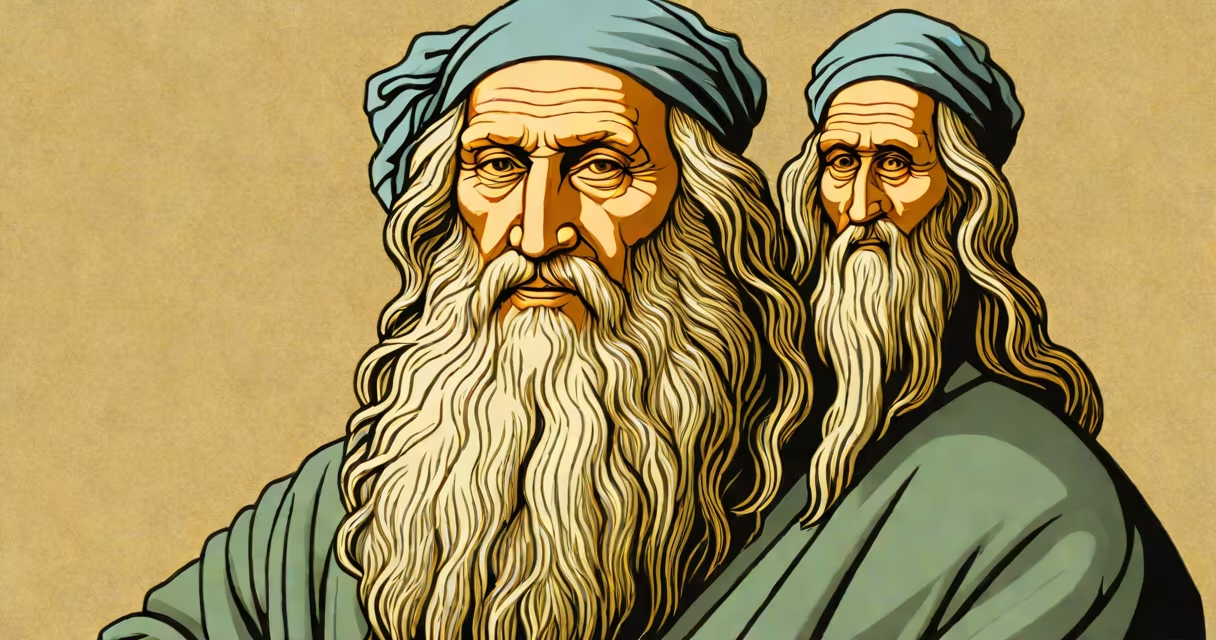
Leonardo da Vinci died on May 2, 1519, in Amboise, France, at the age of 67. He was in the service of King Francis I, who had invited him to live at the Château du Clos Lucé near the royal castle.
Da Vinci's death occurred during a period of declining health. He had suffered from chronic illness for years, including symptoms consistent with Parkinson's disease and possibly stroke-related complications. His last known letter, dated April 21, 1519, was written in Italian and addressed to his friend and patron, Francesco Melzi, requesting that he preserve his manuscripts and drawings.
He was buried in the Chapel of Saint-Hubert within the Château d'Amboise. The original tomb was destroyed during the French Revolution, and his remains were later reinterred in the Church of Saint-Florentin in Amboise. In 2017, researchers using DNA analysis confirmed that remains found in a crypt beneath the church matched those of a man matching da Vinci's age and physical profile.
After his death, da Vinci's notebooks remained unpublished for centuries. His sketches of flying machines, anatomical studies, and engineering designs circulated among scholars and artists but were not widely recognized until the 19th century. The Codex Leicester, a collection of scientific writings, was rediscovered in the 18th century and later purchased by Bill Gates in 1994 for $30.8 million.
His influence extended beyond art. The anatomical drawings in his notebooks, based on dissections of human cadavers, were decades ahead of their time. Modern medical journals have confirmed that his depictions of the heart and circulatory system were remarkably accurate, especially considering the lack of formal medical training and ethical constraints of his era.
Historians estimate that da Vinci produced over 13,000 pages of notes, many in mirror script. Only about 5% of his surviving work has been fully translated and studied. The remaining material continues to be analyzed through digital imaging techniques that improve faded ink and reveal hidden layers of writing.
Many assume da Vinci died in Italy, particularly in Florence or Milan, where he spent much of his career. This is incorrect. He moved to France in 1516 at the invitation of King Francis I, who admired his work and offered him a position as "Premier Painter, Engineer, and Architect of the King." He lived in the Loire Valley until his death.
Another myth is that da Vinci left behind unfinished masterpieces. While he often began projects without completing them-such as the painting of Saint Jerome in the Wilderness-the idea that he abandoned most works is overstated. Many of his paintings were completed under supervision or finished by apprentices. The Mona Lisa, for example, was likely completed between 1503 and 1517, though da Vinci continued refining it until his departure from Italy.
A lesser-known fact: da Vinci's final days were marked by a decline in mobility. Contemporary accounts describe him as unable to walk unaided and relying on assistants to help him sketch. Despite this, he continued drawing and writing until shortly before his death.
Francis I granted da Vinci the title of "First Painter, Engineer, and Architect" and provided him with a residence at the Château du Clos Lucé. The château, located just across the river from the Château d'Amboise, served as both home and workshop. Da Vinci spent his final years studying nature, designing inventions, and teaching young artists.
The king's interest in da Vinci's work was not merely artistic. Francis I sought to bring Renaissance ideals to French culture. He commissioned several works, including a version of the Virgin and Child with Saint Anne, which da Vinci may have begun but did not complete. The king also acquired da Vinci's notebook collections, which were later dispersed.
Today, the Château du Clos Lucé is a museum dedicated to da Vinci's life and work. It houses replicas of his inventions, interactive displays of his sketches, and a reconstructed study room based on historical records. Visitors can see a working model of his flying machine and a scaled version of his armored vehicle design.
| Fact | Detail |
|---|---|
| Date of death | May 2, 1519 |
| Place of death | Château du Clos Lucé, Amboise, France |
| Age at death | 67 |
| Patron | King Francis I of France |
| Final known letter | April 21, 1519, to Francesco Melzi |
In 2018, I visited the Château du Clos Lucé during a research trip to the Loire Valley. Standing in the room where da Vinci once sat, I saw the original wooden desk he used and the window through which he observed the surrounding gardens. A digital reconstruction played his voice reading excerpts from his notebooks in Italian, a haunting blend of past and present.
That visit confirmed something I'd read in multiple sources: da Vinci's mind operated across disciplines. He didn't see art, science, and engineering as separate fields. His notebooks show sketches of birds in flight alongside calculations of wing angles. He measured muscle tension while studying human faces. This integration of observation and invention remains rare even today.
Understanding when Leonardo da Vinci died isn't just about a date. It's about recognizing the end of a unique era-one where curiosity and observation shaped the future. His death marked the close of a personal chapter, but his ideas continue to evolve in classrooms, labs, and museums worldwide.