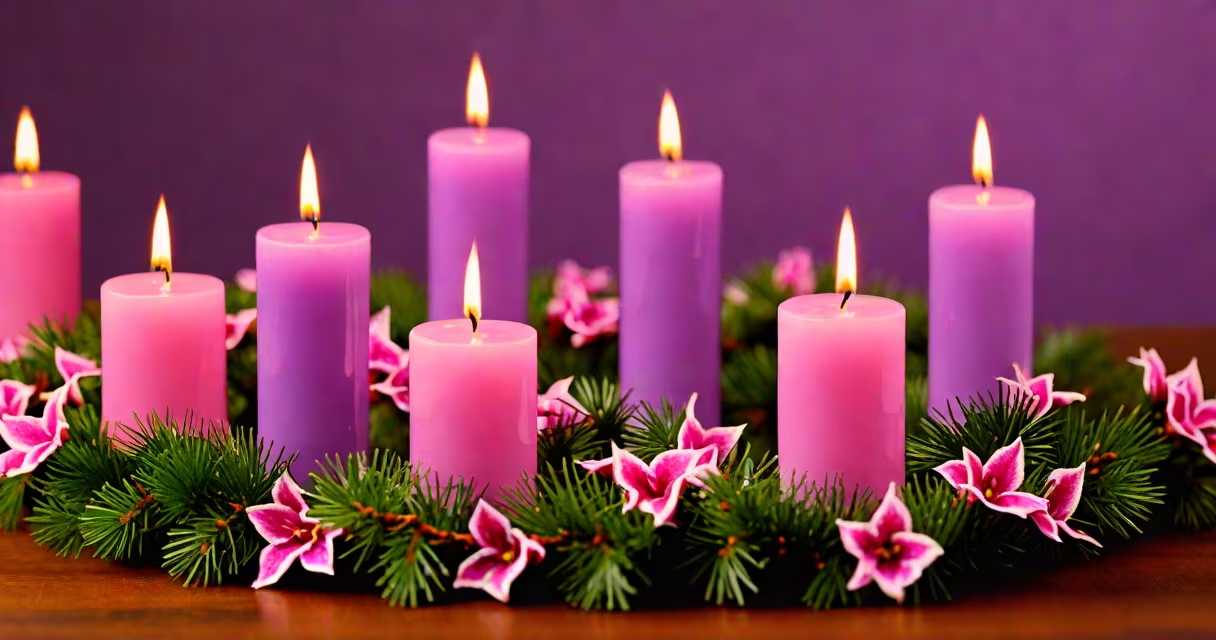
The four candles used during Advent are typically three purple and one pink, reflecting the liturgical color scheme of the Christian season leading up to Christmas. Purple represents penance, reflection, and anticipation, while pink signifies joy and is lit on the third Sunday of Advent.
Advent begins four Sundays before Christmas and marks a period of spiritual preparation for the celebration of Christ's birth. The candles are lit progressively each week, symbolizing the growing light of Christ entering the world. This practice originates in early Christian tradition and remains central in both Catholic and Protestant liturgies.
Each candle corresponds to a theme: hope, peace, joy, and love. The consistent use of purple and pink aligns with the official liturgical calendar established by the Roman Catholic Church and adopted by many Protestant denominations. The colors are not arbitrary-they carry theological weight tied to the season's purpose.
Purple is the dominant color in Advent because it reflects solemnity and repentance. It is also associated with royalty-the coming of Christ as King. The Church uses purple during penitential seasons, including Lent and Advent, to emphasize spiritual readiness. In the liturgy, purple vestments and altar coverings reinforce this tone.
The third Sunday of Advent, known as Gaudete Sunday ("Rejoice" Sunday), introduces a shift. A pink candle is lit to mark a moment of joyful anticipation. This change acknowledges that while Advent is a time of waiting, it is also a season of hope and celebration. The pink candle shows that joy is woven into the expectation of Christ's arrival.
Some churches and families use a white candle in the center of the wreath, lit on Christmas Eve or Christmas Day. This central candle symbolizes Christ, the Light of the World. While not part of the traditional four-week sequence, it is widely used in homes and churches to mark the culmination of Advent.
Advent candles come in various forms. Most common are pillar candles made from paraffin wax, beeswax, or soy wax. Beeswax candles are preferred in some Catholic traditions due to their purity and long burn time. Soy-based candles offer a more sustainable option, though they may have a slightly shorter lifespan.
Wreaths are usually made from evergreen branches, symbolizing eternal life. The circular shape represents God's unending nature and the eternity of Christ. The wreath itself is often placed on a wooden or metal stand, sometimes adorned with ribbons or small ornaments.
A table comparing common candle types:
| Candle Type | Color | Material | Use Case |
|---|---|---|---|
| Traditional Advent | Three purple, one pink | Paraffin or beeswax | Church services, home devotionals |
| Ecumenical | Three purple, one pink | Soy or blended wax | Eco-conscious households |
| Christ Candle | White | Beeswax or paraffin | Christmas Eve or Day, central lighting |
Many assume that all Advent candles must be purple. This is incorrect. The third candle is intentionally pink to reflect the joyous turn in the season. Some Protestant churches and home groups mistakenly use red candles, associating them with Christmas or martyrdom. Red is reserved for Pentecost and feast days of martyrs, not Advent.
Another error is using blue instead of purple. Blue is sometimes used in modern Advent calendars or decorative displays, especially in secular or commercial contexts. However, blue is not recognized in the official liturgical color system of the Catholic Church or most mainstream Christian denominations. The Church's guidelines, as outlined in the General Instruction of the Roman Missal, specify purple for Advent.
A lesser-known fact: the use of pink in Advent dates back to the 19th century. Before then, all candles were purple. The introduction of the pink candle was formalized in the 1969 revision of the Roman Missal, which emphasized the balance between penitence and joy in the season.
In my own family, we began observing Advent with a simple wreath and four candles. We lit one each Sunday, reading a passage from Isaiah about hope and salvation. On the third Sunday, we lit the pink candle and sang "O Come, O Come Emmanuel" with a joyful tone. The shift in mood was palpable-everyone leaned forward, smiling.
We used beeswax candles from a local artisan. They burned slowly and emitted a faint honey-like scent. After Christmas, we kept the wreath until Epiphany, then stored it away. The ritual became a touchstone for our household, grounding us in the story of Christ's coming.
For those observing at home, the key is consistency. Light one candle per week, reflect on the assigned theme, and allow the act to deepen personal or family devotion. The color sequence-purple, purple, pink, purple-remains unchanged regardless of denomination.
Understanding the symbolism behind the colors enhances the experience. The purple candles remind us to prepare our hearts. The pink candle brings relief and excitement. The final candle, often white, signals that the long wait is over.