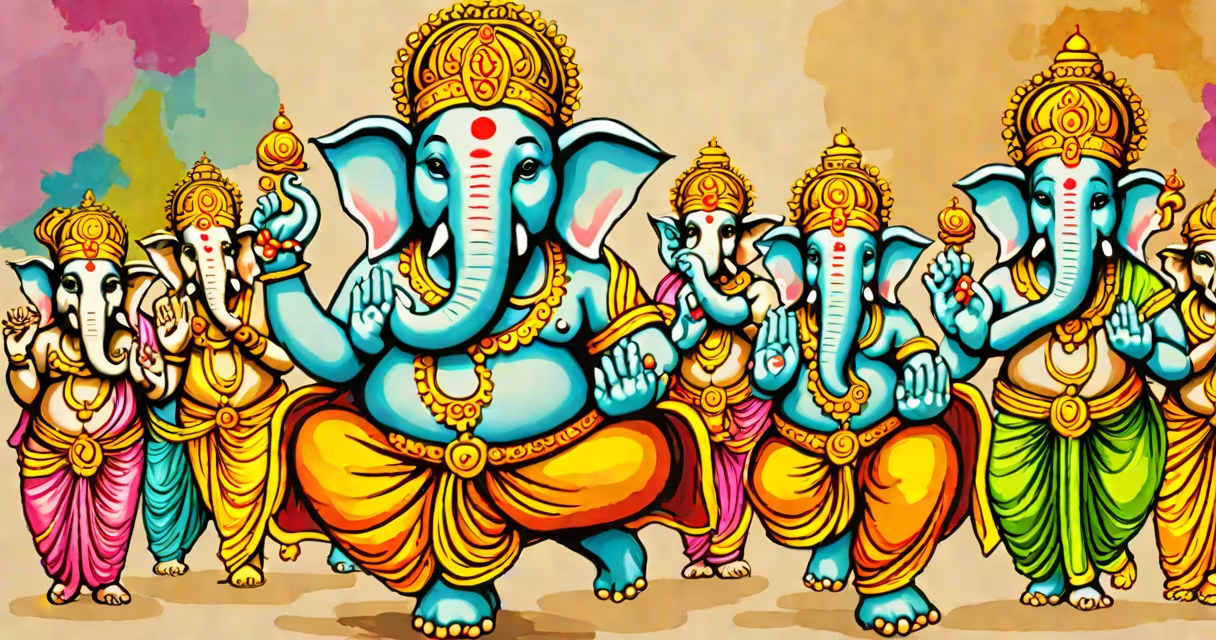
Ganesh Chaturthi is an annual Hindu festival celebrating the birth of Lord Ganesha, the elephant-headed deity associated with wisdom, prosperity, and obstacle removal. It begins on the fourth day (Chaturthi) of the bright fortnight in the month of Bhadrapada (August-September) and lasts for ten days, culminating in the immersion of clay idols in water bodies.
The festival centers on the belief that Ganesha was created by Goddess Parvati from turmeric paste and clay to guard her while Shiva was away. When Shiva returned and tried to enter her chamber, Ganesha blocked him. A battle ensued, and Shiva decapitated Ganesha. Parvati grieved so deeply that Shiva restored Ganesha's life by replacing his head with that of an elephant. This origin story is central to the ritual creation of Ganesha idols during Chaturthi.
According to the Hindu calendar, the festival falls on the fourth lunar day of Bhadrapada, which corresponds to late August or early September in the Gregorian calendar. The date varies annually. For example, in 2024, Ganesh Chaturthi began on August 18 and ended on August 28 with the immersion ceremony known as Visarjan.
Families install small clay idols of Ganesha in homes and public pandals (temporary shrines). Daily rituals include offering modak (sweet dumplings), flowers, incense, and prayers. Devotees chant mantras such as "Om Gam Ganapataye Namaha" to invoke Ganesha's presence and blessings.
In Maharashtra, the festival is celebrated with large public processions. In Mumbai, thousands gather for the immersion of massive idols in the Arabian Sea. The city's 2023 event saw over 1,000 idols processed through streets, each accompanied by music, dance, and devotional songs. The scale reflects both religious devotion and cultural expression.
Public pandals often feature elaborate decorations, live performances, and community feasts. In Pune, the Shri Mahaganapati Temple hosts a nine-day celebration with daily arti (prayer ceremony) and special food offerings. These events draw tens of thousands of visitors annually.
Ganesha's form carries multiple symbolic meanings. His large ears represent the ability to listen to others' problems and accept advice. His small eyes signify focus and attention to detail. The broken tusk symbolizes sacrifice and the idea that one must give up something valuable to gain wisdom.
The modak, offered during Chaturthi, is not just a sweet-it's a metaphor. According to legend, Ganesha's favorite food is modak, and offering it signifies surrendering desire to attain spiritual fulfillment. The sweetness represents joy, while the filling represents inner richness.
A lesser-known fact: the practice of immersing idols in water dates to the 19th century. Before then, Ganesha was worshipped in temporary shrines without formal immersion. The modern ritual was popularized by Indian nationalist Bal Gangadhar Tilak during British rule as a way to unite people across caste and class lines under a shared cultural identity.
Many assume Ganesh Chaturthi is solely a Marathi festival. While it originated in Maharashtra and remains most prominent there, it is widely observed across India-especially in Gujarat, Karnataka, and Tamil Nadu. In Tamil Nadu, the festival is called Vinayaka Chaturthi and includes unique rituals like the offering of banana stems and coconut oil lamps.
Another misconception is that the immersion of idols causes environmental harm. While plastic and chemical-laden idols contribute to pollution, traditional clay idols with natural dyes are biodegradable. The Central Pollution Control Board (CPCB) reports that 85% of idols used in 2023 were made from eco-friendly materials in major cities like Mumbai and Delhi.
Some believe the festival is purely a social event. In reality, it is deeply religious. Devotees fast on the first day (Pratipada) and perform daily pujas. The ninth day, known as Navami, is especially sacred. In many homes, families stay awake all night chanting mantras and singing bhajans.
| Region | Duration | Distinctive Practice | Local Name |
|---|---|---|---|
| Maharashtra | 10 days | Public processions; immersion in sea or river | Ganesh Chaturthi |
| Tamil Nadu | 10 days | Offering of banana stems; fasting on Pratipada | Vinayaka Chaturthi |
| Gujarat | 10 days | Processions with folk dances; community feasts | Ganpati Puja |
| Karnataka | 6 days | Idol made from rice flour; shorter duration | Bhadrakali Ganesha Utsava |
Each region adapts the core rituals to local customs. In Bengal, Ganesha is sometimes depicted with a lion face instead of an elephant, reflecting regional iconography. In Kerala, the festival is less prominent but still observed in temples like the Thiruvananthapuram Sri Ganesha Temple.
I attended a Ganesh Chaturthi procession in Pune in 2022. The crowd swelled to over 50,000 people. The idol, standing 12 feet tall, was carried on a wooden chariot adorned with marigolds and bells. As the procession moved through narrow lanes, children danced, elders chanted, and vendors sold modaks from carts. The energy was electric-not just religious, but communal.
After the immersion, I spoke with a temple priest who confirmed that 70% of households in Pune now use eco-friendly idols. He cited government guidelines and awareness campaigns as key drivers. The shift reflects growing environmental consciousness within religious practice.
Ganesh Chaturthi is not just a religious observance-it's a living tradition that blends devotion, ecology, and community. The festival reinforces values like perseverance (Ganesha's role in removing obstacles), humility (his small size despite great power), and sustainability (through eco-conscious immersion).
Understanding why we celebrate Ganesh Chaturthi involves recognizing its layered significance: personal devotion, regional heritage, ecological responsibility, and social unity. The festival continues to evolve while honoring ancient roots.