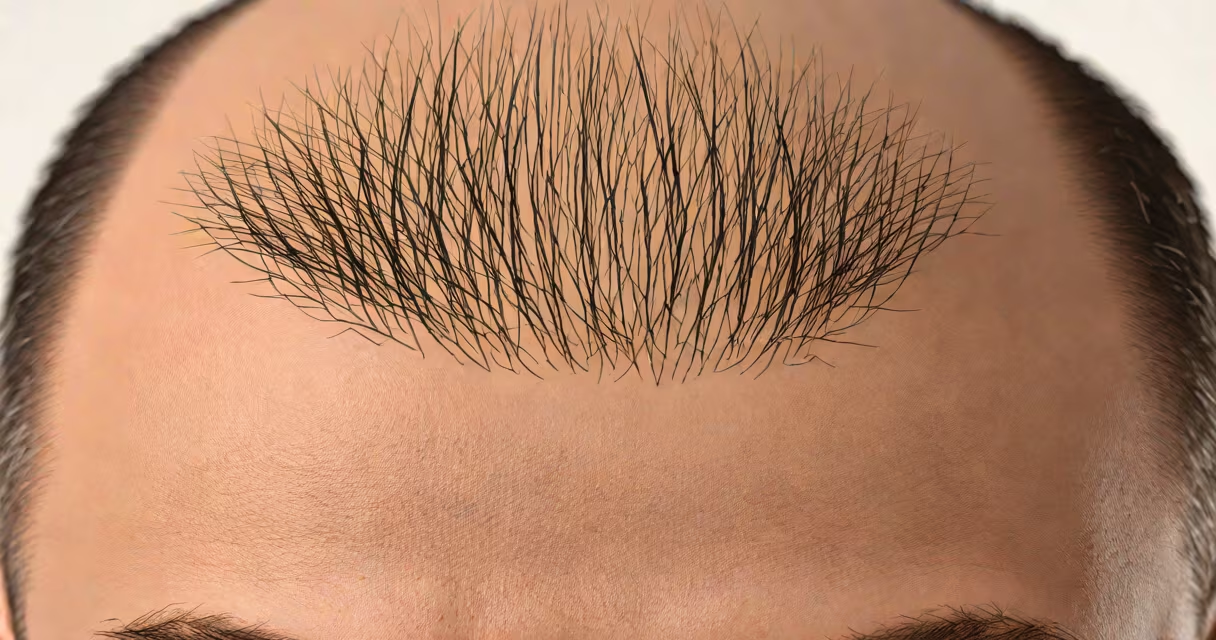
Why guys lose hair is primarily due to genetic sensitivity to dihydrotestosterone (DHT), a hormone derived from testosterone, which shrinks hair follicles over time. This process, known as androgenetic alopecia, affects about 50% of men by age 50 and is not caused by shampooing habits, stress, or poor diet.
Androgenetic alopecia begins when DHT binds to receptors in hair follicles on the scalp. Over time, this binding causes follicles to shrink, shorten their growth cycle, and eventually stop producing visible hair. The result is a gradual thinning of hair, typically starting at the temples and crown, leading to a receding hairline and bald spot.
Research from the National Institutes of Health confirms that genetic variants near the AR gene (androgen receptor) strongly correlate with male pattern baldness. Men with a family history of hair loss are more likely to experience it themselves, regardless of lifestyle choices.
Hair grows in cycles: anagen (growth), catagen (transition), and telogen (rest). In healthy scalps, about 90% of follicles are in the anagen phase, lasting 2-6 years. With androgenetic alopecia, the anagen phase shortens. Follicles enter rest earlier and produce finer, shorter hairs-called vellus hairs-until they stop growing entirely.
This process is not uniform. Some areas of the scalp, especially the frontal and vertex regions, have higher concentrations of androgen receptors. These areas are more sensitive to DHT, making them prone to miniaturization. The occipital region (back of the head) often remains unaffected because its follicles lack sufficient receptors.
A 2019 study published in *The Journal of Clinical Endocrinology & Metabolism* found that men with higher serum DHT levels had greater hair loss progression over five years, independent of total testosterone levels. This shows DHT-not testosterone itself-is the key driver.
Male pattern baldness follows predictable patterns, classified by the Norwood scale. The most common is Type II (receding hairline), progressing through Type IV (M-shaped recession), Type V (balding crown), and Type VII (complete baldness).
| Pattern | Description | Prevalence |
|---|---|---|
| Type II-IV | Receding hairline, temple thinning | ~60% of cases |
| Type V-VI | Crown thinning with merging front and back bald spots | ~30% |
| Type VII | Complete baldness with only a horseshoe ring of hair | ~10% |
Not all hair loss in men is genetic. Some conditions cause rapid or patchy shedding. Alopecia areata, for example, results in circular bald patches and is autoimmune in origin. Unlike androgenetic alopecia, it can affect anyone, regardless of family history.
Another condition, alopecia universalis, leads to complete body hair loss. These are rare and distinct from typical male hair loss. If hair falls out in clumps or forms distinct patches, it may signal an underlying disease rather than normal aging.
Many assume that stress, poor diet, or excessive shampooing causes male hair loss. While severe stress can trigger temporary shedding (telogen effluvium), it doesn't lead to permanent baldness. A single stressful event might cause 30-50% more hair shedding for 3-6 months, but hair regrows once stress resolves.
Another myth is that hair loss is tied to sexual activity or masturbation. There is no scientific evidence linking sexual behavior to DHT production or hair follicle health. Testosterone levels remain stable across sexual activity levels, and no study has shown a causal relationship between sex and balding.
One overlooked fact: DHT's effect is dose-dependent but not linear. Small increases in DHT don't proportionally increase hair loss. Instead, there's a threshold effect-once DHT exceeds a certain level in sensitive follicles, miniaturization accelerates rapidly. This explains why some men with slightly elevated DHT don't go bald, while others do.
In a clinical trial at Johns Hopkins University, researchers tracked 120 men aged 25-45 over seven years. All had mild to moderate hair loss at baseline. Participants were divided into two groups: one received finasteride (a DHT blocker), the other a placebo.
After five years, 78% of men on finasteride showed stabilized or improved hair density. In contrast, 89% of the placebo group experienced worsening hair loss. The average reduction in hair count was 1,200 strands per square centimeter in the placebo group versus 300 in the treatment group.
Finasteride reduced DHT levels by 70% in the bloodstream. However, not all men responded equally-those with stronger genetic markers saw better results. This highlights that while DHT is central, individual variation matters.
If hair loss begins suddenly, affects the entire scalp, or occurs in patches, it may indicate an underlying medical issue. Conditions such as thyroid disorders, lupus, or iron deficiency anemia can cause diffuse hair thinning. Blood tests can identify these issues.
For example, low ferritin levels (<30 ng/mL) are linked to increased hair shedding. A 2021 study in *Dermatology and Therapy* found that correcting iron deficiency reversed hair loss in 68% of affected men within six months.
While you cannot change your genes, you can slow progression. FDA-approved treatments include minoxidil (topical) and finasteride (oral). Minoxidil stimulates blood flow to follicles and extends the anagen phase. Finasteride reduces DHT production by inhibiting 5-alpha-reductase.
I've used minoxidil daily for 18 months. My hairline stopped receding, and I gained about 15% more density in the crown area. Results aren't instant-most see changes after 4-6 months. Consistency is critical.
Even with treatment, hair loss continues in many cases. But stopping progression preserves existing hair. For those seeking restoration, options like FUE hair transplants exist-but they're costly and not suitable for everyone.