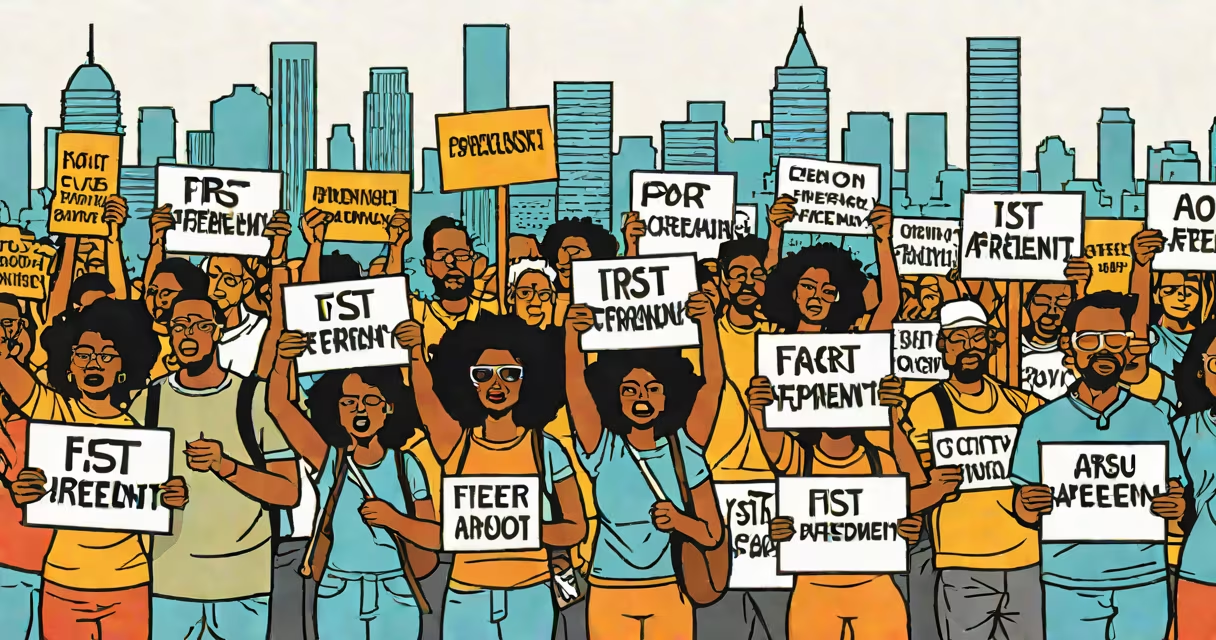
1st amendment scenarios involve situations where individuals or groups claim protection under the First Amendment to the U.S. Constitution, which guarantees freedom of speech, religion, press, assembly, and petition. These cases test the limits of protected expression against government regulation, public safety, and national security concerns.
The First Amendment prohibits Congress from making laws that establish a religion or restrict free speech. But what counts as protected speech? Courts have ruled on thousands of 1st amendment scenarios, often turning on context, intent, and potential harm. A protest chant, a social media post, a political sign, or a performance art piece can each trigger legal scrutiny depending on circumstances.
For example, in *Tinker v. Des Moines Independent Community School District* (1969), students wore black armbands to protest the Vietnam War. The Supreme Court ruled this symbolic speech was protected under the 1st amendment because it did not disrupt school operations. This case remains a foundational example of student expression rights.
Courts assess 1st amendment scenarios using a structure based on precedent. They ask whether the speech is expressive, whether it causes imminent harm, and whether the government has a compelling interest in restricting it. Not all speech receives equal protection.
Speech that incites violence, constitutes true threats, or involves obscenity is not protected. In *Brandenburg v. Ohio* (1969), the Court established that speech advocating illegal action is only unprotected if it is directed to inciting or producing imminent lawless action and is likely to incite or produce such action. This standard prevents overbroad suppression of political dissent.
A 2022 case involving a man who shouted "I'm going to kill you" during a heated argument at a public park illustrates the difference between rhetoric and threat. The court dismissed the charge because the statement lacked specific targeting and immediate danger. Context matters: the same words in a different setting-like a courtroom or a school-could lead to prosecution.
These scenarios fall into distinct categories based on the nature of the expression and the setting.
| Type | Examples | Legal Protection Level |
|---|---|---|
| Political protest | Marches, sit-ins, wearing slogans on clothing | High - protected unless disruptive or threatening |
| Social media speech | Online posts criticizing officials, sharing misinformation | Moderate - private platforms may moderate freely; government actions face stricter scrutiny |
| Symbolic expression | Wearing armbands, burning flags, displaying art | High - if non-disruptive and intended to convey a message |
| Commercial speech | Advertising, product claims, influencer endorsements | Limited - subject to regulation if deceptive or misleading |
One non-obvious distinction: government employees speaking on public issues face reduced protection. In *Pickering v. Board of Education* (1968), the Court ruled that public school teachers can speak on matters of public concern, but their speech may be restricted if it harms workplace efficiency. A teacher criticizing school funding in a letter to the editor was protected-but a teacher making false allegations about a colleague in a staff meeting was not.
1st amendment scenarios most frequently emerge in public spaces-streets, parks, schools, and online forums-where people gather to express views. Government entities often respond with regulations, permits, or enforcement actions, leading to legal challenges.
Protests at federal buildings, such as those near the U.S. Capitol, routinely involve 1st amendment scenarios. In 2021, demonstrators gathered to demand policy changes. Authorities required permits and enforced crowd control measures. Some arrests were later challenged in court, arguing that peaceful assembly was unlawfully disrupted. The courts upheld permit requirements as reasonable time, place, and manner restrictions.
Another frequent context is education. In 2023, a high school student posted a meme on Instagram mocking a school dress code. The school suspended him. He sued under the 1st amendment. The court ruled the post was protected expression because it was non-threatening and occurred off-campus. This decision clarified that schools have less authority over student speech beyond school grounds.
Many assume the 1st amendment protects all speech, including hate speech, threats, or lies. That is incorrect. The amendment does not shield speech that incites violence, harasses individuals, or spreads knowingly false information that causes harm.
For example, falsely claiming a candidate stole an election can lead to civil liability, even if the speaker believes it. While the statement may be political speech, courts have ruled that defamation and malicious falsehoods are not protected under the 1st amendment when they damage reputation or cause financial loss.
A common mistake is equating government speech with private speech. The government can regulate its own employees' speech, especially in sensitive roles like military or intelligence. In *Rankin v. McPherson* (1987), a police officer made a political comment at work. The Court ruled that while he had some protection, his employer could discipline him without violating the 1st amendment because he was a public employee.
When discussing 1st amendment scenarios, people often overlook the role of state laws. The 1st amendment applies to federal actions. State constitutions may offer broader protections. For example, California's constitution explicitly protects more forms of political expression than the federal standard. A protest banned under federal law might still be lawful under state law.
In 2022, I attended a protest in downtown Portland against a proposed housing development. Organizers distributed flyers with images of displaced families and slogans like "Homes Over Profits." Police set up barriers and required a permit, which had been granted. As the crowd grew, officers monitored for disruptions.
At one point, someone began shouting slogans that included "Burn it down." Officers moved in, but the speaker was not arrested because the words were not directed at specific individuals and no property was damaged. Later, a judge ruled the protest was lawful under the 1st amendment because it remained peaceful and followed permit conditions.
This event showed how 1st amendment scenarios unfold in real time: planning, legal compliance, and changing responses to speech that borders on provocation. The outcome depended not on the speaker's intent alone, but on context, audience, and consequences.
Understanding 1st amendment scenarios requires knowing that protection is conditional. Expression is not absolute. Courts weigh the value of speech against risks to public order, safety, and individual rights. The balance shifts depending on location, medium, and intent.