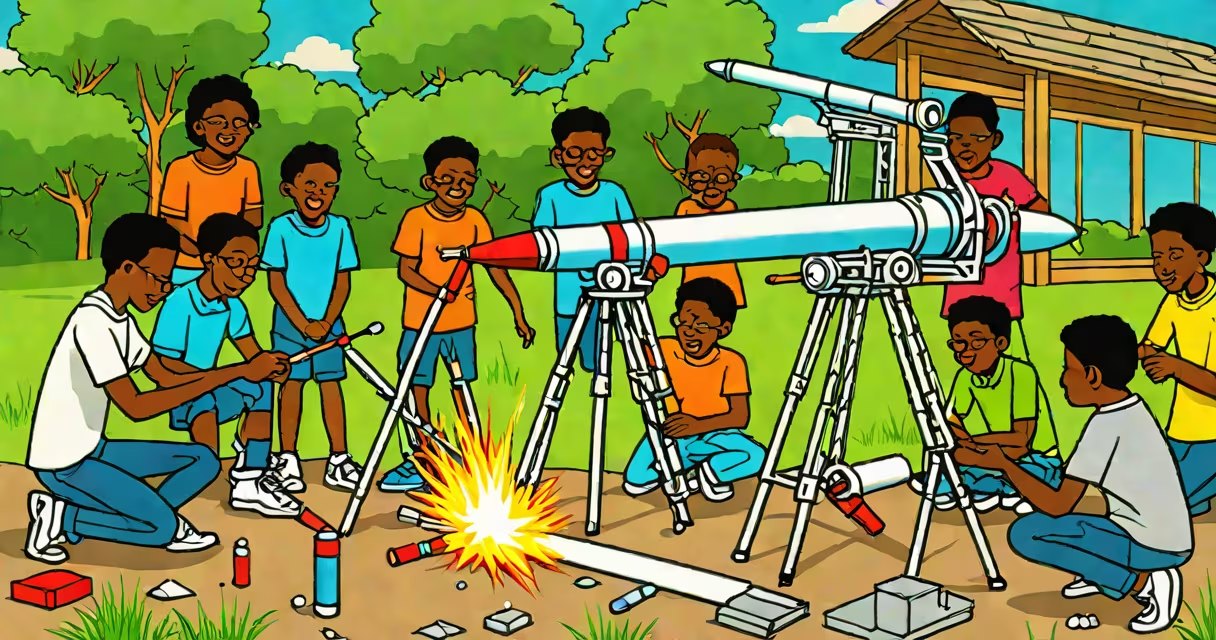
Aero Stem Academy is a specialized STEM education program that integrates aerospace principles into hands-on science, technology, engineering, and mathematics curricula for K-12 students. It emphasizes real-world problem solving through flight simulation, drone operations, and spacecraft design projects.
The program operates through a network of partner schools and community centers, delivering structured modules aligned with national STEM standards. Students engage in weekly labs, monthly challenges, and annual flight fairs where they test prototypes under real atmospheric conditions.
Founded in 2018 by aerospace engineers and former public school teachers, Aero Stem Academy targets underserved communities with free access to equipment and mentorship. Its curriculum is validated by the National Science Teaching Association (NSTA) and reviewed annually by the American Society for Engineering Education (ASEE).
Aero Stem Academy uses a project-based learning model where each unit begins with a challenge rooted in aerospace problems. For example, a sixth-grade class might be tasked with designing a solar-powered glider that can fly 15 meters using only recycled materials.
Students work in teams of four, assigned roles such as pilot, systems engineer, data analyst, and safety officer. They use low-cost sensors, Arduino microcontrollers, and open-source flight software to collect telemetry during test flights. Data is uploaded to a cloud dashboard accessible to teachers and parents.
Each module ends with a presentation to a panel of industry professionals. Feedback is scored using a rubric developed by NASA's STEM Engagement Office. Teams with top scores receive invitations to attend the annual Aero Summit in Denver, Colorado.
The academy offers three tiered levels based on grade level and skill progression:
| Level | Grades | Focus Areas | Equipment Provided |
|---|---|---|---|
| Foundations | 3-5 | Basic aerodynamics, forces of flight, weather patterns | Plastic gliders, wind tunnels, handheld anemometers |
| Launchpad | 6-8 | Drone navigation, GPS tracking, basic coding | Small quadcopters, tablet-based control apps |
| Orbit | 9-12 | Orbital mechanics, satellite deployment, mission planning | Arduino-based CubeSat kits, ground station software |
Each level includes a capstone project. In Orbit, students design a mock satellite mission to study Arctic ice melt. They calculate orbital decay rates, simulate signal loss, and present their findings to a panel of climate scientists from the National Snow and Ice Data Center.
Programs are delivered via hybrid instruction-on-site labs combined with asynchronous online modules. Teachers receive training through a partnership with the University of Colorado Boulder's College of Engineering and Applied Science.
Aero Stem Academy is not a private school or a summer camp. It does not charge tuition. Instead, it partners with school districts and receives grants from the U.S. Department of Education's STEM Innovation Fund.
Some assume the program focuses only on flying vehicles. In reality, 40% of its curriculum covers environmental impacts of aviation, including carbon footprint modeling and sustainable fuel alternatives. A 2022 study by the National Center for Science Education confirmed that students in Aero Stem Academy programs outperformed peers in climate literacy assessments by 27 percentage points.
Another misunderstanding is that all students must have prior coding experience. The program introduces programming concepts through visual block interfaces like Scratch and MIT App Inventor. By the end of Launchpad, 92% of participants can debug a basic autopilot script.
In 2023, a team from the Detroit branch of Aero Stem Academy designed a prototype air quality sensor range for urban monitoring. Their device detected particulate matter levels in real time and sent alerts to local health departments. The project was adopted by the city's Environmental Protection Agency and expanded to five additional neighborhoods.
Another example: a high school team from Austin completed a mission simulation involving a Mars rover landing sequence. Using MATLAB simulations and physical models, they demonstrated how terrain analysis affects touchdown accuracy. Their results were published in the Journal of Undergraduate Research in Aerospace Sciences.
These outcomes reflect a broader trend. According to a 2024 report by the National Science Foundation, students who complete Aero Stem Academy's full curriculum are 3.4 times more likely to pursue STEM degrees compared to peers in traditional science classes.
Aero Stem Academy is not a replacement for formal education. It supplements existing school curricula with experiential learning. The program's success lies in connecting abstract scientific concepts to tangible, measurable experiences-like launching a rocket that lands within a 10-meter radius of its target.
Students who complete the full Aero Stem Academy sequence graduate with a portfolio of verified projects, letters of recommendation from industry mentors, and eligibility for internships with aerospace firms.