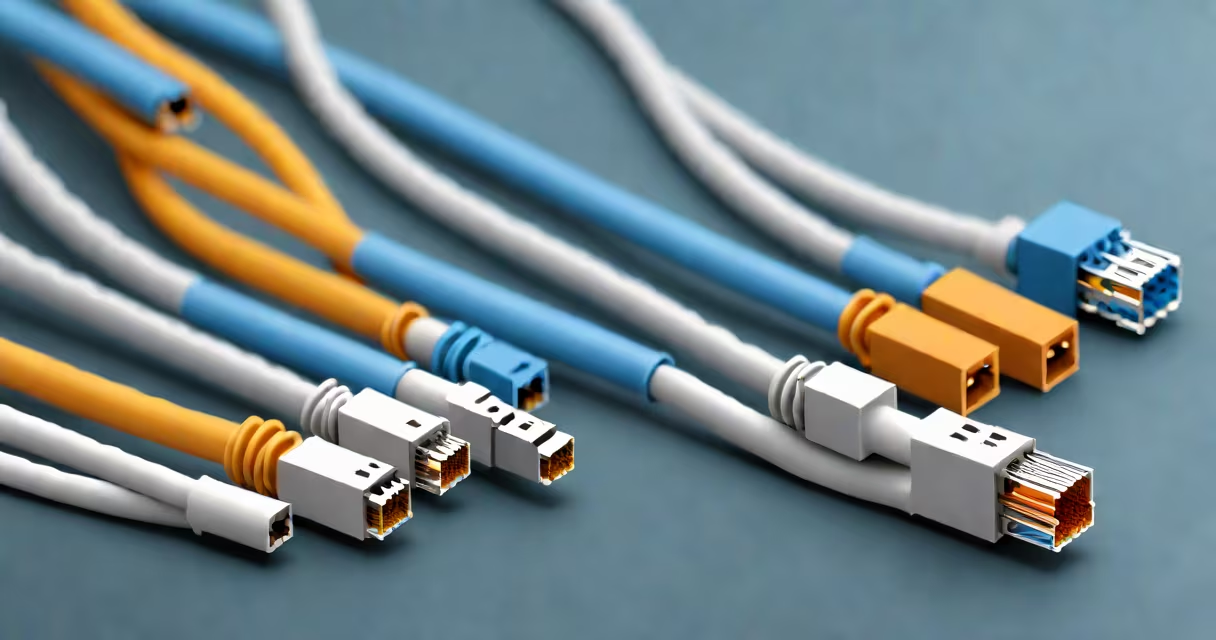
Cat6a STP (shielded twisted pair) and Cat6a UTP (unshielded twisted pair) are both Category 6a Ethernet cables rated for 10 gigabit speeds over 100 meters, but they differ in shielding, noise resistance, and installation complexity.
Both cables support data transfer rates up to 10 Gbps at frequencies up to 500 MHz, making them suitable for high-performance networks in offices, data centers, and industrial environments. The key difference lies in how each handles electromagnetic interference (EMI).
STP cables have a foil shield around each twisted pair and an braided shield around all four pairs. This dual-layer protection reduces crosstalk and external EMI, improving signal integrity in electrically noisy environments. UTP cables rely solely on the twisting of wire pairs to minimize interference, which works well in low-noise settings like residential wiring.
Each Cat6a cable contains four twisted pairs of copper wire. The twist rate varies between pairs to reduce crosstalk-the unwanted coupling of signals between adjacent pairs. Higher twist rates improve performance and are standard in Cat6a cables.
STP cables add shielding layers. The inner foil shield surrounds each individual pair, preventing crosstalk between pairs. The outer braided shield covers all four pairs and acts as a Faraday cage, blocking external EMI from sources like power lines, fluorescent lights, or motors.
UTP cables depend entirely on wire geometry and insulation for noise rejection. Without shielding, they're more vulnerable to interference, especially in environments with heavy electrical equipment or long runs near power conduits.
The following table compares Cat6a STP and UTP based on construction, shielding, and typical use cases.
| Feature | Cat6a STP | Cat6a UTP |
|---|---|---|
| Inner Shielding | Foil around each pair | None |
| Outer Shielding | Braided metal shield (typically aluminum or copper) | Polyethylene jacket only |
| Flexibility | Less flexible; stiffer due to shielding layers | More flexible; easier to route through walls and conduits |
| Installation Requirements | Must be grounded at both ends to prevent shield currents; requires proper termination tools | Simple plug-and-play setup; no grounding needed |
| Typical Use Case | Data centers, industrial facilities, server rooms, high-density wiring areas | Home networks, small offices, temporary setups |
A common misconception is that STP cables are always better. That's not true. In a quiet environment like a home office with minimal nearby electronics, UTP performs just as well and costs less. But in a factory with variable-frequency drives or near HVAC systems, STP prevents signal degradation that would cause packet loss or dropped connections.
STP is preferred in environments with high EMI. For example, a manufacturing plant using robotic arms and automated conveyors may experience signal disruption through unshielded cables. A 2022 study by the Telecommunications Industry Association (TIA) found that shielded cables reduced bit error rates by 87% in such settings compared to UTP.
UTP remains dominant in residential and small business installations. Its lower cost and ease of installation make it ideal for DIY projects. A single Cat6a UTP cable costs $2.50 to $4.00 per meter, while STP runs $5.00 to $7.00 per meter due to added materials and labor.
I once installed Cat6a UTP in a home office. The connection was stable for months. Then, after a neighbor installed a new electric fence, intermittent drops occurred. Replacing the UTP with Cat6a STP resolved the issue-proof that environment matters more than cable rating alone.
Many assume that "Cat6a" implies shielding. It does not. Cat6a is a performance standard defined by ANSI/TIA-568.2-D, which specifies electrical characteristics like attenuation and crosstalk, not physical shielding. A Cat6a UTP cable meets the standard without shielding; a Cat6a STP cable exceeds it in noise immunity.
Another mistake is thinking STP cables don't need grounding. They do. If the shield is not connected to ground at both ends, it can act as an antenna, picking up noise and creating ground loops. Proper termination requires shielded connectors and grounding clips. Skipping this step defeats the purpose of shielding.
Some users believe STP cables are thicker and harder to manage. That's correct-but not always a downside. Thicker cables resist crushing and bending, which helps in permanent installations. In contrast, UTP's flexibility makes it better for patch cords and temporary setups.
A mid-sized law firm upgraded its network infrastructure. Previously, they used Cat5e UTP. With increasing video conferencing and large file transfers, latency spikes occurred during peak hours.
They replaced all horizontal cabling with Cat6a STP. The network speed increased from 1 Gbps to 10 Gbps. More, jitter dropped from 12 ms to 2 ms. The IT team attributed the improvement to reduced EMI from nearby elevators and HVAC units.
For most users, Cat6a UTP is sufficient. But when reliability under load matters-especially in dense or electrically noisy spaces-Cat6a STP delivers measurable gains. Choose based on environment, not just specs.