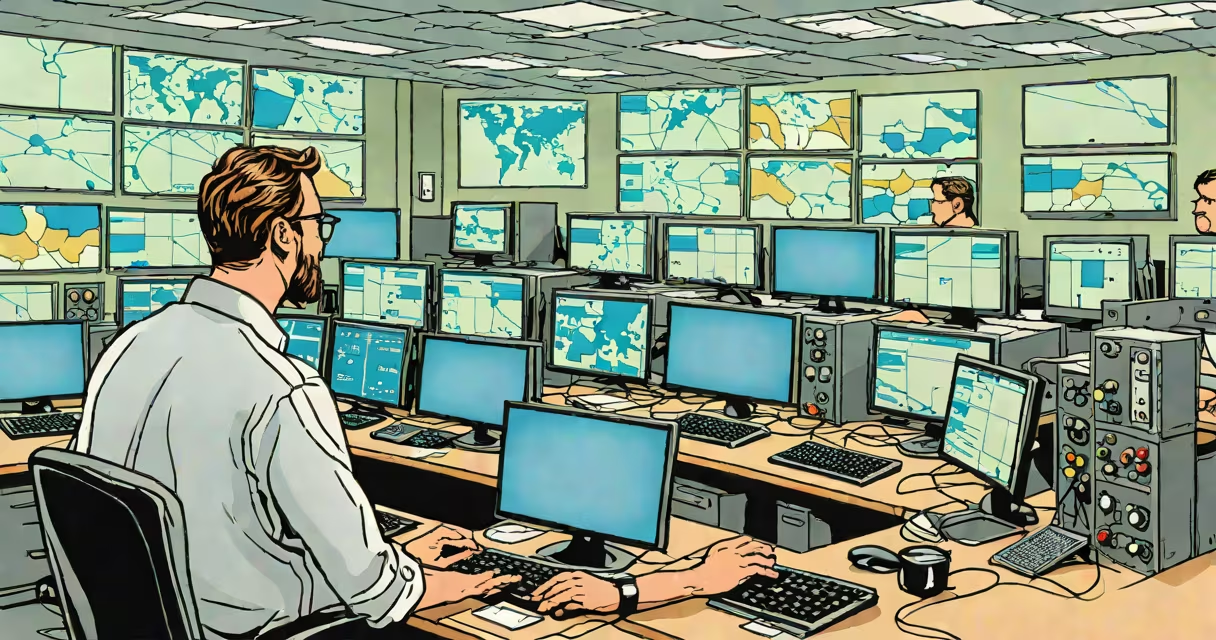
Network administrator training equips individuals with the technical knowledge and hands-on experience needed to design, implement, monitor, and secure computer networks. This training covers protocols, hardware configurations, security policies, and troubleshooting procedures essential for maintaining reliable network operations.
Training programs vary in format-classroom-based, online, or hybrid-but all emphasize practical application. Participants learn to manage routers, switches, firewalls, and network access points using real tools like Cisco Packet Tracer, Wireshark, and Windows Server. Most programs include labs simulating enterprise environments, where trainees configure VLANs, set up DHCP servers, and respond to simulated cyber intrusions.
According to CompTIA, 68% of hiring managers prioritize candidates with formal training or industry-recognized certifications. Training often leads to credentials such as CompTIA Network+, Cisco CCNA, or Microsoft Certified: Azure Administrator Associate. These certifications validate skills in routing, switching, cloud integration, and endpoint protection.
Training begins with foundational concepts: IP addressing, subnetting, TCP/IP stack behavior, and OSI model layers. Trainees map out network topologies using diagrams and then build them in virtual lab environments. For example, a typical exercise involves setting up a small office network with two subnets-one for HR and one for engineering-using a single router and two switches.
Once infrastructure is deployed, trainees configure access control lists (ACLs) to restrict traffic between departments. They assign static IPs to servers and enable DHCP for workstations. Monitoring tools like PRTG or SolarWinds are introduced to track bandwidth usage, detect anomalies, and generate performance reports.
A critical component is incident response. Trainees simulate a DDoS attack on a test server and apply firewall rules to block malicious packets. They analyze logs using tools like Splunk or ELK Stack to trace the source and assess impact. This mirrors real scenarios where administrators must act within minutes to prevent service disruption.
Training paths differ based on career goals and employer requirements. Below is a breakdown of common program types:
| Type | Duration | Focus Areas | Typical Outcomes |
|---|---|---|---|
| Vendor-specific (e.g., Cisco) | 4-8 weeks | Routing protocols (OSPF, BGP), switch configuration, SD-WAN | CCNA certification, job readiness in enterprise networks |
| General IT (e.g., CompTIA Network+) | 6-10 weeks | Network architecture, wireless standards, basic security | Entry-level roles, eligibility for junior admin positions |
| Advanced (e.g., AWS Certified Advanced Networking) | 12+ weeks | Cloud networking, VPCs, load balancing, hybrid connectivity | Specialized roles in cloud infrastructure teams |
Some programs integrate cybersecurity modules. A course offered by the National Institute of Standards and Technology (NIST) includes training on configuring firewalls to meet NIST SP 800-53 controls. This ensures compliance with federal security standards for government contractors.
Trainees often report that the most challenging aspect is managing real-time failures. During one session, I configured a redundant link between two sites using OSPF. When I intentionally shut down the primary connection, the backup took 14 seconds to activate-longer than acceptable for VoIP services. Adjusting the hello interval and dead timer reduced failover time to under 3 seconds.
Organizations deploy trained network administrators to ensure uninterrupted communication across systems. Hospitals rely on stable networks for patient records and imaging systems. Financial institutions require low-latency connections for trading platforms. Education institutions depend on solid Wi-Fi for remote learning and digital exams.
Failure to maintain proper network health leads to measurable losses. A 2022 study by Gartner found that unplanned downtime costs large enterprises an average of $5,600 per minute. Training reduces risk by enabling early detection of issues like packet loss, latency spikes, or unauthorized device access.
For example, a school district in Colorado used network administrator training to resolve recurring Wi-Fi dropouts during standardized testing. After analyzing traffic patterns, the team discovered that legacy access points were causing interference. Replacing them with 802.11ac units and adjusting channel assignments restored stability. The fix prevented test delays affecting 1,200 students.
Many assume network administration is solely about fixing broken connections. In reality, it involves proactive planning. Administrators design redundancy, allocate bandwidth, and enforce policies before problems arise. A 2021 survey by the Computing Technology Industry Association (CompTIA) showed that 73% of network issues stem from misconfigurations, not hardware failure.
Another misconception is that training ends with certification. Certification validates knowledge but doesn't guarantee competence. A 2020 report from the U.S. Department of Labor found that 41% of newly hired network admins required additional onboarding support due to gaps in real-world problem-solving.
Effective training combines theory, simulation, and mentorship. Programs that include shadowing experienced staff see a 30% faster ramp-up in job performance compared to those relying only on classroom instruction, according to a 2023 study by the University of California, Berkeley School of Information.
Network administrator training is not a one-time event. Continuous learning is required due to evolving threats and technologies. Professionals must stay current with updates to protocols like IPv6, emerging standards like 5G backhaul, and new security frameworks such as Zero Trust Architecture.
For anyone entering the field, start with foundational courses like CompTIA Network+ or free resources from Cisco Networking Academy. Build a home lab using old routers and switches. Practice configuring ACLs, setting up VLANs, and diagnosing connectivity issues. Apply these skills to real challenges-like securing a guest Wi-Fi network against unauthorized access-to solidify understanding.
With consistent effort, network administrator training transforms theoretical knowledge into actionable expertise. The result is a professional capable of maintaining resilient, secure, and high-performing networks across industries.