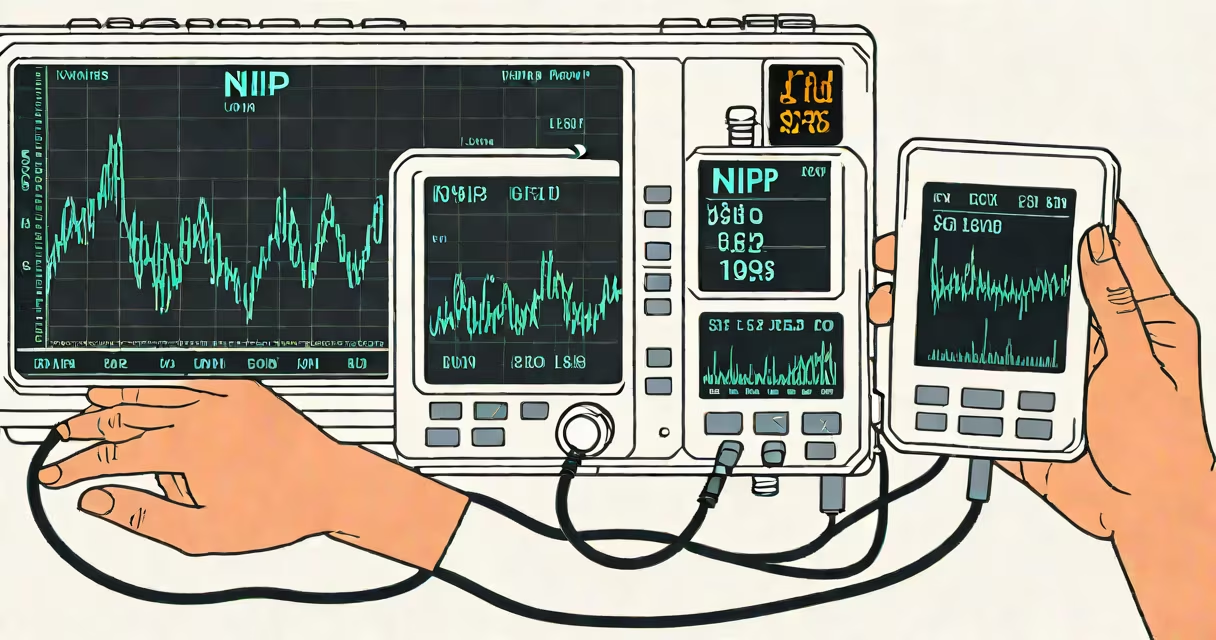
NIBP stands for non-invasive blood pressure, a method used to measure arterial pressure using an inflatable cuff placed around the upper arm. It's the most common way to assess blood pressure in clinical settings without requiring a needle or surgical access.
The term appears frequently in hospital charts, emergency rooms, and intensive care units. NIBP readings are displayed as two numbers-like 120/80 mmHg-representing systolic and diastolic pressure. These values help clinicians detect hypertension, hypotension, or changes during anesthesia or critical illness.
According to the American Heart Association, accurate blood pressure monitoring is essential for diagnosing and managing cardiovascular risk. NIBP is the preferred initial method because it's safe, repeatable, and widely available across healthcare environments.
NIBP uses oscillometric technology. A cuff wraps around the upper arm and inflates above systolic pressure, temporarily stopping blood flow in the brachial artery. As the cuff deflates, tiny pulses of blood flow return through the artery, causing vibrations in the vessel wall.
A sensor detects these oscillations. The device analyzes the amplitude of the pulses and identifies the pressure level at which the largest oscillation occurs-the systolic value. The diastolic pressure corresponds to the point where the pulse amplitude begins to decrease.
Modern devices perform this calculation automatically within seconds. Most hospital monitors update NIBP readings every 5 to 15 minutes during routine monitoring, though some settings allow continuous tracking via advanced algorithms.
Standard NIBP systems consist of three core components: an automated cuff, a pressure sensor, and a control unit with display and processing software. The cuff is typically made of durable synthetic rubber with a flexible bladder inside. It connects to the monitor via tubing.
There are two main types of NIBP measurement:
| Type | How It Works | Use Case |
|---|---|---|
| Oscillometric | Measures pressure fluctuations in the cuff as it deflates | Most common in clinics and home devices |
| Manual (Auscultatory) | Uses a stethoscope and mercury or aneroid sphygmomanometer | Gold standard in research and training; less common now |
Oscillometric NIBP is the default in most modern patient monitors. It requires no trained clinician to operate, making it ideal for rapid assessment in emergencies. Manual methods remain useful for validating automated readings, especially in patients with arrhythmias or very low blood pressure.
NIBP is routinely used in emergency departments, operating rooms, outpatient clinics, and long-term care facilities. It's part of every patient's baseline important signs assessment upon arrival.
In surgery, NIBP provides real-time feedback during anesthesia. A drop in systolic pressure below 90 mmHg may indicate hypovolemia or cardiac instability, prompting immediate intervention. During recovery, frequent NIBP checks help detect early signs of shock or hemorrhage.
For chronic conditions like hypertension, patients often use home NIBP devices. The American College of Cardiology recommends home monitoring for better control of blood pressure. Devices labeled "FDA-cleared" meet strict accuracy standards and are validated against invasive measurements.
Many people assume NIBP gives the same result as invasive arterial pressure monitoring. This is incorrect. Invasive monitoring, which uses a catheter inserted into an artery, measures pressure directly and is more accurate during rapid changes in blood pressure.
NIBP can underestimate systolic pressure in patients with severe atherosclerosis or in those who are obese. A 2021 study published in *Hypertension* found that NIBP readings were, on average, 10 mmHg lower than invasive readings in critically ill patients with peripheral vascular disease.
Another misconception is that NIBP is always accurate. Factors like improper cuff size, limb movement, or arrhythmias can cause errors. Using a cuff that's too small increases the reading by up to 10 mmHg. A 2019 review in *The Lancet* emphasized that correct technique reduces false positives in hypertension diagnosis by over 30%.
Consider a 68-year-old man brought to the emergency department with chest pain. His initial NIBP reading is 180/100 mmHg. The triage nurse notes the elevated systolic pressure and alerts the team.
After oxygen and nitroglycerin, a repeat NIBP shows 160/90 mmHg. The change indicates response to treatment. However, the patient remains unstable. An invasive arterial line is placed, revealing a true systolic pressure of 155 mmHg-lower than the NIBP reading.
This discrepancy highlights a key limitation: NIBP can overestimate pressure in certain conditions. The team adjusts medication based on the invasive reading, avoiding unnecessary interventions.
NIBP does not replace invasive monitoring in high-acuity settings. It cannot detect transient hypotensive episodes between measurements. It also doesn't provide beat-to-beat variability, which is important in septic shock or cardiac arrest.
Some confuse NIBP with pulse oximetry (SpO₂), which measures oxygen saturation. While both are important signs, they track different physiological parameters. SpO₂ reflects lung function and hemoglobin saturation, while NIBP reflects circulatory dynamics.
Understanding the difference matters. Misinterpreting NIBP as equivalent to invasive pressure leads to poor decisions. Always consider context: patient stability, comorbidities, and the purpose of the measurement.
I once monitored a patient with atrial fibrillation during a surgical procedure. The NIBP device showed consistent readings around 110/70 mmHg. But during a sudden drop in perfusion, the machine failed to register a change for nearly two minutes.
Only after switching to an arterial line did we see the true systolic pressure fall to 75 mmHg. The NIBP system had missed the episode due to irregular heartbeats interfering with oscillometric detection. That moment reinforced the limits of non-invasive tools in changing clinical situations.
Non-invasive blood pressure monitoring remains a foundational tool in medicine. It's fast, accessible, and effective for most patients. But knowing its limits ensures better outcomes when accuracy is critical.