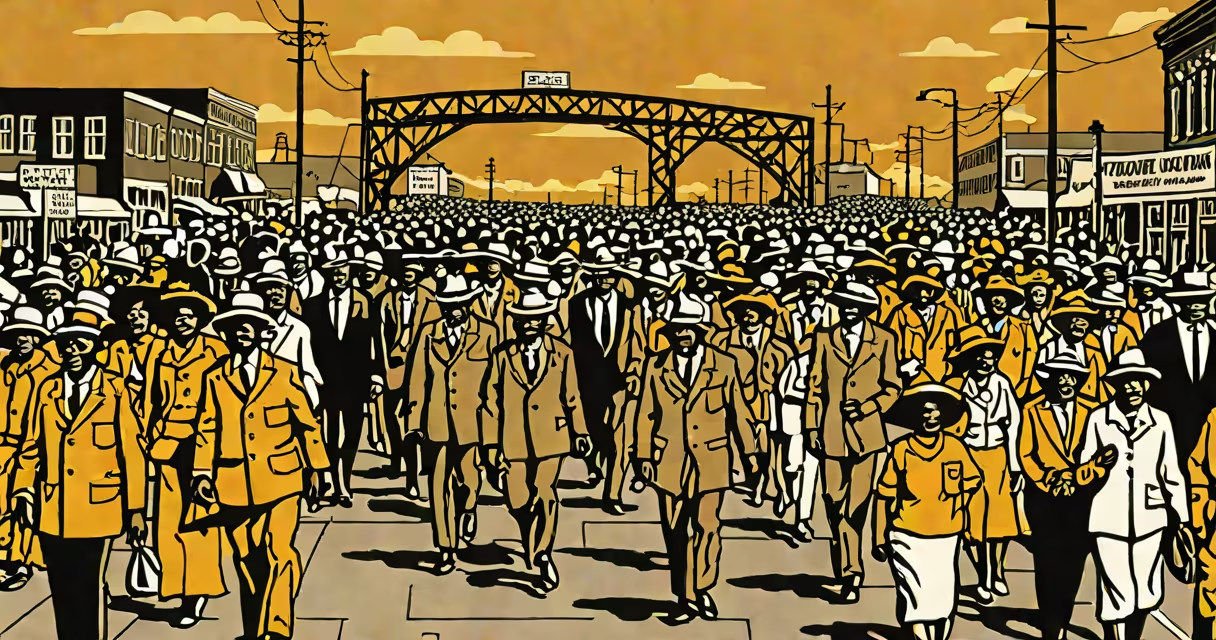
The civil rights movement was a mass campaign in the United States from the mid-1950s through the late 1960s to end racial segregation and secure legal protections for African Americans. It challenged systemic discrimination through nonviolent protest, court cases, and federal legislation.
Rooted in centuries of slavery and post-Reconstruction disenfranchisement, the movement gained national momentum after the 1954 Supreme Court decision in Brown v. Board of Education, which ruled that segregated public schools violated the Equal Protection Clause of the Fourteenth Amendment. This ruling dismantled the legal foundation of "separate but equal" established in Plessy v. Ferguson (1896).
Protests were organized across the South. In 1955, Rosa Parks' arrest for refusing to give up her bus seat in Montgomery, Alabama, sparked the Montgomery Bus Boycott. Led by a then-unknown pastor, Martin Luther King Jr., the 381-day boycott ended with the Supreme Court declaring segregated buses unconstitutional.
Nonviolent direct action became the movement's signature strategy. Sit-ins at segregated lunch counters began in 1960 after four Black college students sat at a whites-only Woolworth's counter in Greensboro, North Carolina. Within weeks, similar protests erupted in over 50 cities.
Freedom Rides in 1961 tested desegregation of interstate travel. Activists rode buses into the Deep South, facing violent attacks from white mobs and local police. Federal authorities intervened after images of burning buses and beaten riders appeared on national television.
The 1963 March on Washington drew over 250,000 people to demand jobs and freedom. Martin Luther King Jr. delivered his "I Have a Dream" speech, a defining moment in American oratory. The event helped build public support for the Civil Rights Act of 1964, which outlawed segregation in public places and banned employment discrimination based on race, color, religion, sex, or national origin.
The Voting Rights Act of 1965 eliminated barriers that had prevented Black citizens from voting in the South. It suspended literacy tests and authorized federal oversight of voter registration in jurisdictions with histories of discrimination. Within five years, Black voter registration in Mississippi rose from 6.7% to 59.5%, according to the U.S. Department of Justice.
Despite passage of civil rights laws, enforcement remained inconsistent. In 1965, state troopers attacked peaceful marchers crossing the Edmund Pettus Bridge in Selma, Alabama. The violence, broadcast nationally, prompted President Lyndon B. Johnson to urge Congress to pass the Voting Rights Act. The marchers later completed their process to Montgomery, where they held a rally demanding federal protection.
A lesser-known fact: the FBI under J. Edgar Hoover monitored Martin Luther King Jr. as a potential security threat. Files released under the Freedom of Information Act show agents wiretapped King and sent him anonymous threats, including a 1964 letter urging him to commit suicide.
| Event | Date | Outcome |
|---|---|---|
| Montgomery Bus Boycott | December 1955 - December 1956 | Supreme Court ruled segregated buses illegal |
| Greensboro Sit-Ins | February 1960 | Sparked nationwide sit-in movement |
| Freedom Rides | May 1961 | Forced federal intervention on interstate travel |
| March on Washington | August 28, 1963 | Helped pass the Civil Rights Act of 1964 |
| Selma to Montgomery Marches | March 1965 | Direct catalyst for the Voting Rights Act of 1965 |
The movement is often portrayed as a single, unified effort led solely by Martin Luther King Jr. In reality, it included diverse strategies and leaders. Malcolm X, associated with the Nation of Islam, advocated for Black self-determination and criticized nonviolence as ineffective. His speeches emphasized economic independence and resistance to white supremacy.
Even within the movement, disagreements existed. Some activists believed legal victories were insufficient without structural change. The Poor People's Campaign, launched in 1968 after King's assassination, focused on poverty and housing inequality, not just racial justice.
I visited the National Museum of African American History and Culture in Washington, D.C., in 2022. One exhibit displayed a copy of the 1965 Voting Rights Act alongside a voter registration form from 1965 filled out by a Black woman in Selma. Her name was crossed out by officials. The form was rejected. She later registered successfully after federal marshals arrived in the county.
This artifact illustrates how law and lived experience diverged. The Voting Rights Act passed in August 1965. But in many counties, local officials still blocked access. Only with federal oversight did registration numbers rise.
Today, the legacy of the civil rights movement continues in efforts to address voter suppression, police reform, and educational equity. The 2021 passage of the John Lewis Voting Rights Advancement Act aims to restore provisions struck down by the Supreme Court in Shelby County v. Holder (2013), showing that the fight for equal protection remains active.
The civil rights movement reshaped American law and society. Its core achievements-desegregation, voting rights, anti-discrimination laws-were not automatic. They emerged from sustained pressure, moral courage, and strategic legal challenges. Understanding what happened in the civil rights movement requires seeing both the triumphs and the persistent gaps between promise and practice.