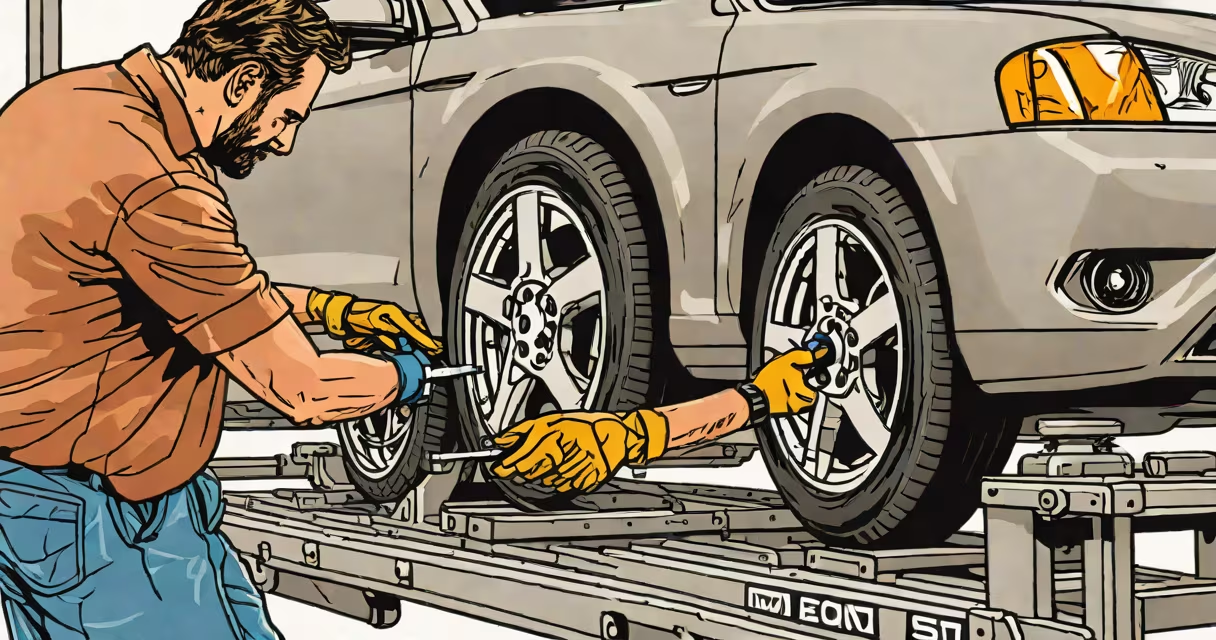
A wheel alignment adjusts the angles of a vehicle's wheels to match the manufacturer's specifications, ensuring optimal contact with the road. This process corrects deviations in camber, caster, and toe settings to improve handling, reduce tire wear, and maintain straight-line stability.
Modern vehicles rely on precise geometry between tires and the road surface. Misalignment causes uneven pressure distribution, leading to premature tread wear, pulling to one side, and reduced fuel efficiency. A proper alignment restores factory-set angles, maximizing grip and minimizing mechanical stress.
According to the National Institute for Automotive Service Excellence (ASE), misaligned wheels are a leading cause of irregular tire degradation, contributing to up to 30% of preventable tire failures. Regular alignment checks help avoid costly repairs and extend tire life.
Wheel alignment involves adjusting three primary angles: camber, caster, and toe. These angles define how wheels sit relative to the ground and each other. Each adjustment targets a specific performance factor.
Camber measures the inward or outward tilt of the wheel when viewed from the front. Positive camber tilts the top of the wheel outward; negative camber tilts it inward. Most passenger cars have slight negative camber for better cornering grip. Excessive camber causes inner or outer tire wear.
Caster refers to the forward or backward tilt of the steering axis when viewed from the side. Positive caster improves high-speed stability and steering return. Too much caster increases steering effort. Incorrect caster leads to wandering or delayed response during turns.
Toe describes whether the front edges of the tires point toward or away from each other. Toe-in means the fronts are closer together; toe-out means they're farther apart. Correct toe ensures straight-line tracking and prevents feathering on tires.
Alignment services differ based on the vehicle's design and the level of precision required. Most shops offer two standard types: four-wheel alignment and two-wheel alignment.
| Service Type | Wheels Adjusted | Best For | Accuracy Level |
|---|---|---|---|
| Two-Wheel Alignment | Front wheels only | Front-wheel-drive cars with non-independent rear suspensions | Basic |
| Four-Wheel Alignment | All four wheels | SUVs, trucks, and vehicles with independent rear suspensions | High |
Four-wheel alignment is recommended for all modern vehicles, especially those with advanced suspension systems. A 2022 study by the Motor & Equipment Manufacturers Association (MEMA) found that 87% of new vehicles require four-wheel alignment due to complex rear suspension designs.
Some repair centers use laser-guided alignment systems with computerized sensors. These tools measure angles to within 0.1 degrees, far exceeding manual methods. The system compares current settings to OEM specifications stored in the vehicle's service database.
Alignment should be checked every 6,000 miles or annually, whichever comes first. Many manufacturers recommend this interval in their owner's manuals. Some models, like the Toyota Camry and Honda Accord, include alignment reminders in the dashboard display.
Immediate alignment is necessary after hitting a pothole, curb, or experiencing a minor collision. Even small impacts can bend control arms or displace ball joints. A 2021 AAA report noted that 1 in 5 drivers experienced alignment issues after driving through a speed bump at 30 mph or higher.
Signs of misalignment include uneven tire wear, steering wheel vibration, or the car drifting left or right while driving straight. If the tread shows bald spots on one side, or if the car pulls to one side without turning, an alignment check is urgent.
I once diagnosed a customer's 2018 Subaru Outback with severe shoulder wear on the right front tire. After measuring angles, we found the camber was off by 1.8 degrees-well beyond the 0.5-degree tolerance. After realigning, the car tracked straight, and the tire wear stopped progressing.
Many people confuse wheel alignment with balancing. Balancing addresses weight imbalances in a rotating tire, causing vibrations at highway speeds. Alignment fixes geometric angles. A car can be balanced but still pull to one side due to misalignment.
Another myth is that alignment is only needed after an accident. While accidents are a trigger, gradual wear on bushings, ball joints, and tie rods causes slow drift. Suspension components degrade over time, shifting angles even without impact.
Some believe alignment is a one-time fix. It isn't. Worn parts continue to affect alignment. A 2020 study by the Society of Automotive Engineers (SAE) showed that 43% of vehicles needing alignment had worn control arm bushings. Replacing worn parts before alignment ensures lasting results.
At a certified shop, a technician mounts the vehicle on a lift and attaches sensors to each wheel hub. The system scans current angles and compares them to the factory specs. The mechanic then adjusts the tie rod ends, camber bolts, or shims as needed.
The entire process takes 30 to 45 minutes. Most shops provide a printout showing pre- and post-alignment readings. You'll see changes in camber, caster, and toe values. A reputable shop will also inspect related components like ball joints and sway bar links.
After the service, test drive the vehicle on a straight, flat road. The car should track straight without steering wheel correction. If it still pulls, further inspection may be needed.
For owners who want to assess their vehicle's condition, offloading your car's value assessment includes checking alignment status as part of a full mechanical evaluation.
Regular alignment maintains safety, extends tire life, and supports fuel economy. Neglecting it risks sudden loss of control, especially in wet or high-speed conditions. A properly aligned car performs as designed-efficiently, predictably, and safely.