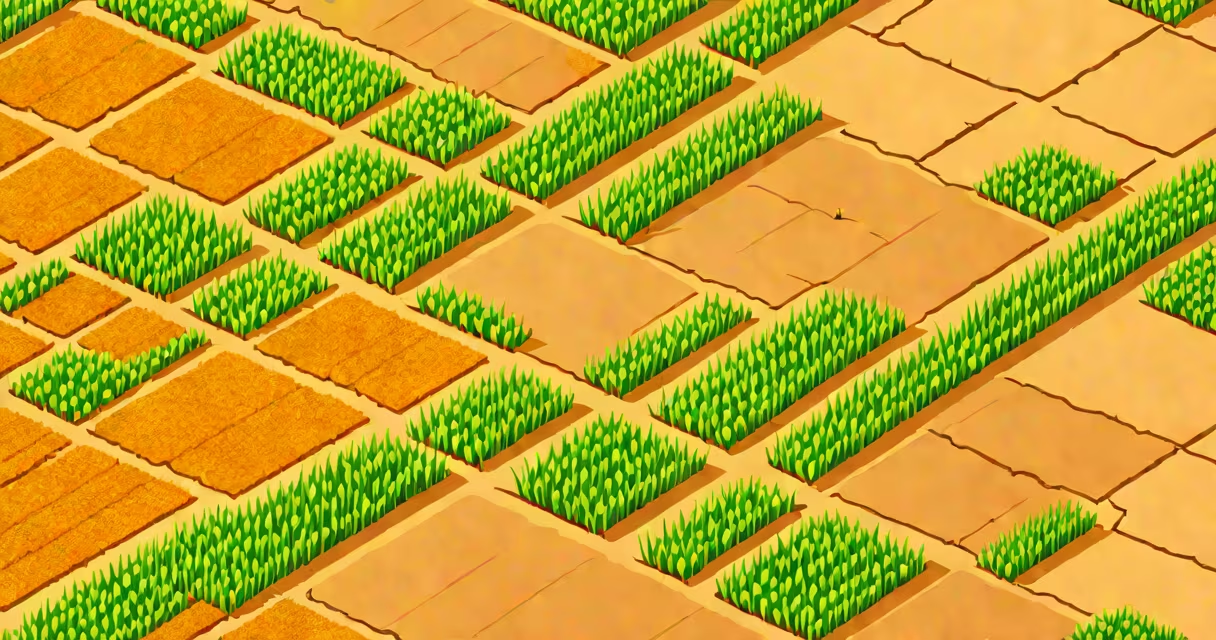
Dryland farming is a method of cultivating crops in regions with limited annual rainfall-typically less than 20 inches-where irrigation is unavailable or impractical. It depends entirely on stored soil moisture and seasonal precipitation, using techniques to maximize water retention and minimize evaporation.
This approach is common in arid and semi-arid zones such as the Great Plains of North America, parts of Central Asia, and sub-Saharan Africa. Farmers grow drought-tolerant crops like wheat, barley, sorghum, and certain legumes, adapting planting schedules, tillage methods, and crop rotations to match local climate patterns.
Unlike irrigated systems, dryland farming does not depend on external water sources. Instead, it relies on soil's ability to hold moisture through careful land preparation, residue retention, and timing of planting. Success hinges on understanding local hydrology and selecting crops suited to variable rainfall.
At its core, dryland farming manages water scarcity by slowing runoff, increasing infiltration, and reducing evaporation. Soil preparation begins before planting with minimal tillage or no-till practices, which preserve organic matter and reduce surface disturbance. This maintains soil structure and allows water to penetrate deeper into the root zone.
After harvest, crop residues are left on the field. These act as a natural mulch, shielding the soil from wind and sun. Research from the USDA's Agricultural Research Service shows that leaving 30% or more of crop residue on the surface can increase water infiltration by up to 35% compared to bare fields.
Planting dates are carefully timed to align with expected rainfall windows. For example, in Kansas, winter wheat is sown in September or October to take advantage of fall rains and early spring moisture. Delaying planting until after the rainy season can result in poor germination and lower yields.
Several interlinked strategies define effective dryland farming:
A 2021 study published in Field Crops Research found that dryland farms using continuous no-till and diverse rotations had 22% higher long-term yields than those using conventional tillage, even during multi-year droughts.
Dryland farming is often mistaken for subsistence farming or traditional small-scale agriculture. While both may occur in dry regions, dryland farming is a systematic, science-based practice designed for consistent production under water constraints-not just survival.
It is also not synonymous with "rainfed agriculture," though the terms overlap. Rainfed agriculture includes all systems relying on rainfall, including high-yield systems with supplemental irrigation. Dryland farming specifically excludes any artificial water inputs.
Another misconception is that dryland farming is inherently low-productivity. Modern dryland systems achieve yields comparable to irrigated ones in favorable years. In 2022, Montana dryland wheat farms averaged 42 bushels per acre-close to the national average for irrigated wheat in California, which was 46 bushels per acre, according to USDA data.
In eastern Montana, farmers have used dryland techniques since the early 20th century. A 2019 case study by the University of Montana examined 12 farms across the region, tracking yield stability between 2000 and 2018. All farms used no-till, rotated wheat with peas, and planted in late August to capture residual moisture.
During a severe drought in 2012, average yields dropped by 31%, but all farms still produced marketable grain. In contrast, nearby conventional farms using moldboard plows and monoculture wheat lost 60% of their yield and faced financial losses.
One farmer, Sarah Thompson, reported that her dryland wheat consistently outperformed neighboring irrigated plots during wet years due to better root development and nutrient cycling. "The soil remembers," she said. "When you protect it, it gives back."
While both aim to produce food, they differ sharply in resource use and environmental impact.
| Factor | Dryland Farming | Conventional Farming |
|---|---|---|
| Water source | Natural precipitation only | Irrigation or supplemental water |
| Tillage | Minimal or none | Frequent plowing and tilling |
| Yield variability | High, but stable over time | Stable with irrigation, but vulnerable to supply issues |
| Soil health | Improves with residue retention | Degrades faster due to exposure |
These differences make dryland farming more sustainable in water-stressed regions. According to the FAO, dryland systems cover 40% of global cropland and support 2 billion people, yet receive less than 10% of agricultural research funding.
With climate change increasing drought frequency, dryland farming offers a resilient alternative to water-intensive agriculture. In regions like the American Southwest and the Horn of Africa, expanding dryland practices could stabilize food supplies and reduce pressure on dwindling aquifers.
Dryland systems sequester carbon in soil more effectively than tilled fields. A 2020 analysis by the Intergovernmental Panel on Climate Change (IPCC) noted that widespread adoption of dryland techniques could offset 1.2 gigatons of CO₂ annually-equivalent to removing 250 million cars from roads.
For farmers facing rising input costs and unreliable water access, dryland farming provides a viable path forward. It's not about abandoning productivity-it's about redefining it within ecological limits.
Understanding the dryland farming definition helps clarify its role in building food security in dry environments. It's not a fallback strategy; it's a proven system that thrives under constraint.