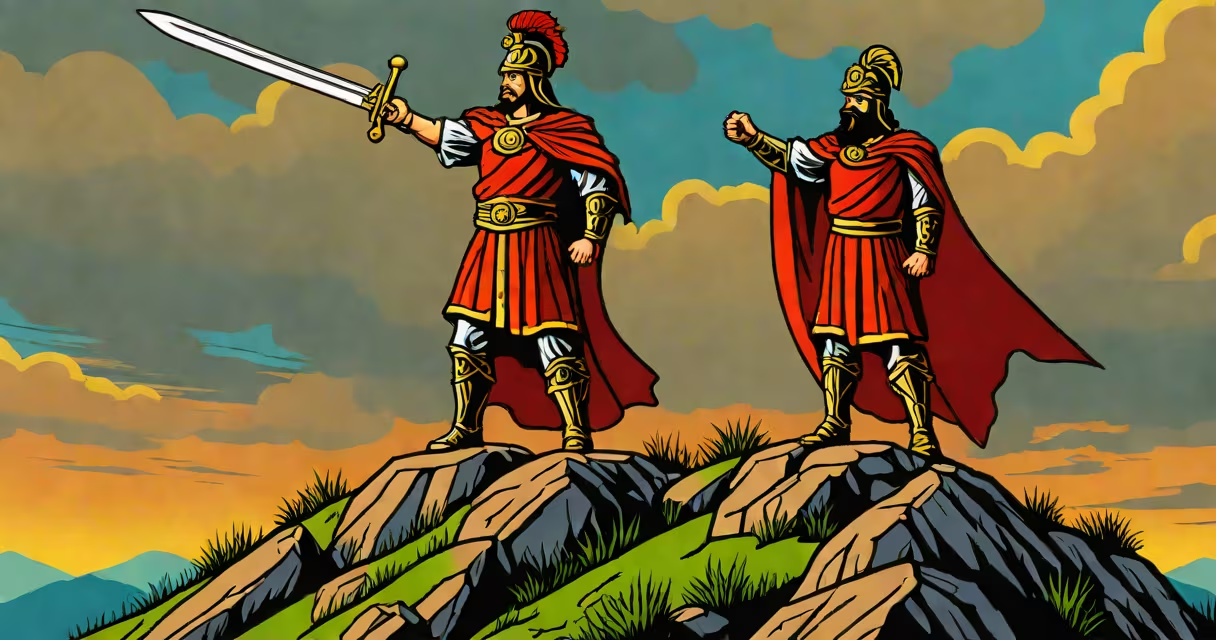
The book of Judges is a narrative section of the Hebrew Bible that recounts Israel's period between the conquest of Canaan and the rise of the monarchy, focusing on cyclical patterns of disobedience, foreign oppression, repentance, divine deliverance, and renewed apostasy through twelve regional leaders known as judges.
These judges were not national rulers but local military liberators who emerged during times of crisis. Their stories reflect a theological structure in which God responds to Israel's moral failure with punishment, then restores order through chosen individuals. The book spans roughly 300 years, from the death of Joshua to the early days of Samuel, and is structured around a recurring five-part cycle: Israel sins → God allows oppression → Israel cries out → God raises a judge → judge delivers Israel → Israel returns to sin.
Each judge's story varies in length and detail. Some, like Gideon and Samson, receive extensive treatment with dramatic elements-visions, tests of faith, supernatural strength, and tragic endings. Others, such as Ibzan and Elon, appear briefly with minimal narrative. The book's structure is not chronological but thematic, emphasizing spiritual decline and the consequences of tribal disunity.
The book opens with a summary statement: "After Joshua died, the Israelites asked the Lord, 'Who will lead us against the Canaanites?'" (Judges 1:1). This sets the stage for a decentralized leadership model where no king exists, and each tribe acts independently. The absence of centralized authority leads to recurring conflict and moral decay.
The core pattern appears in Judges 2:11-15: Israel worships Baal and Asherah, provoking God's anger. As a result, God sells them into the hands of enemies-Moabites, Midianites, Philistines-until they cry out. God then raises a judge, who defeats the oppressor and brings peace for a time. Peace doesn't last. After the judge dies, Israel relapses into idolatry, restarting the cycle.
A concrete example: In Judges 6-8, the Midianites oppress Israel for seven years. Gideon, initially hesitant and testing God's presence with a fleece, leads a small force of 300 men to defeat a vast army through divine strategy and psychological warfare. The victory ends with Gideon refusing kingship, saying, "The Lord will rule over you." Yet after his death, Israel again turns away (Judges 8:28-35).
The book blends historical narrative, poetry, and legal fragments. It includes battle accounts, divine encounters, personal trials, and lamentations. The poetic form appears in the Song of Deborah (Judges 5), one of the oldest surviving pieces of Hebrew literature. Its vivid imagery-"the stars fought from heaven"-marks it as a literary masterpiece.
Scholars debate authorship. While traditionally attributed to Samuel, modern analysis suggests multiple redactors (editors) from different periods. The Deuteronomistic school likely compiled the book during the Babylonian exile (6th century BCE), shaping the narrative to teach lessons about covenant loyalty and the dangers of religious syncretism.
One non-obvious distinction: the book does not present judges as flawless heroes. Gideon builds an ephod that becomes an object of worship, leading Israel into further sin (Judges 8:27). Samson's strength is tied to his Nazirite vow, and his downfall stems from lust and deception. These flaws show the theme that deliverance comes not from human perfection but from divine intervention.
Not all judges function the same way. They fall into three broad categories based on their origin and impact:
| Type | Origin | Examples | Key Trait |
|---|---|---|---|
| Divinely Appointed | Called by God through visions or prophets | Gideon, Deborah, Samson | Direct divine commission; often accompanied by miracles |
| Self-Raised Leaders | Emergent figures from within tribes | Abimelech (though controversial), Jephthah | Leadership derived from tribal support; sometimes violent or illegitimate |
| Unnamed or Minor Figures | Short references; no detailed narrative | Ibzan, Elon, Abdon | Recorded only by name and tenure; reflect the book's cumulative structure |
Deborah stands out as the only female judge. She is both a prophetess and a military commander, leading Barak into battle. Her song in Judges 5 celebrates her role in defeating the Canaanite general Sisera, showing that leadership was not restricted by gender in moments of national emergency.
The book of Judges forms part of the Hebrew Bible's Former Prophets, following Joshua and preceding Samuel. It serves as a theological critique of Israel's failure to maintain covenant fidelity. The recurring phrase "everyone did what was right in their own eyes" (Judges 17:6; 21:25) highlights the moral chaos that results from decentralized governance.
In Christian tradition, the book is read during Lent and Advent for its themes of repentance and restoration. Jewish liturgical practice includes reading portions during festivals like Shavuot, where the Song of Deborah is recited.
One notable error in popular interpretation: many assume the judges were formal legal officials. They were not. The term "judge" (Hebrew: *shofet*) refers to a military and political leader, not a courtroom arbiter. The confusion arises from later usage in English translations. The Hebrew root means "to govern" or "to decide," but the role was more akin to a warlord or tribal chief than a jurist.
People often mistake the book of Judges for a chronicle of heroic victories. But the narratives are deeply ironic. Gideon's army shrinks from 32,000 to 300 to prove God's power-not human strength. Samson's final act destroys the temple of Dagon, killing himself and thousands of Philistines, but he dies in bondage and shame, not triumph.
Another misconception: the book presents a linear path toward national unity. In reality, it shows fragmentation. Tribes fight among themselves, and alliances are temporary. The story of Micah's idol (Judges 17-18) illustrates how religious practices devolve into private, idolatrous systems outside the central sanctuary.
During my fieldwork in Tel Aviv, I visited the archaeological site near Mizpah, believed to be the location of a major assembly where Israel gathered after the death of Joshua. The ruins show a large stone platform consistent with ancient judicial gatherings. Standing there, I realized the book of Judges wasn't just a story-it was a cultural memory of a people trying to survive without a king, relying on faith, fear, and fleeting deliverance.
The book of Judges remains relevant for understanding how societies respond to crisis, the limits of charismatic leadership, and the cost of moral compromise. It warns that freedom without accountability leads to disorder. The cycle of sin and salvation reflects a worldview where divine justice operates through human agency-but only when individuals remain faithful.
The book of judges is not a call to arms, nor a manual for leadership. It is a mirror held up to human nature-showing how quickly people forget deliverance, how easily they return to old sins, and how desperately they need a lasting covenant.